Sunday, July 13, 2014

Sunday Morning Insight: Zero Knowledge Sensor Design / Data Driven Sensor Design


Out of the many things we can tell from the general field of Machine Learning and from the experiment I mentioned this week [1,2,3] are that:
  • training sets can become large, very large.
  • if you want to have a better model, you need even more data 
This is enabled through several factors, all of them directly related to Moore's law (one of the steamrollers) and distributed architectures.


In effect, we can gather very large training sets in the lab and we can even learn transfer functions from these sets.

Given all this, let us look at the traditional steps involved in sensor design:
  • build a sensor with a requirement that it should follow a (preferably) linear interpretation
  • after that sensor is built and before each new measurement in the field, perform a calibration step
  • obtain a new measurement. 
Step 2 is old fashion, nobody wants to talk about calibration, much less fund it. In fact, it's a little bit like sex: beyond not talking about it, there is the question of where and when and most importantly how much time it takes: For some it may take a minute or less, for others, four hours. The parallel obviously stops here as we all yearn for a quickie, eeerrr.... that did not come out right. Anyway, since we don't talk about it, it's a not an issue in polite society .
What is true though is, the more you insist on, say, your sensor being linear, the more time is spent on the calibration process. Is that fair ? Is this a good use of your time ? especially since your sensor will be recording a world with its own statistics, a world which, while it may seem very high dimensional, is, in fact, pretty low dimensional. Should insisting on a particular shape of the transfer function in sensor design be an actual requirement when we can have access to very large training sets ?

Probably not. 

Given all this, Zero Knowledge Sensor Design or Data Driven Sensor Design would be the process by which one build sensors and make up/discover their transfer functions thanks to the supervised learning of very large training datasets.

Let me give an example. Let us imagine the experiment we featured this week and imagine that instead of focusing on getting a linear transfer function, the point of the paper, we would produce a very large training dataset and learn the transfer function of that system with the help of learning algorithms found in Machine Learning or elsewhere. That process would be an instance of Zero Knowledge or Data Driven Sensor Design. Some folks will rightly argue that not much would be known about the model error and attendant noise of such sensor and they would be right. What noise are we witnessing: white noise? pink noise? folded noise ? Think of it differently: we currently spend a lot of time getting data from cameras and spent another inordinate amount of time doing image processing/machine learning to make sense of them. Zero Knowledge or Data Driven Sensor Design might provide a shortcut.

Of note, some of these ideas have been expressed in one form or another in blog entries related to manifold signal processing, task-specific imaging, blind deconvolution or calibration but also on entries related to the JIONC meetings. Phase transitions might also play a role here as they are probably a good way of figuring out if a certain transfer functions are admissible or not see [4-10] for attendant discussions.

Blog entries related to Data Driven Sensor Design can be found at:


P.S: I was initially thinking about "Data Driven Sensor Design". The wording "Zero Knowledge Sensor Design" came from a discussion with Laurent Daudet who remembered another discussion with Remi GribonvalLaurent tells me that the wording did not originate with him, so we are actively seeking the origin of that term in order to provide adequate reference (don't hesitate to add anything on the matter in the comment section) 


References:

[5] Sunday Morning Insight: Sharp Phase Transitions in Machine Learning ?
[6] Sunday Morning Insight: Exploring Further the Limits of Admissibility
[7] Sunday Morning Insight: The Map Makers
[8] Sunday Morning Insight: Faster Than a Blink of an Eye
[9] Sunday Morning Insight: A Quick Panorama of Sensing from Direct Imaging to Machine Learning
[10] From Direct Imaging to Machine Learning ... a rapid panorama (JIONC 2014)

Saturday, July 12, 2014

Saturday Morning Videos: Machine Learning Summer School Pittsburgh 2014, Muthu Muthukrishnan


Of note, Muthu was a recent speaker to our Paris/Europe Wide Machine Learning Meetup. RandNLA and Sketching/streaming are coming to ML fast and our meetup was at the forefront, Woohoo ! Here are the very interesting videos of Muthu, enjoy !

Friday, July 11, 2014

Additional Photos and Video to "Imaging With Nature: Compressive Imaging Using a Multiply Scattering Medium"


The following photos and video are going to be added to our project page, ( https://sites.google.com/site/imagingwithnature/) as they are not part of the manuscript: Imaging With Nature: A Universal Analog Compressive Imager Using a Multiply Scattering Medium.

Photograph 1: Set-up used in the experiment

Photograph 2: Elements annotated in the experiment

Video 1:
 The following video is made up of a series of frames recorded on the focal plane array of the camera. For each frame, the image represents the same object in front of the multiple scattering medium. One can see that the frame change over time in a vibration like manner. This is an early recording.


Join the CompressiveSensing subreddit or the Google+ Community and post there !
Liked this entry ? subscribe to Nuit Blanche's feed, there's more where that came from. You can also subscribe to Nuit Blanche by Email, explore the Big Picture in Compressive Sensing or the Matrix Factorization Jungle and join the conversations on compressive sensing, advanced matrix factorization and calibration issues on Linkedin.

Thursday, July 10, 2014

The Post Publication Peer Review of "Imaging With Nature: Compressive Imaging Using a Multiply Scattering Medium"


On our project page, ( https://sites.google.com/site/imagingwithnature/) I have left several avenues for providing some feedback on our paper. Imaging With Nature: A Universal Analog Compressive Imager Using a Multiply Scattering Medium. I am contemplating writing a paper on TheWinnower on the various pre-publication peer reviews we received. Stay tuned. In the meantime, from the project page:


5. The Discussions and Post Publication Peer Reviews

There are multiples ways to provide a view on this work:

If you want to remain anonymous and provide an input on this publication, use 1 through 3 or 4 (with a throwaway account) or 5 with an anonymous name. There is the possibility that in solution 4 through 6, your input might get deleted because of 
Related discussions on Nuit Blanche (one of the co-author, Igor Carron, is editor of Nuit Blanche )


credit SOHO; ESA and NASA


Join the CompressiveSensing subreddit or the Google+ Community and post there !
Liked this entry ? subscribe to Nuit Blanche's feed, there's more where that came from. You can also subscribe to Nuit Blanche by Email, explore the Big Picture in Compressive Sensing or the Matrix Factorization Jungle and join the conversations on compressive sensing, advanced matrix factorization and calibration issues on Linkedin.

Wednesday, July 09, 2014

Imaging With Nature: Compressive Imaging Using a Multiply Scattering Medium


So it all comes down to this moment: I am one of the co-author of a paper that just appeared in Scientific Reports. The previous entry titled Random Matrices Are Too Damn Large ! was probably a small giveaway, but a solution to this conundrum might be the use of multiple scattering materials to do the deed.


We set up a project page: https://sites.google.com/site/imagingwithnature/ where we will eventually release the attendant (large amount of) data but also feature links to post publication peer review. Personally, I am especially proud that we could get Figure 4, a sharp phase transition diagram where every point is the result of several experimental realizations, a feat I have yet to see elsewhere.


As listed in the project page, I will eventually make public the different reviews we had before getting published, much fun will be had and you'll probably need to get some popcorn when reading that entry. Without further ado, enjoy! Imaging With Nature: Compressive Imaging Using a Multiply Scattering Medium by Antoine Liutkus, David Martina, Sébastien Popoff, Gilles Chardon, Ori Katz, Geoffroy Lerosey, Sylvain Gigan,Laurent Daudet, Igor Carron
The recent theory of compressive sensing leverages upon the structure of signals to acquire them with much fewer measurements than was previously thought necessary, and certainly well below the traditional Nyquist-Shannon sampling rate. However, most implementations developed to take advantage of this framework revolve around controlling the measurements with carefully engineered material or acquisition sequences. Instead, we use the natural randomness of wave propagation through multiply scattering media as an optimal and instantaneous compressive imaging mechanism. Waves reflected from an object are detected after propagation through a well-characterized complex medium. Each local measurement thus contains global information about the object, yielding a purely analog compressive sensing method. We experimentally demonstrate the effectiveness of the proposed approach for optical imaging by using a 300-micrometer thick layer of white paint as the compressive imaging device. Scattering media are thus promising candidates for designing efficient and compact compressive imagers.

The project page is here: https://sites.google.com/site/imagingwithnature/ where we will eventually release the data.

If you have any questions, don't hesitate to put in the comment section of this blog or any of the outlet mentioned in the project page (that includes Google+ Community and the CompressiveSensing subreddit ).

Join the CompressiveSensing subreddit or the Google+ Community and post there !
Liked this entry ? subscribe to Nuit Blanche's feed, there's more where that came from. You can also subscribe to Nuit Blanche by Email, explore the Big Picture in Compressive Sensing or the Matrix Factorization Jungle and join the conversations on compressive sensing, advanced matrix factorization and calibration issues on Linkedin.

Random Matrices Are Too Damn Large !


This morning, we saw that we could have fast reconstruction solvers that are not even specific to the sparsity constraint on the unknown. But one of the requirement had that the measurement matrix had to be a gaussian matrix. The main battleground for hardware makers and sensor designers is really to examine what sort of measurement matrix allows for seamless recovery. Sometimes, the measurement operator is known, sometimes, it is up for grabs. In a recent preprint mentioned here on Nuit Blanche [1], the authors developed a framework that re-evaluates compressive sensing with a newer mathematical slant. One of their very valid points is listed as follows:  

Storage and speed. 
Random matrices, popular in traditional CS, besides being inapplicable in many applications (most Type I problems), are also slow and require (large) storage. This yields slow recovery and limits the maximum signal size, which severely affects computations and, more importantly, sparsity structure. Section 10 discusses this aspect and also shows that simply addressing the speed and storage problems via fast transforms and non-random matrices is not sufficient to achieve improved recovery compared to what multilevel sampling of non-universal matrices can offer.
and later:

Storage/speed: Is non-random/orthogonality enough?
Random matrices have another important practical drawback: they require (large) storage and lack fast transforms. This limits the maximum signal resolution and yields slow recovery. For example, a 1024×1024 experiment with 25% subsampling of a random Gaussian matrix would require 2 Terabytes of free memory and O(10^12) time complexity, making it impractical at best
This is a good point and the reason why the single pixel camera, while inspirational, has remained limited to a niche market or that approaches like a tensor based projection made up of lower dimensional random vectors should be looked into. In about a few hours here on Nuit Blanche and nearly 10 years after the first papers on compressive sensing, we will try to provide a different solution to that issue. Let us also point out that this issue is not just for sensors and hardware makers. This week we saw that Big Data could be transformed in Smaller Data thanks to random projections


[1] http://nuit-blanche.blogspot.fr/2014/07/entropic-uncertainty-relations-in.html

This paper demonstrates how new principles of compressed sensing, namely asymptotic incoherence, asymptotic sparsity and multilevel sampling, can be utilised to better understand underlying phenomena in practical compressed sensing and improve results in real-world applications. The contribution of the paper is fourfold:
First, it explains how the sampling strategy depends not only on the signal sparsity but also on its structure, and shows how to design effective sampling strategies utilising this.
Second, it demonstrates that the optimal sampling strategy and the efficiency of compressed sensing also depends on the resolution of the problem, and shows how this phenomenon markedly affects compressed sensing results and how to exploit it.
Third, as the new framework also fits analog (infinite dimensional) models that govern many inverse problems in practice, the paper describes how it can be used to yield substantial improvements.
Fourth, by using multilevel sampling, which exploits the structure of the signal, the paper explains how one can outperform random Gaussian/Bernoulli sampling even when the classical l1 recovery algorithm is replaced by modified algorithms which aim to exploit structure such as model based or Bayesian compressed sensing or approximate message passaging. This final observation raises the question whether universality is desirable even when such matrices are applicable.
Examples of practical applications investigated in this paper include Magnetic Resonance Imaging (MRI), Electron Microscopy (EM), Compressive Imaging (CI) and Fluorescence Microscopy (FM). For the latter, a new compressed sensing approach is also presented.


Image Credit: NASA/JPL/Space Science Institute
N00225783.jpg was taken on July 07, 2014 and received on Earth July 07, 2014. The camera was pointing toward METHONE, and the image was taken using the CL1 and CL2 filters.


Join the CompressiveSensing subreddit or the Google+ Community and post there !
Liked this entry ? subscribe to Nuit Blanche's feed, there's more where that came from. You can also subscribe to Nuit Blanche by Email, explore the Big Picture in Compressive Sensing or the Matrix Factorization Jungle and join the conversations on compressive sensing, advanced matrix factorization and calibration issues on Linkedin.
Compressed Sensing via Universal Denoising and Approximate Message Passing

Tomorrow Today, there should be a big announcement here on Nuit Blanche at 11:30AM EST/5:30PM Paris time.

Let's put things in perspective. Ever since the beginning of this week, we noted that random projections could be used directly in sensing devices ( Transmission of quantum entanglement through a random medium / Terahertz compressive imaging with metamaterial spatial light modulators ) because the unknown is sparse or compressible.

We have also gotten to the point that some of the solvers are very rapid ( as opposed to l1 minimization) as they use short iterative schemes with very few matrix-vector mutliply ( (Sw)AMP solvers in A Second Inflection Point in Genome Sequencing ? and then ... ).

Finally, we noticed that random projections could be used to perform dimension reduction on more complex objects than vectors while still keeping the relevant infirmation at hand (the RandNLA theme as examplified in Randomized Numerical Linear Algebra for Large Scale Data Analysis ( libSkylark: Sketching based Matrix computations for Machine Learning). In effect, the general view is that information can be kept with random projections when the unknown is either sparse or ... not. Information can even be decoded in a quick fashion when the unknown is sparse. Can we do better ? Can we relax some of these conditions ?

Maybe

Today, we have an AMP solver (one of the fastest way to go about reconstruction in the sparsity seeking solver area) that aims at reconstructing signals that are not sparse but rather have unknown statistics (after they have been multiplexed with gaussian measurement matrices). I can't wait to see an implementation of it but the World got bigger (we featured a similar solver recently )


We study compressed sensing (CS) signal reconstruction problems where an input signal is measured via matrix multiplication under additive white Gaussian noise. Our signals are assumed to be stationary and ergodic, but the input statistics are unknown; the goal is to provide reconstruction algorithms that are universal to the input statistics. We present a novel algorithm that combines: (i) the approximate message passing (AMP) CS reconstruction framework, which converts the matrix channel recovery problem into scalar channel denoising; (ii) a universal denoising scheme based on context quantization, which partitions the stationary ergodic signal denoising into independent and identically distributed (i.i.d.) subsequence denoising; and (iii) a density estimation approach that approximates the probability distribution of an i.i.d. sequence by fitting a Gaussian mixture (GM) model. In addition to the algorithmic framework, we provide three contributions: (i) numerical results showing that state evolution holds for non-separable Bayesian sliding-window denoisers; (ii) a universal denoiser that does not require the input signal to be bounded; and (iii) we modify the GM learning algorithm, and extend it to an i.i.d. denoiser. Our universal CS recovery algorithm compares favorably with existing reconstruction algorithms in terms of both reconstruction quality and runtime, despite not knowing the input statistics of the stationary ergodic signal.

Monday, July 07, 2014

Randomized Numerical Linear Algebra for Large Scale Data Analysis ( libSkylark: Sketching based Matrix computations for Machine Learning )

While reading up some RandNLA papers, I stumbled upon the Randomized Numerical Linear Algebra for Large Scale Data Analysis page which has been added to the collection of Highly Technical Reference Pages. Here is what the main page says: 

The Sketching Linear Algebra Kernel is a library for matrix computations suitable for general statistical data analysis and optimization applications.
Many tasks in machine learning and statistics ultimately end up being problems involving matrices: whether you're matching lenders and loans in the microfinance space, or finding the key players in the bitcoin market, or inferring where tweets came from, you'll want to have a toolkit for low-rank matrix approximation, least-squares and robust regression, eigenvector analysis, CUR and non-negative matrix factorizations, and other matrix computations.
Sketching is a way to compress matrices that preserves key matrix properties; it can be used to speed up many matrix computations. Sketching takes a given matrix A and produces a sketch matrixB that has fewer rows and/or columns than A. For a good sketch B, if we solve a problem with inputB, the solution will also be pretty good for input A. For some problems, sketches can also be used to get faster ways to find high-precision solutions to the original problem. In other cases, sketches can be used to summarize the data by identifying the most important rows or columns.
A simple example of sketching is just sampling the rows (and/or columns) of the matrix, where each row (and/or column) is equally likely to sampled. This uniform sampling is quick and easy, but doesn't always yield good sketches; however, there are sophisticated sampling methods that do yield good sketches.
The goal of this project is to build a sketching-based open-source software stack for NLA


and its applications, as shown:


Matrix Completion
Nonlinear RLS,
SVM, PCA
Robust Regression

Other applications

Python: Python-based data analytics scripting layer
PythonBinding: C++ to Python bindings

NLA: Numerical Linear Algebra primitives
(Least squares regression, low-rank approximation, randomized estimators)

Sketch: Sketching kernels
JL, FJL, Gaussian, Sign, Sparse Embedding

Third-Party Libraries:
MPI, Elemental, BLAS, CombBLAS, FFTW, Boost


Here are the recent papers from this RandNLA effort

Random Laplace Feature Maps for Semigroup Kernels on Histograms

Jiyan Yang, Vikas Sindhwani, Quanfu Fan, Haim Avron, Michael Mahoney
IEEE Conference on Computer Vision and Pattern Recognition (CVPR), 2014

Efficient Dimensionality Reduction for Canonical Correlation Analysis

Haim Avron, Christos Boutsidis, Sivan Toledo, Anastasios Zouzias
SIAM Journal on Scientific Computing, to appear, 2014
Preliminary version appeared in the Proceedings of the 30th International Conference on Machine Learning (ICML), 2013

Quasi-Monte Carlo Feature Maps for Shift-Invariant Kernels

Jiyan Yang*, Vikas Sindhwani*, Haim Avron*, Michael Mahoney
Proceedings of the 31th International Conference on Machine Learning (ICML), 2014
(*) Equal contributors.

Kernel Methods Match Deep Neural Networks on TIMIT

Po-Sen Huang, Haim Avron, Tara Sainath, Vikas Sindhwani, Bhuvana Ramabhadran
IEEE International Conference on Acoustics, Speech, and Signal Processing (ICASSP), 2014
Best Student Paper Award

Optimal CUR Matrix Decompositions

Christos Boutsidis, David Woodruff
ACM Symposium on Theory of Computing (STOC), 2014

Efficient Dimensionality Reduction for Canonical Correlation Analysis

Haim Avron, Christos Boutsidis, Sivan Toledo, Anastasios Zouzias
SIAM Journal on Scientific Computing, to appear, 2014

Faster SVD-truncated Regularized Least-squares

Christos Boutsidis, Malik Magdon-Ismail
Technical Report, 2014

A Note on Sparse Least-squares Regression

C. Boutsidis and M. Magdon-Ismail
Information Processing Letters, to appear, 2014

Approximate Spectral Clustering via Randomized Sketching

A. Gittens, A. Kambadur, C. Boutsidis.
Technical Report, updated Feb 15, 2014

Revisiting Asynchronous Linear Solvers: Provable Convergence Rate Through Randomization

Haim Avron, Alex Druinsky, Anshul Gupta
Proceeding of the 28th IEEE International Parallel & Distributed Processing Symposium (IPDPS) , 2014

Random Projections for Linear Support Vector Machines

S. Paul, C. Boutsidis, M. Magdon-Ismail, P. Drineas
ACM Transactions on Knowledge Discovery from Data, to appear, 2014


Also of interest is libSkylark: Sketching based Matrix computations for Machine Learning on GitHub. From the page:


Introduction
The Sketching based Matrix computations for Machine Learning is a library for matrix computations suitable for general statistical data analysis and optimization applications.
Many tasks in machine learning and statistics ultimately end up being problems involving matrices: whether you're finding the key players in the bitcoin market, or inferring where tweets came from, or figuring out what's in sewage, you'll want to have a toolkit for least-squares and robust regression, eigenvector analysis, non-negative matrix factorization, and other matrix computations.

Sketching is a way to compress matrices that preserves key matrix properties; it can be used to speed up many matrix computations. Sketching takes a given matrix A and produces a sketch matrix B that has fewer rows and/or columns than A. For a good sketch B, if we solve a problem with input B, the solution will also be pretty good for input A. For some problems, sketches can also be used to get faster ways to find high-precision solutions to the original problem. In other cases, sketches can be used to summarize the data by identifying the most important rows or columns.
A simple example of sketching is just sampling the rows (and/or columns) of the matrix, where each row (and/or column) is equally likely to be sampled. This uniform sampling is quick and easy, but doesn't always yield good sketches; however, there are sophisticated sampling methods that do yield good sketches.
The goal of this project is to build a sketching-based open-source software stack for NLA and its applications, as shown:
Matrix CompletionNonlinear RLS,
SVM, PCA
Robust RegressionOther applications
Python: Python-based data analytics scripting layer
PythonBinding: C++ to Python bindings
NLA: Numerical Linear Algebra primitives
(Least squares regression, low-rank approximation, randomized estimators)
Sketch: Sketching kernels
JL, FJL, Gaussian, Sign, Sparse Embedding
Third-Party Libraries:
MPI, Elemental, BLAS, CombBLAS, FFTW, Boost
Image Credit: NASA/JPL-Caltech

Navcam: Left B

2014-07-04 20:21:29 UTC
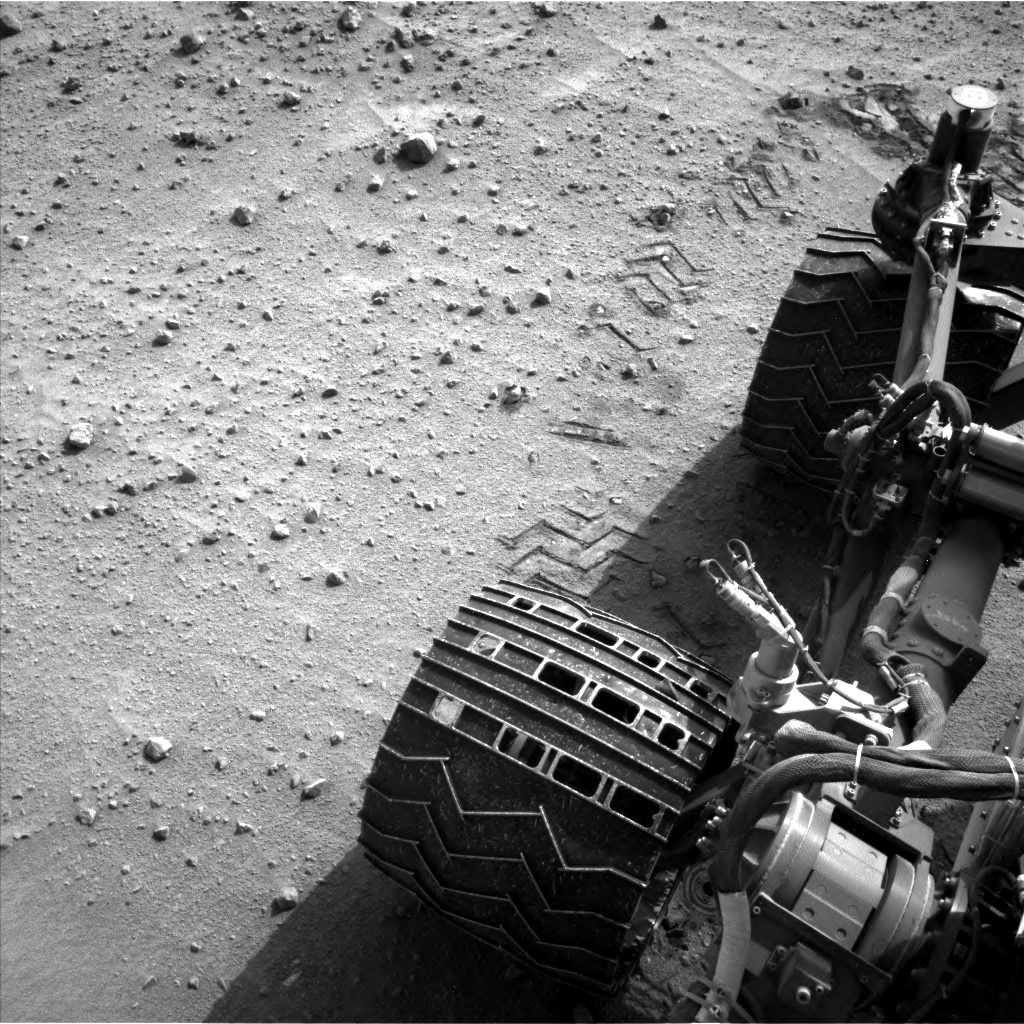
This image was taken by Navcam: Left B (NAV_LEFT_B) onboard NASA's Mars rover Curiosity on Sol 679 (2014-07-04 20:21:29 UTC).
Full Resolution

Join the CompressiveSensing subreddit or the Google+ Community and post there !
Liked this entry ? subscribe to Nuit Blanche's feed, there's more where that came from. You can also subscribe to Nuit Blanche by Email, explore the Big Picture in Compressive Sensing or the Matrix Factorization Jungle and join the conversations on compressive sensing, advanced matrix factorization and calibration issues on Linkedin.

Transmission of quantum entanglement through a random medium / Terahertz compressive imaging with metamaterial spatial light modulators

There are really two ways of producing some randomness. One way is to use a random medium and expect that the laws of transport will provide some sort of multiplexing. The other way is to engineer the random multiplexing. This week, we will have another example of the former but today we have an instance of both:


One item that comes with papers that are behind walls: I need to have access to the second paper because I wonder about the "no moving parts" claim. You reader know my email, wink wink. Without further ado:


We study the high-dimensional entanglement of a photon pair transmitted through a random medium. We show that multiple scattering in combination with the subsequent selection of only a fraction of outgoing modes reduces entanglement of an initially maximally entangled two-photon state. Entanglement corresponding to a random pure state is obtained when the number of modes accessible in transmission is much less than the number of modes in the incident light. An amount of entanglement approaching that of the incident light can be recovered by accessing a larger number of transmitted modes. In contrast, a pair of nonentangled photons does not gain any entanglement when transmitted through a random medium.

Imaging at long wavelengths, for example at terahertz and millimetre-wave frequencies1, is a highly sought-after goal of researchers2, 3 because of the great potential for applications ranging from security screening4 and skin cancer detection5 to all-weather navigation6 and biodetection7. Here, we design, fabricate and demonstrate active metamaterials that function as real-time tunable, spectrally sensitive spatial masks for terahertz imaging with only a single-pixel detector. A modulation technique permits imaging with negative mask values, which is typically difficult to achieve with intensity-based components. We demonstrate compressive techniques allowing the acquisition of high-frame-rate, high-fidelity images. Our system is all solid-state with no moving parts, yields improved signal-to-noise ratios over standard raster-scanning techniques8, and uses a source orders of magnitude lower in power than conventional set-ups9. The demonstrated imaging system establishes a new path for terahertz imaging that is distinct from existing focal-plane-array-based cameras.


h/t Sylvain for the second paper.

Sunday, July 06, 2014

Sunday Morning Insight: Note By Note Cooking

Here is a small follow up to the Computational Cooking Sunday Morning Insight and related entries [1-3]. Note By Note Cooking is the set of techniques and algorithms behind building food. One of the main criticism of this approach is that it is merely a bunch of sauce. This is not the case. Note By Note Cooking aims at studying and making structurally stronger food (I started a meetup group in Paris on the subject). In the video below, Herve This shows his business card, i.e. an algorithm that can produce several structures for cooking. This is reflection of the paper featured in the last Sunday Morning Insight on the subject [3] (While the video is entertaining it is all in French though). Of note, here is a list of note by note cooking recipes performed by Pierre Gagnaire.


The video features Pierre Gagnaire, three stars on the Guide Michelin, and Hervé This.


Printfriendly