Showing posts with label RandomFeatures. Show all posts

Tuesday, April 07, 2020

LightOn Cloud 2.0 featuring LightOn Aurora OPUs

** Nuit Blanche is now on Twitter: @NuitBlog **


At LightOn, we just launched LightOn Cloud 2.0 that feature several Aurora Optical Processing Unit for use by the Machine Learning Community. the blog post about this can be found here. You can request access to the Cloud at https://cloud.lighton.ai/

We are also having a LightOn Cloud for Research program: https://cloud.lighton.ai/lighton-research/


Follow @NuitBlog or join the CompressiveSensing Reddit, the Facebook page, the Compressive Sensing group on LinkedIn  or the Advanced Matrix Factorization group on LinkedIn

Liked this entry ? subscribe to Nuit Blanche's feed, there's more where that came from. You can also subscribe to Nuit Blanche by Email.

Other links:
Paris Machine Learning: Meetup.com||@Archives||LinkedIn||Facebook|| @ParisMLGroup
About LightOn: Newsletter ||@LightOnIO|| on LinkedIn || on CrunchBase || our Blog
About myself: LightOn || Google Scholar || LinkedIn ||@IgorCarron ||Homepage||ArXiv

Wednesday, June 26, 2019

Distributed Learning with Random Features

** Nuit Blanche is now on Twitter: @NuitBlog **


Distributed learning and random projections are the most common techniques in large scale nonparametric statistical learning. In this paper, we study the generalization properties of kernel ridge regression using both distributed methods and random features. Theoretical analysis shows the combination remarkably reduces computational cost while preserving the optimal generalization accuracy under standard assumptions. In a benign case, O(N−−√)partitions and O(N−−√) random features are sufficient to achieve O(1/N) learning rate, where N is the labeled sample size. Further, we derive more refined results by using additional unlabeled data to enlarge the number of partitions and by generating features in a data-dependent way to reduce the number of random features.


Follow @NuitBlog or join the CompressiveSensing Reddit, the Facebook page, the Compressive Sensing group on LinkedIn  or the Advanced Matrix Factorization group on LinkedIn

Liked this entry ? subscribe to Nuit Blanche's feed, there's more where that came from. You can also subscribe to Nuit Blanche by Email.

Other links:
Paris Machine Learning: Meetup.com||@Archives||LinkedIn||Facebook|| @ParisMLGroup< br/> About LightOn: Newsletter ||@LightOnIO|| on LinkedIn || on CrunchBase || our Blog
About myself: LightOn || Google Scholar || LinkedIn ||@IgorCarron ||Homepage||ArXiv

Wednesday, May 08, 2019

Low-Precision Random Fourier Features for Memory-Constrained Kernel Approximation

** Nuit Blanche is now on Twitter: @NuitBlog **

Quantization does not seem to be an issue for Random Features !

We investigate how to train kernel approximation methods that generalize well under a memory budget. Building on recent theoretical work, we define a measure of kernel approximation error which we find to be more predictive of the empirical generalization performance of kernel approximation methods than conventional metrics. An important consequence of this definition is that a kernel approximation matrix must be high rank to attain close approximation. Because storing a high-rank approximation is memory intensive, we propose using a low-precision quantization of random Fourier features (LP-RFFs) to build a high-rank approximation under a memory budget. Theoretically, we show quantization has a negligible effect on generalization performance in important settings. Empirically, we demonstrate across four benchmark datasets that LP-RFFs can match the performance of full-precision RFFs and the Nyström method, with 3x-10x and 50x-460x less memory, respectively.

Follow @NuitBlog or join the CompressiveSensing Reddit, the Facebook page, the Compressive Sensing group on LinkedIn  or the Advanced Matrix Factorization group on LinkedIn

Liked this entry ? subscribe to Nuit Blanche's feed, there's more where that came from. You can also subscribe to Nuit Blanche by Email.

Other links:
Paris Machine Learning: Meetup.com||@Archives||LinkedIn||Facebook|| @ParisMLGroup About LightOn: Newsletter ||@LightOnIO|| on LinkedIn || on CrunchBase || our Blog
About myself: LightOn || Google Scholar || LinkedIn ||@IgorCarron ||Homepage||ArXiv

Friday, November 17, 2017

DCASE 2017 TASK 1: Acoustic Scene Classification Using Shift-Invariant Kernels and Random Features

Thanks Mark and Laurent for the heads-up on finding this work.


DCASE 2017 TASK 1: Acoustic Scene Classification Using Shift-Invariant Kernels and Random Features by Abelino Jimenez, Benjamın Elizalde and Bhiksha Raj 

Acoustic scene recordings are represented by different types of handcrafted or Neural Network features. These features, typically of thousands of dimensions, are classified in state of the art approaches using kernel machines, such as the Support Vector Machines (SVM). However, the complexity of training these methods increases with the dimensionality of these input features and the size of the dataset. A solution is to map the input features to a randomized low-dimensional feature space. The resulting random features can approximate non-linear kernels with faster linear kernel computation. In this work, we computed a set of 6,553 input features and used them to compute random features to approximate three types of kernels, Guassian, Laplacian and Cauchy. We compared their performance using an SVM in the context of the DCASE Task 1 - Acoustic Scene Classification. Experiments show that both, input and random features outperformed the DCASE baseline by an absolute 4%. Moreover, the random features reduced the dimensionality of the input by more than three times with minimal loss of performance and by more than six times and still outperformed the baseline. Hence, random features could be employed by state of the art approaches to compute low-storage features and perform faster kernel computations.


Join the CompressiveSensing subreddit or the Google+ Community or the Facebook page and post there !
Liked this entry ? subscribe to Nuit Blanche's feed, there's more where that came from. You can also subscribe to Nuit Blanche by Email, explore the Big Picture in Compressive Sensing or the Matrix Factorization Jungle and join the conversations on compressive sensing, advanced matrix factorization and calibration issues on Linkedin.

Friday, July 28, 2017

Beyond Filters: Compact Feature Map for Portable Deep Model


Beyond Filters: Compact Feature Map for Portable Deep Model by Yunhe Wang, Chang Xu, Chao Xu, Dacheng Tao

Convolutional neural networks (CNNs) have shown extraordinary performance in a number of applications, but they are usually of heavy design for the accuracy reason. Beyond compressing the filters in CNNs, this paper focuses on the redundancy in the feature maps derived from the large number of filters in a layer. We propose to extract intrinsic representation of the feature maps and preserve the discriminability of the features. Circulant matrix is employed to formulate the feature map transformation, which only requires O(d log d) computation complexity to embed a d-dimensional feature map. The filter is then reconfigured to establish the mapping from original input to the new compact feature map, and the resulting network can preserve intrinsic information of the original network with significantly fewer parameters, which not only decreases the online memory for launching CNN but also accelerates the computation speed. Experiments on benchmark image datasets demonstrate the superiority of the proposed algorithm over state-ofthe-art methods.


Join the CompressiveSensing subreddit or the Google+ Community or the Facebook page and post there !
Liked this entry ? subscribe to Nuit Blanche's feed, there's more where that came from. You can also subscribe to Nuit Blanche by Email, explore the Big Picture in Compressive Sensing or the Matrix Factorization Jungle and join the conversations on compressive sensing, advanced matrix factorization and calibration issues on Linkedin.

Wednesday, July 12, 2017

SGD, What Is It Good For ?

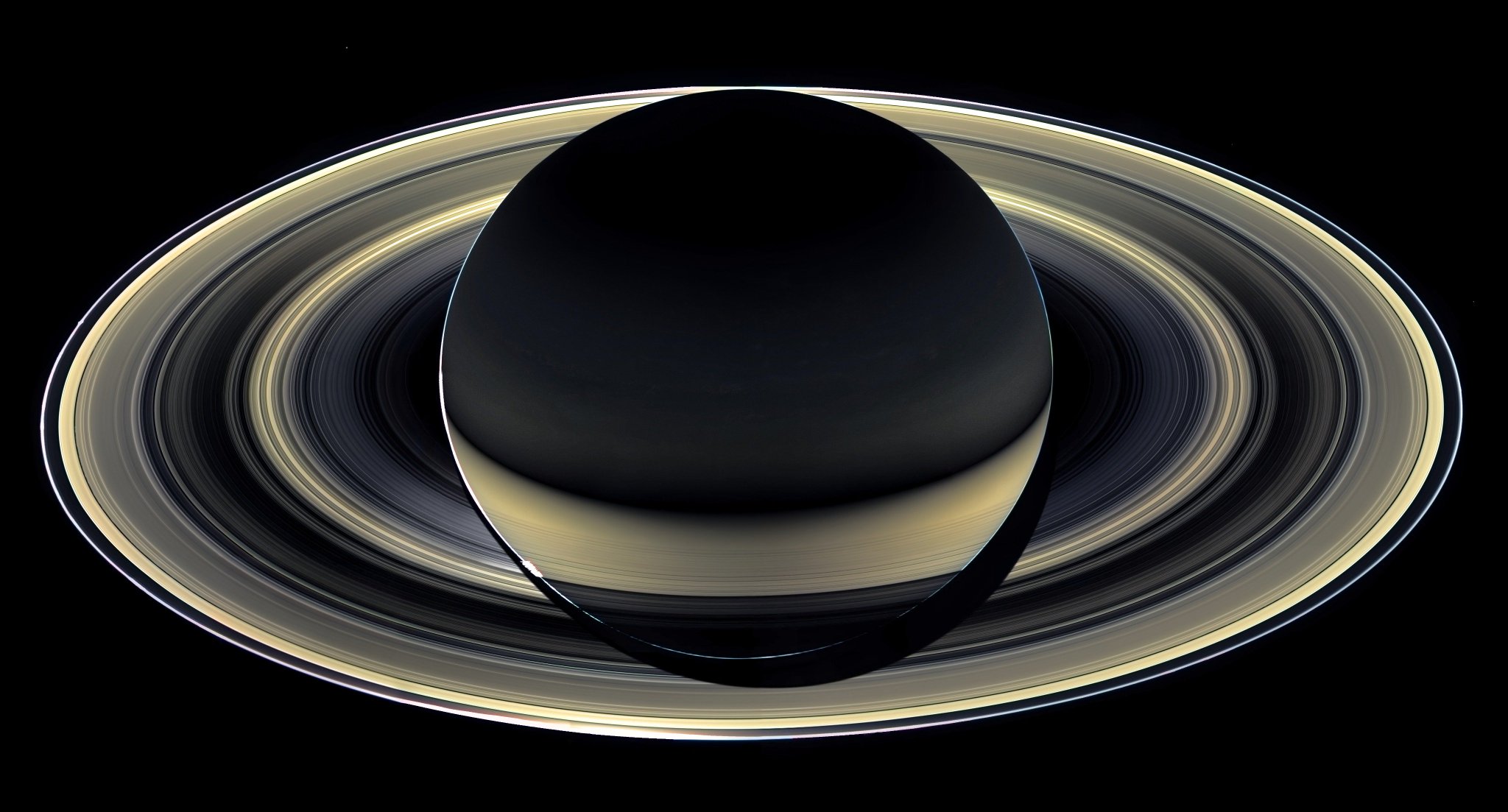
Image Credit: NASA/JPL-Caltech/Space Science Institute, 
N00284488.jpg, Titan, Jul. 11, 2017 10:12 AM

As noted per the activity on the subject, there is growing interest in understanding better SGD and related methods, we mentioned two such study recently on Nuit Blanche: 

Sebastian Ruder updated his blog entry on the subject in An overview of gradient descent optimization algorithms (Added derivations of AdaMax and Nadam). In Reinforcement Learning or Evolutionary Strategies? Nature has a solution: Both, Arthur Juliani makes a mention of an insight on gradient based methods in RL (h/t Tarin for the pointer on Twitter)

It is clear that for many reactive policies, or situations with extremely sparse rewards, ES is a strong candidate, especially if you have access to the computational resources that allow for massively parallel training. On the other hand, gradient-based methods using RL or supervision are going to be useful when a rich feedback signal is available, and we need to learn quickly with less data.

But we also had people trying to speed SGD up while others put some grain of salt in the whole adaptive approach. We also have one where SGD helped by random features helps in solving the linear Bellman equation, a tool central in linear control theory. 
Deep learning thrives with large neural networks and large datasets. However, larger networks and larger datasets result in longer training times that impede research and development progress. Distributed synchronous SGD offers a potential solution to this problem by dividing SGD minibatches over a pool of parallel workers. Yet to make this scheme efficient, the per-worker workload must be large, which implies nontrivial growth in the SGD minibatch size. In this paper, we empirically show that on the ImageNet dataset large minibatches cause optimization difficulties, but when these are addressed the trained networks exhibit good generalization. Specifically, we show no loss of accuracy when training with large minibatch sizes up to 8192 images. To achieve this result, we adopt a linear scaling rule for adjusting learning rates as a function of minibatch size and develop a new warmup scheme that overcomes optimization challenges early in training. With these simple techniques, our Caffe2-based system trains ResNet-50 with a minibatch size of 8192 on 256 GPUs in one hour, while matching small minibatch accuracy. Using commodity hardware, our implementation achieves ~90% scaling efficiency when moving from 8 to 256 GPUs. This system enables us to train visual recognition models on internet-scale data with high efficiency. 


Adaptive optimization methods, which perform local optimization with a metric constructed from the history of iterates, are becoming increasingly popular for training deep neural networks. Examples include AdaGrad, RMSProp, and Adam. We show that for simple overparameterized problems, adaptive methods often find drastically different solutions than gradient descent (GD) or stochastic gradient descent (SGD). We construct an illustrative binary classification problem where the data is linearly separable, GD and SGD achieve zero test error, and AdaGrad, Adam, and RMSProp attain test errors arbitrarily close to half. We additionally study the empirical generalization capability of adaptive methods on several state-of-the-art deep learning models. We observe that the solutions found by adaptive methods generalize worse (often significantly worse) than SGD, even when these solutions have better training performance. These results suggest that practitioners should reconsider the use of adaptive methods to train neural networks.

We introduce a data-efficient approach for solving the linear Bellman equation, which corresponds to a class of Markov decision processes (MDPs) and stochastic optimal control (SOC) problems. We show that this class of control problem can be cast as a stochastic composition optimization problem, which can be further reformulated as a saddle point problem and solved via dual kernel embeddings [1]. Our method is model-free and using only one sample per state transition from stochastic dynamical systems. Different from related work such as Z-learning [2, 3] based on temporal-difference learning [4], our method is an online algorithm following the true stochastic gradient. Numerical results are provided, showing that our method outperforms the Z-learning algorithm


Gradient descent optimization algorithms, while increasingly popular, are often used as black-box optimizers, as practical explanations of their strengths and weaknesses are hard to come by. This article aims to provide the reader with intuitions with regard to the behaviour of different algorithms that will allow her to put them to use. In the course of this overview, we look at different variants of gradient descent, summarize challenges, introduce the most common optimization algorithms, review architectures in a parallel and distributed setting, and investigate additional strategies for optimizing gradient descent.


Join the CompressiveSensing subreddit or the Google+ Community or the Facebook page and post there !

Wednesday, June 28, 2017

Compressive Statistical Learning with Random Feature Moments

Learning, Compressive Sensing and Random Features together !


We describe a general framework --compressive statistical learning-- for resource-efficient large-scale learning: the training collection is compressed in one pass into a low-dimensional sketch (a vector of random empirical generalized moments) that captures the information relevant to the considered learning task. A near-minimizer of the risk is computed from the sketch through the solution of a nonlinear least squares problem. We investigate sufficient sketch sizes to control the generalization error of this procedure. The framework is illustrated on compressive clustering, compressive Gaussian mixture Modeling with fixed known variance, and compressive PCA.


Join the CompressiveSensing subreddit or the Google+ Community or the Facebook page and post there !

Wednesday, May 17, 2017

Thesis (Honors): Improved Genomic Selection using VowpalWabbit with Random Fourier Features, Jiaqin Jaslyn Zhang

Image Credit: NASA/JPL-Caltech/Space Science Institute, Ian Regan

Combining Random Features and Vowpal Wabbit in this honors thesis. Congratulations Jiaqin !

Improved Genomic Selection using VowpalWabbit with Random Fourier Features by Jiaqin Jaslyn Zhang
Nonlinear regression models are often used in statistics and machine learning due to greater accuracy than linear models. In this work, we present a novel modeling framework that is both computationally efficient for high-dimensional datasets, and predicts more accurately than most of the classic state-of-the-art predictive models. Here, we couple a nonlinear random Fourier feature data transformation with an intrinsically fast learning algorithm called Vowpal Wabbit or VW. The key idea we develop is that by introducing nonlinear structure to an otherwise linear framework, we are able to consider all possible higher-order interactions between entries in a string. The utility of our nonlinear VW extension is examined, in some detail, under an important problem in statistical genetics: genomic selection (i.e. the prediction of phenotype from genotype). We illustrate the benefits of our method and its robustness to underlying genetic architecture on a real dataset, which includes 129 quantitative heterogeneous stock mice traits from the Wellcome Trust Centre for Human Genetics.


Join the CompressiveSensing subreddit or the Google+ Community or the Facebook page and post there !
Liked this entry ? subscribe to Nuit Blanche's feed, there's more where that came from. You can also subscribe to Nuit Blanche by Email, explore the Big Picture in Compressive Sensing or the Matrix Factorization Jungle and join the conversations on compressive sensing, advanced matrix factorization and calibration issues on Linkedin.

Friday, April 21, 2017

Random Feature Expansions for Deep Gaussian Processes / AutoGP: Exploring the Capabilities and Limitations of Gaussian Process Models - implementation -

[I will be at ICLR next week, let's grab some coffee if you are there]


Random Feature Expansions for Deep Gaussian Processes by Kurt Cutajar, Edwin V. Bonilla, Pietro Michiardi, Maurizio Filippone
The composition of multiple Gaussian Processes as a Deep Gaussian Process (DGP) enables a deep probabilistic nonparametric approach to flexibly tackle complex machine learning problems with sound quantification of uncertainty. Existing inference approaches for DGP models have limited scalability and are notoriously cumbersome to construct. In this work, we introduce a novel formulation of DGPs based on random feature expansions that we train using stochastic variational inference. This yields a practical learning framework which significantly advances the state-of-the-art in inference for DGPs, and enables accurate quantification of uncertainty. We extensively showcase the scalability and performance of our proposal on several datasets with up to 8 million observations, and various DGP architectures with up to 30 hidden layers.
A python / TensorFlow implementation can be found here: https://github.com/mauriziofilippone/deep_gp_random_features

We investigate the capabilities and limitations of Gaussian process models by jointly exploring three complementary directions: (i) scalable and statistically efficient inference; (ii) flexible kernels; and (iii) objective functions for hyperparameter learning alternative to the marginal likelihood. Our approach outperforms all previously reported GP methods on the standard MNIST dataset; performs comparatively to previous kernel-based methods using the RECTANGLES-IMAGE dataset; and breaks the 1% error-rate barrier in GP models using the MNIST8M dataset, showing along the way the scalability of our method at unprecedented scale for GP models (8 million observations) in classification problems. Overall, our approach represents a significant breakthrough in kernel methods and GP models, bridging the gap between deep learning approaches and kernel machines.
and here is a recent presentation by one of the author: "Practical and Scalable Inference for Deep Gaussian Processes"

Monday, April 17, 2017

F2F: A Library For Fast Kernel Expansions

( Personal message: I will at ICLR next week, let's grab some coffee if you are there. )

F2F is a C++ library for large-scale machine learning. It contains a CPU optimized implementation of the Fastfood algorithm, that allows the computation of approximated kernel expansions in loglinear time. The algorithm requires to compute the product of Walsh-Hadamard Transform (WHT) matrices. A cache friendly SIMD Fast Walsh-Hadamard Transform (FWHT) that achieves compelling speed and outperforms current state-of-the-art methods has been developed. F2F allows to obtain non-linear classification combining Fastfood and a linear classifier.
I am told by one of the author that the library should be out at some point in time.


Join the CompressiveSensing subreddit or the Google+ Community or the Facebook page and post there !

Wednesday, March 29, 2017

Random Features for Compositional Kernels

Random features used in a hierarchical manner, I like it !


We describe and analyze a simple random feature scheme (RFS) from prescribed compositional kernels. The compositional kernels we use are inspired by the structure of convolutional neural networks and kernels. The resulting scheme yields sparse and efficiently computable features. Each random feature can be represented as an algebraic expression over a small number of (random) paths in a composition tree. Thus, compositional random features can be stored compactly. The discrete nature of the generation process enables de-duplication of repeated features, further compacting the representation and increasing the diversity of the embeddings. Our approach complements and can be combined with previous random feature schemes.


Join the CompressiveSensing subreddit or the Google+ Community or the Facebook page and post there !
Liked this entry ? subscribe to Nuit Blanche's feed, there's more where that came from. You can also subscribe to Nuit Blanche by Email, explore the Big Picture in Compressive Sensing or the Matrix Factorization Jungle and join the conversations on compressive sensing, advanced matrix factorization and calibration issues on Linkedin.

Friday, March 17, 2017

The Unreasonable Effectiveness of Random Orthogonal Embeddings


In the series "The Unreasonable effectiveness of", we've had 

Today, we have something that is a subset of random projections: The Unreasonable Effectiveness of Random Orthogonal Embeddings by Krzysztof Choromanski, Mark Rowland, Adrian Weller
We present a general class of embeddings based on structured random matrices with orthogonal rows which can be applied in many machine learning applications including dimensionality reduction, kernel approximation and locality-sensitive hashing. We show that this class yields improvements over previous state-of-the-art methods either in computational efficiency (while providing similar accuracy) or in accuracy, or both. In particular, we propose the \textit{Orthogonal Johnson-Lindenstrauss Transform} (OJLT) which is as fast as earlier methods yet provably outperforms them in terms of accuracy, leading to a `free lunch' improvement over previous dimensionality reduction mechanisms. We introduce matrices with complex entries that further improve accuracy. Other applications include estimators for certain pointwise nonlinear Gaussian kernels, and speed improvements for approximate nearest-neighbor search in massive datasets with high-dimensional feature vectors.

Join the CompressiveSensing subreddit or the Google+ Community or the Facebook page and post there !

Tuesday, March 07, 2017

Deep Semi-Random Features for Nonlinear Function Approximation


Deep Semi-Random Features for Nonlinear Function Approximation by Kenji Kawaguchi, Bo Xie, Le Song

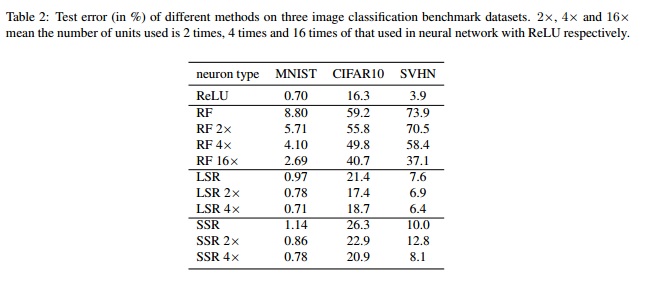
We propose semi-random features for nonlinear function approximation. Semi-random features are defined as the product of a random nonlinear switching unit and a linear adjustable unit. The flexibility of semi-random feature lies between the fully adjustable units in deep learning and the random features used in kernel methods. We show that semi-random features possess a collection of nice theoretical properties despite the non-convex nature of its learning problem. In experiments, we show that semi-random features can match the performance of neural networks by using slightly more units, and it outperforms random features by using significantly fewer units. Semi-random features provide an interesting data point in between kernel methods and neural networks to advance our understanding of the challenge of nonlinear function approximation, and it opens up new avenues to tackle the challenge further.


Join the CompressiveSensing subreddit or the Google+ Community or the Facebook page and post there !
Liked this entry ? subscribe to Nuit Blanche's feed, there's more where that came from. You can also subscribe to Nuit Blanche by Email, explore the Big Picture in Compressive Sensing or the Matrix Factorization Jungle and join the conversations on compressive sensing, advanced matrix factorization and calibration issues on Linkedin.

McGan: Mean and Covariance Feature Matching

Random Features for GANs.


McGan: Mean and Covariance Feature Matching GAN by Youssef Mroueh, Tom Sercu, Vaibhava Goel

We introduce new families of Integral Probability Metrics (IPM) for training Generative Adversarial Networks (GAN). Our IPMs are based on matching statistics of distributions embedded in a finite dimensional feature space. Mean and covariance feature matching IPMs allow for stable training of GANs, which we will call McGan. McGan minimizes a meaningful loss between distributions.
Join the CompressiveSensing subreddit or the Google+ Community or the Facebook page and post there !
Liked this entry ? subscribe to Nuit Blanche's feed, there's more where that came from. You can also subscribe to Nuit Blanche by Email, explore the Big Picture in Compressive Sensing or the Matrix Factorization Jungle and join the conversations on compressive sensing, advanced matrix factorization and calibration issues on Linkedin.

Monday, February 06, 2017

Randomness in Neural Networks: An Overview


Randomness in Neural Networks: An Overview by Simone Scardapane, Dianhui Wang

Neural networks, as powerful tools for data mining and knowledge engineering, can learn from data to build feature-based classifiers and nonlinear predictive models. Training neural networks involves the optimization of non-convex objective functions, and usually the learning process is costly and infeasible for applications associated with data streams. A possible, albeit counter-intuitive alternative is to randomly assign a subset of the networks’ weights, so that the resulting optimization task can be formulated as a linear least-squares problem. This methodology can be applied to both feedforward and recurrent networks, and similar techniques can be used to approximate kernel functions. Many experimental results indicate that such randomized models can reach sound performance compared to fully adaptable ones, with a number of favourable benefits, including (i) simplicity of implementation, (ii) faster learning with less intervention from human beings, and (iii) possibility of leveraging over all linear regression and classification algorithms (e.g.,`1 norm minimization for obtaining sparse formulations). All these points make them attractive and valuable to the data mining community, particularly for handling large scale data mining in real-time. However, the literature in the field is extremely vast and fragmented, with many results being reintroduced multiple times under different names. This overview aims at providing a self-contained, uniform introduction to the different ways in which randomization can be applied to the design of neural networks and kernel functions. A clear exposition of the basic framework underlying all these approaches helps to clarify innovative lines of research, open problems and, most importantly, foster the exchanges of well-known results throughout different communities. 


Join the CompressiveSensing subreddit or the Google+ Community or the Facebook page and post there !
Liked this entry ? subscribe to Nuit Blanche's feed, there's more where that came from. You can also subscribe to Nuit Blanche by Email, explore the Big Picture in Compressive Sensing or the Matrix Factorization Jungle and join the conversations on compressive sensing, advanced matrix factorization and calibration issues on Linkedin.

Printfriendly