Showing posts with label HammingsTime. Show all posts

Friday, May 05, 2017

Hamming's Time: The Desperate Researchers of Computer Vision


Back in August 2014, I mentioned this roundtable at the Technion ( Is Deep Learning the Final Frontier and the End of Signal Processing ? ). Then Yoshua provided his view on Deep Learning. Two years and half later, Miki just wrote the following op-ed in SIAM News: Deep, Deep Trouble: Deep Learning’s Impact on Image Processing, Mathematics, and Humanity. It is difficult to understate how much of The Great Convergence we are witnessing. This is how it starts.
I am really confused. I keep changing my opinion on a daily basis, and I cannot seem to settle on one solid view of this puzzle. No, I am not talking about world politics or the current U.S. president, but rather something far more critical to humankind, and more specifically to our existence and work as engineers and researchers. I am talking about…deep learning.....
.....Now back to the main question: should we be pleased about emerging solutions based on deep learning? Is our frustration justified? What is the role of deep learning in imaging science? These questions present themselves when researchers in the community meet at conferences, and the answers are diverse and confusing. The facts speak loudly for themselves; in most cases, deep learning-based solutions lack mathematical elegance and offer very little interpretability of the found solution or understanding of the underlying phenomena. On the positive side, however, the performance obtained is terrific. This is clearly not the school of research we have been taught, and not the kind of science we want to practice. Should we insist on our more rigorous ways, even at the cost of falling behind in terms of output quality? Or should we fight back and seek ways to fuse ideas from deep learning into our more solid foundations?
To further complicate this story, certain deep learning-based contributions bear some elegance that cannot be dismissed. Such is the case with the style-transfer problem, which yielded amazingly beautiful results, and with inversion ideas of learned networks used to synthesize images out of thin air, as Google’s Deep Dream project does. A few years ago we did not have the slightest idea how to formulate such complicated tasks; now they are solved formidably as a byproduct of a deep neural network trained for the completely extraneous task of visual classification. 

The whole thing is here.

h/t Ulugbeck


Join the CompressiveSensing subreddit or the Google+ Community or the Facebook page and post there !
Liked this entry ? subscribe to Nuit Blanche's feed, there's more where that came from. You can also subscribe to Nuit Blanche by Email, explore the Big Picture in Compressive Sensing or the Matrix Factorization Jungle and join the conversations on compressive sensing, advanced matrix factorization and calibration issues on Linkedin.

Saturday, March 26, 2016

It's Friday afternoon, it's Hamming's time: Antipodal Comet Deposits

 
In a tweet stream from the #LPSC2016 conference (47th Lunar and Planetary Science Conference (#lpsc2016)) , Parvathy Prem uses Direct Simulation Monte Carlo (DSMCto figure out how meteorite deposits on a planet with no atmosphere such as the Moon. Here are some of her papers:


Related:

 
Join the CompressiveSensing subreddit or the Google+ Community or the Facebook page and post there !
Liked this entry ? subscribe to Nuit Blanche's feed, there's more where that came from. You can also subscribe to Nuit Blanche by Email, explore the Big Picture in Compressive Sensing or the Matrix Factorization Jungle and join the conversations on compressive sensing, advanced matrix factorization and calibration issues on Linkedin.

Friday, December 18, 2015

Hamming's Time: Making Hyperspectral Imaging Mainstream

Friday afternoon is Hamming's time. Today I decided to compete in the Best Camera Application contest of XIMEA, a maker of small hyperspectral cameras. Here is my entry:


Challenging task: Make hyperspectral imaging mainstream

Idea: Create a large database of hyperspectral imagery for use in Machine/Deep Learning Competitions


Background

Machine Learning is the field concerned with creating, training and using algorithms dedicated to making  sense of data. These algorithms are taking advantage of training data (images, videos) as a way of improving for tasks such as detection, classification, etc. In recent years, we have witnessed a spectacular growth in this field thanks to the joint availability of large datasets originating from the internet and the attendant curating/labeling efforts of said images and videos.

Numerous labeled datasets available such as CIFAR [1], Imagenet [2], etc. routinely permit algorithms of increased complexity to be developed and compete in state of the art classification contests. For instance, the rise of deep learning algorithms comes from breaking all the state-of-the-art classification results in the “ILSVRC-2012 competition and achieved a winning top-5 test error rate of 15.3%, compared to 26.2% achieved by the second-best entry” [3] More  recent examples of this heated competition results were recently shown at the NIPS conference  last week where teams at Microsoft Research produced breakthroughs in classification with an astounding 152 layer neural networks [4]. This intense competition between highly capable teams at universities and large internet companies is only possible because some large amount of training data is being made available.

Image or even video processing for hyperspectral imagery cannot follow the development of image processing that occurred for the past 40 years. The underlying reason stems from the fact that this development was performed at considerable expense by companies and governments alike and eventually yielded standards such as Jpegs, gif, Jpeg2000, mpeg, etc…Because such funding is no longer available we need to find ways of improving and working with new imaging modalities.
Technically, since hyperspectral imagery is still a niche market, most analysis performed in this field runs the risk of being seen as an outgrowth of normal imagery: i.e substandards tools such as JPEG or labor intensive computer vision tools are being used to classify and use this imagery without much thought into using the additional structure of the spectrum information. More sophisticated tools such as advanced matrix factorization (NMF, PCA, Sparse PCA, Dictionary learning, ….) in turn focus on the spectral information but seldomly use the spatial information. Both approaches suffer from not investigating more fully the inherent robust structure of this imagery.  

For hyperspectral imagery to become mainstream, algorithms for compression and for its day-to-day use has to take advantage of the current very active and highly competitive development in Machine Learning algorithms. In short, creating large and rich hyperspectral imagery datasets beyond what is currently available ([5-8] is central for this technology to grow out its niche markets and become central in our everyday lives.


The proposal

In order to make hyperspectral imagery mainstream, I propose to use a XIMEA camera and shoot imagery and video of different objects, locations and label these datasets.

The datasets will then be made available on the internet for use by parties interested in performing classification competition based on them (Kaggle, academic competitions,...).

As a co-organizer of the meetup, I also intend on enlisting some of the folks in the Paris Machine Learning meetup group ( with close to 3000 members it is one of the largest Machine Learning meetup in the world [9]) to help in enriching this dataset.

The dataset should be available from servers probably colocated at a university or some non-profit organization (to be identified). A report presenting the dataset should be eventually academically citable.


References
[2] Imagenet dataset, http://www.image-net.org/
[3] ImageNet Classification with Deep Convolutional Neural Networks, Alex Krizhevsky, Ilya Sutskever, Geoffrey E. Hinton, http://papers.nips.cc/paper/4824-imagenet-classification-with-deep-convolutional-neural-networks.pdf
[8] Parraga CA, Brelstaff G, Troscianko T, Moorhead IR, Journal of the Optical Society of America 15 (3): 563-569, 1998 or G. Brelstaff, A. Párraga, T. Troscianko and D. Carr, SPIE. Vol. 2587. Geog. Inf. Sys. Photogram. and Geolog./Geophys. Remote Sensing, 150-159, 1995,


Join the CompressiveSensing subreddit or the Google+ Community or the Facebook page and post there !
Liked this entry ? subscribe to Nuit Blanche's feed, there's more where that came from. You can also subscribe to Nuit Blanche by Email, explore the Big Picture in Compressive Sensing or the Matrix Factorization Jungle and join the conversations on compressive sensing, advanced matrix factorization and calibration issues on Linkedin.

Friday, May 15, 2015

Hamming's time: The Important Things after Commodity Sequencing


If you recall Friday afternoon Hamming's time takes its roots in one of the comment Dick Hamming made in his famous "You and Your Research". There, he mentioned that while at Bell Labs, he kept some time in the week for thinking of big problems so that he could try to make a go at them. We are also indulging in this similar exercise today, with a few thoughts triggered by the following: A vision for ubiquitous sequencing by Yaniv Erlich here is the abstract:
Genomics has recently celebrated reaching the \$1000 genome milestone, making affordable DNA sequencing a reality. This goal of the sequencing revolution has been successfully completed. Looking forward, the next goal of the revolution can be ushered in by the advent of sequencing sensors - miniaturized sequencing devices that are manufactured for real time applications and deployed in large quantities at low costs. The first part of this manuscript envisions applications that will benefit from moving the sequencers to the samples in a range of domains. In the second part, the manuscript outlines the critical barriers that need to be addressed in order to reach the goal of ubiquitous sequencing sensors.
we've mentioned Yaniv's earlier work connecting population genomics and compressive sensing related techniques before here.

Also right now in London there is a conference by users of the Oxford nanopore technology, here are a few presentations:
and  
and Sequencing ultra-long DNA molecules with the Oxford Nanopore MinION by John M Urban, Jacob Bliss, Charles E Lawrence, Susan A Gerbi 
Oxford Nanopore Technologies’ nanopore sequencing device, the MinION, holds the promise of sequencing ultra-long DNA fragments superior to 100kb. An obstacle to realizing this promise is delivering ultra-long DNA molecules to the nanopores. We present our progress in developing cost-effective ways to overcome this obstacle and our resulting MinION data, including multiple reads superior to 100kb. 
Since sequencing is not NP-hard anymore,  then following Dick's thought process:

Along those lines at some urging from John Tukey and others, I finally adopted what I called ``Great Thoughts Time.'' When I went to lunch Friday noon, I would only discuss great thoughts after that. By great thoughts I mean ones like: ``What will be the role of computers in all of AT&T?'', ``How will computers change science?'' For example, I came up with the observation at that time that nine out of ten experiments were done in the lab and one in ten on the computer. I made a remark to the vice presidents one time, that it would be reversed, i.e. nine out of ten experiments would be done on the computer and one in ten in the lab. They knew I was a crazy mathematician and had no sense of reality. I knew they were wrong and they've been proved wrong while I have been proved right. They built laboratories when they didn't need them. I saw that computers were transforming science because I spent a lot of time asking ``What will be the impact of computers on science and how can I change it?'' I asked myself, ``How is it going to change Bell Labs?'' I remarked one time, in the same address, that more than one-half of the people at Bell Labs will be interacting closely with computing machines before I leave. Well, you all have terminals now. I thought hard about where was my field going, where were the opportunities, and what were the important things to do. Let me go there so there is a chance I can do important things.
and much like Dick and Yaniv, we should ask ourselves:

What will be the impact of commodity sequencing on science and how can we change it? Let us go there so there is a chance we can do important things.

Join the CompressiveSensing subreddit or the Google+ Community and post there !
Liked this entry ? subscribe to Nuit Blanche's feed, there's more where that came from. You can also subscribe to Nuit Blanche by Email, explore the Big Picture in Compressive Sensing or the Matrix Factorization Jungle and join the conversations on compressive sensing, advanced matrix factorization and calibration issues on Linkedin.

Friday, April 10, 2015

Generating a New Reality with Deep Architectures


It started with a tweet and is a good conversation starter for a Friday afternoon's Hamming's time.

 and then the rest of the conversation followed.


Learning to Generate Chairs with Convolutional Neural Networks by Alexey Dosovitskiy, Jost Tobias Springenberg, Thomas Brox

We train a generative convolutional neural network which is able to generate images of objects given object type, viewpoint, and color. We train the network in a supervised manner on a dataset of rendered 3D chair models. Our experiments show that the network does not merely learn all images by heart, but rather finds a meaningful representation of a 3D chair model allowing it to assess the similarity of different chairs, interpolate between given viewpoints to generate the missing ones, or invent new chair styles by interpolating between chairs from the training set. We show that the network can be used to find correspondences between different chairs from the dataset, outperforming existing approaches on this task.
Striving for Simplicity: The All Convolutional Net by Jost Tobias Springenberg, Alexey Dosovitskiy, Thomas Brox, Martin Riedmiller

Most modern convolutional neural networks (CNNs) used for object recognition are built using the same principles: Alternating convolution and max-pooling layers followed by a small number of fully connected layers. We re-evaluate the state of the art for object recognition from small images with convolutional networks, questioning the necessity of different components in the pipeline. We find that max-pooling can simply be replaced by a convolutional layer with increased stride without loss in accuracy on several image recognition benchmarks. Following this finding -- and building on other recent work for finding simple network structures -- we propose a new architecture that consists solely of convolutional layers and yields competitive or state of the art performance on several object recognition datasets (CIFAR-10, CIFAR-100, ImageNet). To analyze the network we introduce a new variant of the "deconvolution approach" for visualizing features learned by CNNs, which can be applied to a broader range of network structures than existing approaches.


Deep Convolutional Inverse Graphics Network by Tejas D. Kulkarni, Will Whitney, Pushmeet Kohli, Joshua B. Tenenbaum

This paper presents the Deep Convolution Inverse Graphics Network (DC-IGN) that aims to learn an interpretable representation of images that is disentangled with respect to various transformations such as object out-of-plane rotations, lighting variations, and texture. The DC-IGN model is composed of multiple layers of convolution and de-convolution operators and is trained using the Stochastic Gradient Variational Bayes (SGVB) algorithm. We propose training procedures to encourage neurons in the graphics code layer to have semantic meaning and force each group to distinctly represent a specific transformation (pose,light,texture,shape etc.). Given a static face image, our model can re-generate the input image with different pose, lighting or even texture and shape variations from the base face. We present qualitative and quantitative results of the model's efficacy to learn a 3D rendering engine. Moreover, we also utilize the learnt representation for two important visual recognition tasks: (1) an invariant face recognition task and (2) using the representation as a summary statistic for generative modeling.


Join the CompressiveSensing subreddit or the Google+ Community and post there !
Liked this entry ? subscribe to Nuit Blanche's feed, there's more where that came from. You can also subscribe to Nuit Blanche by Email, explore the Big Picture in Compressive Sensing or the Matrix Factorization Jungle and join the conversations on compressive sensing, advanced matrix factorization and calibration issues on Linkedin.

Friday, December 12, 2014

Hamming's time: Scientific Discovery Enabled by Compressive Sensing and related fields


I was recently asked an interesting yet challenging question. I have two or three answers and also feel the question is somewhat unfair but it picked my interest. The question was: 
Has compressive sensing helped in making discoveries in the realm of general science (as opposed to computer science, signal processing, better solvers, etc...) ?
It could be better reframed as:
Has any of the compressive sensing pipeline tools (measurement matrices, randomization, L1 or better solvers) allowed one to make a discovery that was not possible before (with the other tools) ?


First, I think this is an unfair question because I don' t feel like it should even be asked! Indeed, nobody asks the obvious question as to whether full rank linear systems and least squares solvers have led to scientific discoveries (they have). On the other hand, a more elaborate technique has to provide an enhanced threshold of justification only a few years after it has been theoretically justified. But here is where it gets weird. I initially indicated that I felt that the following papers from Bruno Ohlshausen were compressive sensing related discoveries:

Emergence of Simple-Cell Receptive Field Properties by Learning a Sparse Code for Natural Images

Olshausen BA, Field DJ (1996).   Nature, 381: 607-609.  reprint (pdf)  |  abstract

Natural Image Statistics and Efficient Coding

Olshausen BA, Field DJ (1996).   Presented at the Workshop on Information Theory and the Brain , September 4-5, 1995, University of Stirling, Scotland. Published in Network, 7: 333-339.   reprint (pdf)  |  abstract


Indeed, after the publication of these papers, the community at large began to realize that sparse coding was not just an artifact of being into the parcimony business. Rather it was an actual biological process that could be mapped to specific cells and a specific area of the brain.

That example did not seem to fit the bill as the paper predated the 2004 papers of Candes, Tao, Romberg and that of Donoho. As such it would not count as compressive sensing.

This was a little disheartening as many people were doing compressive sensing before 2004 (see The invention of compressive sensing) with potentially a link to Prony back to 1796. Further, the clock did not start ticking back in 2004 or 2006, rather it probably began ticking in 2008/2009. Indeed from 2004 till 2007, several measurement matrices allowed nonlinear recovery of sparse signals. In fact during that time frame, there was no technical way of figuring out a simple way whether a specific measurement matrix would allow generic recovery of sparse signals (RIP is NP-Hard to check). It is only in 2007/2008 that generic phase transitions were discovered and eventually we had to wait until 2011 to get even better measurement ensembles beyond strictly random gaussian ensembles. In short, the clock started ticking five years ago, not ten. Given all this background, 

Has there been any discovery or prediction that has been enabled by compressive sensing within the past five years that could not be predicted before ?

I can think of at least two examples:

Compressive ghost imaging by Ori Katz, Yaron Bromberg, and Yaron Silberberg

Why ? Up until that point, ghost imaging was thought to be related to quantum mechanics. Even though various tests were "proving" it was not a quantum mechanical effect, that paper put the last nail to that coffin: The effect is interesting but it ain't quantum mechanical, period.

Applying compressed sensing to genome-wide association studies by Shashaank Vattikuti, James J Lee, Christopher C Chang, Stephen D H Hsu, and Carson C Chow

Why ? because a least squares solver is incapable of enabling a prediction of the type given in that paper. Here thanks to the phase transition found by Tanner and Donoho, one can predict within the linear model how many people are needed to figure out a genetic connection to a specific trait. This is new. You can argue that the linear model is wrong but this is a prediction for that model. There is no similar prediction capibility for a least squares solver.

In the future, I personally think that the map makers are likely to be on the right track to make scientific discoveries.

If you feel that there is a discovery I did not mention, feel free to add your candidate to the comment section of this entry below or in this attendant LinkedIn discussion thread.


Join the CompressiveSensing subreddit or the Google+ Community and post there !
Liked this entry ? subscribe to Nuit Blanche's feed, there's more where that came from. You can also subscribe to Nuit Blanche by Email, explore the Big Picture in Compressive Sensing or the Matrix Factorization Jungle and join the conversations on compressive sensing, advanced matrix factorization and calibration issues on Linkedin.

Friday, June 27, 2014

Random Branches

It's Friday afternoon, it's Hamming's time. Let us push the argument of About t'em Random Projections in Random Forests further.

Leo Breiman, and many others afterwards, were concerned about linking Adaboost with Random Forests (see 7. Conjecture: Adaboost is a Random Forest). Let us look at it some other way, Random Forests are a set of randomized trees built node by node based on the sequential determination of an optimal split of groups of elements according to a certain metric (entropy, variance reduction, etc...). If you focus on one tree, you'll notice that what you see is a greedy algorithm which at every step computes the optimal spitting parameter. The algorithm is randomized in the sense that the choise of features being used at every iteration step is randomized. In effect, a Random Forest can only be seen as a parallel implementation of several greedy randomized iterations. In a sense, a Random Forest is one instance of several randomized Adaboosts.

Why is this interesting to say those things ?

Well ever since Ali Rahimi and Benjamin Recht came out with the idea of Random Kitchen Sinks, we know that we can replace the greedy Adaboost with a more parallel algorithm. Whereas Adaboost greedily search for a new basis function at every step of its iteration with the objective function of reducing the l2 norm between functions of the training sets and their classification results, Random Kitchen Sinks essentially removes the greedy step by choosing a random sets of functions thereby making the problem a linear problem. The solution becomes a simple least squares problem.

In my view, the problem with random forest is not that it is parallel ( a good thing) but that it is greedy.

If one would be interested in making random forests closer to a non greedy approach, then using this image of Random Forests being a collection of Randomized Adaboosts might help. How ?

Imagine that each traditional tree in the Random Forest algorithm is replaced by a (large) set of different Random Branches. In effect, each branch ressembles a Random Forest tree but not only do we choose the elements at each node in a randomized fashion (as in the traditional Random Forests algorithm) but we also get to choose the threshold in a randomized fashion. As is the case of the AdaBoost/Random Kitchen Sinks dual approach, we now require many branches to describe well one single tree of the Random Forests algorithm (i.e. we replace one tree in the Random Forest algorithm by a large set of branches that look exactly like that one tree except that each branch has different set of random threshold at every node). Yes, the problem got much bigger as a result but there is no free lunch. This is the price we would need to pay to transform a nonlinear greedy solver into a linear problem ( as was the case when we went from AdaBoost to the Random Kitchen Sinks approach).

Is there something similar in the compressive sensing literature ?

There is actually. Recently, we mentioned the work on 1bit CS with random biases (One-bit compressive sensing with norm estimation by Karin Knudson, Rayan Saab, Rachel Ward) and there is an implementation right here that allows one to reconstruct elements from several such meausurements. Each node of the proposed randomized branch would constitute an instance of this measurement model.

More on that later.


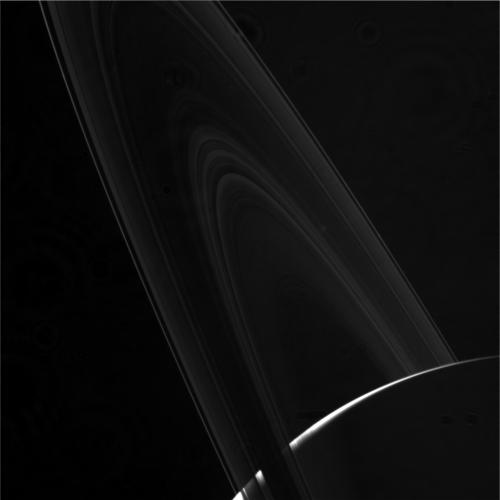
Image Credit: NASA/JPL/Space Science Institute, Full-Res: W00088633.jpg

W00088633.jpg was taken on June 23, 2014 and received on Earth June 25, 2014. The camera was pointing toward SATURN at approximately 1,406,225 miles (2,263,099 kilometers) away, and the image was taken using the MT2 and CL2 filters.

Join the CompressiveSensing subreddit or the Google+ Community and post there !
Liked this entry ? subscribe to Nuit Blanche's feed, there's more where that came from. You can also subscribe to Nuit Blanche by Email, explore the Big Picture in Compressive Sensing or the Matrix Factorization Jungle and join the conversations on compressive sensing, advanced matrix factorization and calibration issues on Linkedin.

Friday, May 09, 2014

The Cosmic Buffon Needle

It's Friday Afternoon, it's Hamming's time.


Recently, I came across a public cloud chamber detector in Paris and that got me thinking (some of these particles include muons [1-5]), what if they were to draw lines on the top glass of the detector, a camera that would do a little bit of what we did with Cable a while ago, and try to approximate Pi ? what about pushing the design further and visually showing people what the Johnson-Lindenstrauss lemma entails [6].
The video is strangely hypnotic.


Join the CompressiveSensing subreddit or the Google+ Community and post there !
Liked this entry ? subscribe to Nuit Blanche's feed, there's more where that came from. You can also subscribe to Nuit Blanche by Email, explore the Big Picture in Compressive Sensing or the Matrix Factorization Jungle and join the conversations on compressive sensing, advanced matrix factorization and calibration issues on Linkedin.

Friday, April 25, 2014

It's Friday afternoon, it's Hamming's time: Antipode Seismic Maps ?

When Carolyn Porco came into town at the Texas A&M Physics seminar in 1995, she presented us with the recent computations of how the atmosphere of Jupiter had been affected by the Shoemaker-Levy 9 comet. They looked llike this simulation on the video below, except her's were more amplified as you could see the wave coming back to the origine, anyhoo...


The fascinating part of that simulation was to show us that if the sphere (planet) was round, then the impact of the comet was likely having an impact some later time on the exact opposite side of the planet. The inital ripple would meet on the other side with a similar force. This was really fascinating and made a big impression on me. Ever sincethat talk I have wondered if geophysicists take into account some metric where a seismic event has a potential effect on the exact opposite side of the Earth. 

Here is a highly speculative and probably wrong example. One of the most impressive volcano explosion in recent times is that of the Krakatoa island in 1883. While the event occured in August 26–27, 1883, the whole thing started with a series of lesser eruptions that began on May 20, 1883 .

What is on the Antipode of Krakatoa ? according to this tool:


a region west of Medellin, Colombia. 

From Wikipedia


Here is what I found on the Interweb, a paragraph from a book entitled Earthquakes by ARNOLD BOSCOWITZ published in 1890.


"...but on March 27, 1883, at 9-25 P.M., a long, deep underground muttering was heard at Iquique, the southernmost part of Peru. Soon after an earthquake shock startled the whole town. Two other terrestrial disturbances had occurred on the 7th of March at 1 1 '25 P.M. and at Andes (Chili), as well as in the town of Copiapo at 3 P.M. on the 8th of March. Besides, the volcano of Ometepa, in the lake of Nicaragua, which had been dormant for centuries, burst forth in smoke and flame. The shock felt at Copiapo on the 8th of March was also felt throughout nearly the whole of Colombia. At Cartagena and Turlio, at the mouth of the Atrato, the shock was violent, but did little damage. At Huda, upon the river Magdalena, the oscillation lasted more than a minute, and in the State of Antioquia much damage was done ; while Medellin, the capital of the state, came off almost scathless, though the cathedral suffered a good deal. In the town of Antioquia, the facade of the cathedral was suddenly thrown forwards in a slanting direction, several pillars were overthrown, and all the houses suffered more or less. At Garumal the prison and 35 houses were destroyed ; at Aquedas the town-hall was destroyed ; while at Abejirral the church and several of the houses were severely shaken and partly demolished. At Rinagana, the principal village in the territory of Darien, the huts, made of palm-branches, were overturned, and the rivers rose and fell with alarming rapidity. At the same time, the Taya Indians, living in the same district, had remarked with alarm the frequency of earthquakes and of the topographical changes which, they said, had completely modified the aspect of the country. They say that dull mutterings were constantly heard in the south- eastern region, which very few whites have explored ; and from this we may conclude that there was some volcanic agency at work in the district of Atrato. A large island at the mouth of the river Atrato, which had been hydrographically surveyed by a United States steamer in 1862, disappeared altogether..."
March 27, 1883 or about two months before the beginning of the Krakatoa's first series of explosion, there was a seismic event that was worthy of a mention in some History books. I realize there are always seismic activity on Earth but this one was worth a mention in that book, in the same way Krakatoa event was.

I wonder if we'd discover more obvious connections between different spots if one were to simply draw past seismic events on antipode maps ? In particular, I wonder about Turkey and its Pacific Ocean antipode.


I am sure it would be easy to do given the location of the earthquakes and draw them directly on some antipode map.

Join the CompressiveSensing subreddit or the Google+ Community and post there !
Liked this entry ? subscribe to Nuit Blanche's feed, there's more where that came from. You can also subscribe to Nuit Blanche by Email, explore the Big Picture in Compressive Sensing or the Matrix Factorization Jungle and join the conversations on compressive sensing, advanced matrix factorization and calibration issues on Linkedin.

Friday, April 26, 2013

It's Friday, It's Hamming's Time: Learning to Learn by Richard Hamming, "You Get What You Measure" / "Error-Correcting Codes"

Forget the MOOCs, it's Friday, it's Hamming Time! Here is a series of videos by Richard Hamming: "Learning to Learn" The Art of Doing Science and Engineering. I featured two at the top but the remaining thirty others are listed below. Which ones did you like ?

Hamming, "You Get What You Measure" (June 1, 1995)


And since we've had some error correcting papers today and yesterday, let's hear it from the horse's mouth:

Hamming, "Error-Correcting Codes" (April 21, 1995)


Here is the rest of the video series "Learning to Learn" The Art of Doing Science and Engineering  by Richard Hamming: 

Printfriendly