Showing posts with label CSHardware. Show all posts

Thursday, August 15, 2019

Hardware realization of a CS-based MIMO radar

** Nuit Blanche is now on Twitter: @NuitBlog **

Kumar just sent me the following the other day:

Hi Igor,
We recently published our work on the hardware realization of a CS-based MIMO radar in IEEE Transactions on Aerospace and Electronic Systems. Your readers might be interested in this.
https://ieeexplore.ieee.org/abstract/document/8743424
--
Regards,
Kumar Vijay Mishra
Thanks Kumar  !

Here is the abstract:


We present a cognitive prototype that demonstrates a colocated, frequency-division-multiplexed, multiple-input multiple-output (MIMO) radar which implements both temporal and spatial sub-Nyquist sampling. The signal is sampled and recovered via the Xampling framework. Cognition is due to the fact that the transmitter adapts its signal spectrum by emitting only those subbands that the receiver samples and processes. Real-time experiments demonstrate sub-Nyquist MIMO recovery of target scenes with 87:5% spatio-temporal bandwidth reduction and signal-to-noise-ratio of -10 dB.


Follow @NuitBlog or join the CompressiveSensing Reddit, the Facebook page, the Compressive Sensing group on LinkedIn  or the Advanced Matrix Factorization group on LinkedIn

Liked this entry ? subscribe to Nuit Blanche's feed, there's more where that came from. You can also subscribe to Nuit Blanche by Email.

Other links:
Paris Machine Learning: Meetup.com||@Archives||LinkedIn||Facebook|| @ParisMLGroup< br/> About LightOn: Newsletter ||@LightOnIO|| on LinkedIn || on CrunchBase || our Blog
About myself: LightOn || Google Scholar || LinkedIn ||@IgorCarron ||Homepage||ArXiv

Tuesday, May 14, 2019

Compressive Single-pixel Fourier Transform Imaging using Structured Illumination

** Nuit Blanche is now on Twitter: @NuitBlog **


Here is some new CS related hardware 


Single Pixel (SP) imaging is now a reality in many applications, e.g., biomedical ultrathin endoscope and fluorescent spectroscopy. In this context, many schemes exist to improve the light throughput of these device, e.g., using structured illumination driven by compressive sensing theory. In this work, we consider the combination of SP imaging with Fourier Transform Interferometry (SP-FTI) to reach high-resolution HyperSpectral (HS) imaging, as desirable, e.g., in fluorescent spectroscopy. While this association is not new, we here focus on optimizing the spatial illumination, structured as Hadamard patterns, during the optical path progression. We follow a variable density sampling strategy for space-time coding of the light illumination, and show theoretically and numerically that this scheme allows us to reduce the number of measurements and light-exposure of the observed object compared to conventional compressive SP-FTI.
Related: Single Pixel Hyperspectral Imaging using Fourier Transform Interferometry


Follow @NuitBlog or join the CompressiveSensing Reddit, the Facebook page, the Compressive Sensing group on LinkedIn  or the Advanced Matrix Factorization group on LinkedIn

Liked this entry ? subscribe to Nuit Blanche's feed, there's more where that came from. You can also subscribe to Nuit Blanche by Email.

Other links:
Paris Machine Learning: Meetup.com||@Archives||LinkedIn||Facebook|| @ParisMLGroup About LightOn: Newsletter ||@LightOnIO|| on LinkedIn || on CrunchBase || our Blog
About myself: LightOn || Google Scholar || LinkedIn ||@IgorCarron ||Homepage||ArXiv

Friday, May 10, 2019

Compressive optical interferometry

** Nuit Blanche is now on Twitter: @NuitBlog **

When interferometry is done with radiowaves, then compressive sensing reconstruction makes immediately sense as we get phase measurements. In the case of light, phase retrieval is required or something has to be done at the hardware level.  Something along the lines of some of throughts put in this entry on These Technologies Do Not Exist.


Compressive sensing (CS) combines data acquisition with compression coding to reduce the number of measurements required to reconstruct a sparse signal. In optics, this usually takes the form of projecting the field onto sequences of random spatial patterns that are selected from an appropriate random ensemble. We show here that CS can be exploited in `native' optics hardware without introducing added components. Specifically, we show that random sub-Nyquist sampling of an interferogram helps reconstruct the field modal structure. The distribution of reduced sensing matrices corresponding to random measurements is provably incoherent and isotropic, which helps us carry out CS successfully.

Follow @NuitBlog or join the CompressiveSensing Reddit, the Facebook page, the Compressive Sensing group on LinkedIn  or the Advanced Matrix Factorization group on LinkedIn


Other links:
Paris Machine Learning: Meetup.com||@Archives||LinkedIn||Facebook|| @ParisMLGroup About LightOn: Newsletter ||@LightOnIO|| on LinkedIn || on CrunchBase || our Blog

Tuesday, April 23, 2019

CSHardware: Development of sparse coding and reconstruction subsystems for astronomical imaging, João Rino-Silvestre


João just let me know the following:
Salut Igor,  
I've noticed that you have a blog dedicated to compressed sensing, so I thought that my MSc dissertation (in which I detail the development of subsystems and of a stand-alone instrument prototype) might be of interest to you and your community. I leave you the link below:
http://hdl.handle.net/10451/37722


Best regards,
João Rino-Silvestre
Compressed sensing (CS) is a revolutionary signal processing technique that allows us, under a specific set of conditions, to fully reconstruct an under-sampled signal. Very early, from its inception, in 2006, to subsequent development and propagation in the following years compressed sensing enabled advancements in photography, holography and medical instrumentation among others. Its application in astronomy however, even though some calls to action have recently been made, has failed to leave the test bed. Continuing from the work developed by Bandarra and Pires in their respective Masters’ dissertations, advancements will here be described on the development of a physical, out of the table, instrument; a compressed sensing astronomy camera (COSAC). Such an instrument was projected to be constituted by five subsystems: optomechanics, signal coding, acquisition electronics, signal reconstruction and the mechanical structure (casing and inner supports for the aforementioned subsystems). The present work focused on the development/implementation of signal coding and reconstruction subsystems, while a simple prototype for the mechanical structure is also proposed to enable testing the instrument in a real world setting; this required the redesign of the optomechanical supports. Additionally, some changes were made to the acquisition electronics in order to not only improve its behavior, but to also facilitate its integration with the signal coding subsystem; as a result two working circuit are proposed, one using an ADC of 10 bits resolution, the other an ADC of 24 bits . A central component to this instrument, which bridges the optomechanics, signal coding and acquisition subsystems, is a digital micromirror device (DMD), an array of independently controlled micromirrors which can be tilted in two, opposed, directions. Such a device can, and is, thus used to manipulate light. For this project a DLP LightCrafter, a projector development kit by Texas Instruments which includes a DMD, was used to encode light signals. The signal coding subsystem is constituted by the LightCrafter and two programs: one written in C/C++ to run either on a PC (DMD-CS.cpp), which main purpose is to control the DMD and communicate with the LightCrafter’s processor, and which also communicates with an Arduino micro-controller that manages the acquisition electronics; the second (which is also part of the acquisition subsystem) in Arduino programming language, to run on the micro-controller (pIDDO.ino), which will manage the processes required to perform measurements with the electronics and communicate with the C/C++ program; the interactions between both programs are crucial to ensure synchronism between the signal coding and acquisition subsystems. The chosen encoding basis are squared Hadamard matrices that can be attained by following simple algorithms; rows of such matrices were then manipulated into tilt configurations for the micromirror grid; the set of rows used will constitute a sampling matrix. Each program outputs a file, one holding information about the sampling matrix used, the other holding the measurements. The signal reconstruction subsystem is another program that takes the files generated by DMD-CS.cpp and pIDDO.ino to reconstruct the original signal by implementing a Matlab script written by Romberg. The program then outputs a BMP image file of that reconstruction. The components of the prototype structural subsystem and optomechanical supports were designed using computer assisted design (CAD) software, with which finite element simulations were also performed to ensure those same components would be able to endure real world conditions. Some of these components were bought most of them were fabricated in the laboratory. All subsystems were individually tested, as well as in couples (when relevant). After passing those tests, these subsystems were assembled to form COSAC. The instrument was calibrated, analysed and validated, using both versions of the acquisition circuit, in a laboratory setting with controlled lighting conditions. Comparative results of COSAC’s performance for three modes of acquisition (raster, Hadamard transform optics and CS with Hadamard base) are also presented. COSAC was shown to be able to produce images of CS measurements, performed in the visible spectrum, with at least 64_64 pixels.


Follow @NuitBlog or join the CompressiveSensing Reddit, the Facebook page, the Compressive Sensing group on LinkedIn  or the Advanced Matrix Factorization group on LinkedIn

Liked this entry ? subscribe to Nuit Blanche's feed, there's more where that came from. You can also subscribe to Nuit Blanche by Email.

Other links:
Paris Machine Learning: Meetup.com||@Archives||LinkedIn||Facebook|| @ParisMLGroup About LightOn: Newsletter ||@LightOnIO|| on LinkedIn || on CrunchBase || our Blog
About myself: LightOn || Google Scholar || LinkedIn ||@IgorCarron ||Homepage||ArXiv

Monday, July 23, 2018

Rank Minimization for Snapshot Compressive Imaging - implementation -


Yang just sent me the following:

Hi Igor,

I am writing regarding a paper on compressive sensing you may find of interest, co-authored with Xin Yuan, Jinli Suo, David Brady, and Qionghai Dai. We get exciting results on snapshot compressive imaging (SCI), i.e., encoding each frame of an image sequence with a spectral-, temporal-, or angular- variant random mask and summing them pixel-by-pixel to form one-shot measurement. Snapshot compressive hyperspectral, high-speed, and ligh-field imaging are among representatives.

We combine rank minimization to exploit the nonlocal self-similarity of natural scenes, which is widely acknowledged in image/video processing and alternating minimization approach to solve this problem. Results of both simulation and real data from four different SCI systems, where measurement noise is dominant, demonstrate that our proposed algorithm leads to significant improvements (>4dB in PSNR) and more robustness to noise compared with current state-of-the-art algorithms.

Paper arXiv link: https://arxiv.org/abs/1807.07837.
Github repository link: https://github.com/liuyang12/DeSCI.

Here is an animated demo for visualization and comparison with the state-of-the-art algorithms, , i.e., GMM-TP (TIP'14), MMLE-GMM (TIP'15), MMLE-MFA (TIP'15), and GAP-TV (ICIP'16).
Thanks,
Yang (y-liu16@mails.tsinghua.edu.cn)


Thanks Yang !

Snapshot compressive imaging (SCI) refers to compressive imaging systems where multiple frames are mapped into a single measurement, with video compressive imaging and hyperspectral compressive imaging as two representative applications. Though exciting results of high-speed videos and hyperspectral images have been demonstrated, the poor reconstruction quality precludes SCI from wide applications.This paper aims to boost the reconstruction quality of SCI via exploiting the high-dimensional structure in the desired signal. We build a joint model to integrate the nonlocal self-similarity of video/hyperspectral frames and the rank minimization approach with the SCI sensing process. Following this, an alternating minimization algorithm is developed to solve this non-convex problem. We further investigate the special structure of the sampling process in SCI to tackle the computational workload and memory issues in SCI reconstruction. Both simulation and real data (captured by four different SCI cameras) results demonstrate that our proposed algorithm leads to significant improvements compared with current state-of-the-art algorithms. We hope our results will encourage the researchers and engineers to pursue further in compressive imaging for real applications.

Join the CompressiveSensing subreddit or the Google+ Community or the Facebook page and post there !

Friday, January 12, 2018

Random Incident Sound Waves for Fast Compressed Pulse-Echo Ultrasound Imaging


Martin just sent me the following

Dear Igor, 
I recently discovered your post about the paper "Compressive 3D ultrasound imaging using a single sensor" (http://advances.sciencemag.org/content/3/12/e1701423) by Kruizinga et al. (https://nuit-blanche.blogspot.de/2017/12/compressive-3d-ultrasound-imaging-using.html) and read it with great interest. Thank you very much for highlighting this important contribution! I have been working on the incorporation of CS into ultrasound imaging for several years now (https://scholar.google.de/citations?user=X35rUbAAAAAJ&hl=de) and independently discovered a very similar method for high-frame rate ultrasound imaging (UI). Instead of minimizing the number of sensors, this method aims at minimizing the number of sequential pulse-echo measurements per image. It emits three types of random ultrasonic waves to reduce the coherence of the sound waves scattered by distinct basis functions, e.g. point-like scatterers or Fourier basis functions. The synthesis of these waves exploits the degrees of freedom provided by modern UI systems combined with planar transducer arrays. Specifically, it leverages random time delays, random apodization weights, and combinations thereof. (In essence, the method electronically realizes the fixed coding mask used by Kruizinga et al. as one type of random incident ultrasonic wave.) arXiv.org provides a preprint of this work: https://arxiv.org/abs/1801.00205
I hope that my method appeals to you and the readers of your blog. It would also mean a lot to me, if you mentioned this work on occasion.
Happy new year and keep up your good work


Thank you Martin ! Here is the paper:


A novel method for the fast acquisition and the recovery of ultrasound images disrupts the tradeoff between the image acquisition rate and the image quality. It recovers the spatial compressibility fluctuations in weakly-scattering soft tissue structures from only a few sequential pulse-echo measurements of the scattered sound field. The underlying linear inverse scattering problem uses a realistic d-dimensional physical model for the pulse-echo measurement process, accounting for diffraction, the combined effects of power-law absorption and dispersion, and the specifications of a planar transducer array. Postulating the existence of a nearly-sparse representation of the spatial compressibility fluctuations in a suitable orthonormal basis, the compressed sensing framework ensures its stable recovery by a sparsity-promoting ℓq-minimization method, if the pulse-echo measurements of the individual basis functions are sufficiently incoherent. The novel method meets this condition by leveraging the degrees of freedom in the syntheses of the incident ultrasonic waves. It emits three types of random ultrasonic waves that outperform the widely-used steered quasi-plane waves (QPWs). Their synthesis applies random time delays, apodization weights, or combinations thereof to the voltage signals exciting the individual elements of the planar transducer array.


Join the CompressiveSensing subreddit or the Google+ Community or the Facebook page and post there !

Monday, December 11, 2017

Compressive 3D ultrasound imaging using a single sensor

Pieter just sent me the following:

Dear Igor,
I have been following your blog for a couple of years now as it served as an excellent introduction to the field of CS and an active source of inspiration for new ideas. Many thanks for that! It was a quite a journey, but finally we managed to get some form of CS working in the field of ultrasound imaging. In our paper (online today:http://advances.sciencemag.org/content/3/12/e1701423, and a short video about this work: https://www.youtube.com/watch?v=whbbaF1nT4A ) we show that 3D ultrasound imaging can be done using only one sensor and a simple coding mask. Unfortunately we do not show any phase transition map and there is not much exploitation of sparsity but it does show that hardware prototyping and the utilisation of signal structure in conjunction with linear algebra can reveal powerful, new ways of imaging.
It would mean a lot to me (a long-held dream) if you could mention our paper on your blog some time.


Kind regards,
Pieter Kruizinga
Awesome Pieter !


Compressive 3D ultrasound imaging using a single sensor by Pieter Kruizinga, Pim van der Meulen, Andrejs Fedjajevs, Frits Mastik, Geert Springeling, Nico de Jong, Johannes G. Bosch and Geert Leus

Three-dimensional ultrasound is a powerful imaging technique, but it requires thousands of sensors and complex hardware. Very recently, the discovery of compressive sensing has shown that the signal structure can be exploited to reduce the burden posed by traditional sensing requirements. In this spirit, we have designed a simple ultrasound imaging device that can perform three-dimensional imaging using just a single ultrasound sensor. Our device makes a compressed measurement of the spatial ultrasound field using a plastic aperture mask placed in front of the ultrasound sensor. The aperture mask ensures that every pixel in the image is uniquely identifiable in the compressed measurement. We demonstrate that this device can successfully image two structured objects placed in water. The need for just one sensor instead of thousands paves the way for cheaper, faster, simpler, and smaller sensing devices and possible new clinical applications. 


Join the CompressiveSensing subreddit or the Google+ Community or the Facebook page and post there !

Tuesday, October 10, 2017

DiffuserCam: Lensless Single-exposure 3D Imaging

One word: Awesome !


We demonstrate a compact and easy-to-build computational camera for single-shot 3D imaging. Our lensless system consists solely of a diffuser placed in front of a standard image sensor. Every point within the volumetric field-of-view projects a unique pseudorandom pattern of caustics on the sensor. By using a physical approximation and simple calibration scheme, we solve the large-scale inverse problem in a computationally efficient way. The caustic patterns enable compressed sensing, which exploits sparsity in the sample to solve for more 3D voxels than pixels on the 2D sensor. Our 3D voxel grid is chosen to match the experimentally measured two-point optical resolution across the field-of-view, resulting in 100 million voxels being reconstructed from a single 1.3 megapixel image. However, the effective resolution varies significantly with scene content. Because this effect is common to a wide range of computational cameras, we provide new theory for analyzing resolution in such systems.


Join the CompressiveSensing subreddit or the Google+ Community or the Facebook page and post there !

Thursday, September 21, 2017

CSHardware: InView Multi-Pix Camera Demonstrates 1FPS SWIR Imaging


This is rare to see an embodiment in hardware of CS and DL ideas in the sensing area and in production. We mentioned the development at InView a while back, Here is a new announcement using compressive sensing technology and neural networks in the SWIR sensing realm. From the press release:
"...Having already harnessed the computational power of the famous Single-Pixel Camera architecture of the InView210 SWIR imager, InView has now enhanced its speed and image processing capability by incorporating a small array of pixels and new compressive computational methods. InView takes advantage of parallel measurements, matrix processing and efficient reconstruction algorithms to produce the highest resolution SWIR images at rates of just a few seconds per frame. As shown below, multi-pixel Compressive Sensing magnifies the resolution of a small pixel array. On the left, is a low-resolution image directly measured from a 64 x 64 InGaAs pixel array. When that same 64 x 64 array is used with compressive sensing, the image is transformed computationally into a detailed 512 x 512 image...."
The rest is here.


Join the CompressiveSensing subreddit or the Google+ Community or the Facebook page and post there !

Friday, September 08, 2017

Super-Resolution Imaging Through Scattering Medium Based on Parallel Compressed Sensing / Cell Detection with Deep Convolutional Neural Network and Compressed Sensing / Exploit imaging through opaque wall via deep learning

So the great convergence between sensing and deep learning continues. The first paper is a potential improvement to our approach, the second mixes compressive sensing and Deep Learning while the last paper uses our approach and builds a deep learning solver (several other groups have done similar things in the past see some of the blog entries under the MLHardware hashtag). Enjoy !


Recent studies show that compressed sensing (CS) can recover sparse signal with much fewer measurements than traditional Nyquist theorem. From another point of view, it provides a new idea for super-resolution imaging, like the emergence of single pixel camera. However, traditional methods implemented measurement matrix by digital mirror device (DMD) or spatial light modulator, which is a serial imaging process and makes the method inefficient. In this paper, we propose a super resolution imaging system based on parallel compressed sensing. The proposed method first measures the transmission matrix of the scattering sheet and then recover high resolution objects by “two-step phase shift” technology and CS reconstruction algorithm. Unlike traditional methods, the proposed method realizes parallel measurement matrix by a simple scattering sheet. Parallel means that charge-coupled device camera can obtain enough measurements at once instead of changing the patterns on the DMD repeatedly. Simulations and experimental results show the effectiveness of the proposed method.


The ability to automatically detect certain types of cells in microscopy images is of significant interest to a wide range of biomedical research and clinical practices. Cell detection methods have evolved from employing hand-crafted features to deep learning-based techniques to locate target cells. The essential idea of these methods is that their cell classifiers or detectors are trained in the pixel space, where the locations of target cells are labeled. In this paper, we seek a different route and propose a convolutional neural network (CNN)-based cell detection method that uses encoding of the output pixel space. For the cell detection problem, the output space is the sparsely labeled pixel locations indicating cell centers. Consequently, we employ random projections to encode the output space to a compressed vector of fixed dimension. Then, CNN regresses this compressed vector from the input pixels. Using L1-norm optimization, we recover sparse cell locations on the output pixel space from the predicted compressed vector. In the past, output space encoding using compressed sensing (CS) has been used in conjunction with linear and non-linear predictors. To the best of our knowledge, this is the first successful use of CNN with CS-based output space encoding. We experimentally demonstrate that proposed CNN + CS framework (referred to as CNNCS) exceeds the accuracy of the state-of-the-art methods on many benchmark datasets for microscopy cell detection. Additionally, we show that CNNCS can exploit ensemble average by using more than one random encodings of the output space.


Imaging through scattering media is encountered in many disciplines or sciences, ranging from biology, mesescopic physics and astronomy. But it is still a big challenge because light suffers from multiple scattering is such media and can be totally decorrelated. Here, we propose a deep-learning-based method that can retrieve the image of a target behind a thick scattering medium. The method uses a trained deep neural network to fit the way of mapping of objects at one side of a thick scattering medium to the corresponding speckle patterns observed at the other side. For demonstration, we retrieve the images of a set of objects hidden behind a 3mm thick white polystyrene slab, the optical depth of which is 13.4 times of the scattering mean free path. Our work opens up a new way to tackle the longstanding challenge by using the technique of deep learning.


Join the CompressiveSensing subreddit or the Google+ Community or the Facebook page and post there !

Friday, May 12, 2017

Speckle-based hyperspectral imaging combining multiple scattering and compressive sensing in nanowire mats

The paper has been pusblished but it was also just put on arxiv since Optics Letters is a Romeo green journal and allows preprints and even postprints to be archived. Enjoy !


Encoding of spectral information onto monochrome imaging cameras is of interest for wavelength multiplexing and hyperspectral imaging applications. Here, the complex spatio-spectral response of a disordered material is used to demonstrate retrieval of a number of discrete wavelengths over a wide spectral range. Strong, diffuse light scattering in a semiconductor nanowire mat is used to achieve a highly compact spectrometer of micrometer thickness, transforming different wavelengths into distinct speckle patterns with nanometer sensitivity. Spatial multiplexing is achieved through the use of a microlens array, allowing simultaneous imaging of many speckles, ultimately limited by the size of the diffuse spot area. The performance of different information retrieval algorithms is compared. A compressive sensing algorithm exhibits efficient reconstruction capability in noisy environments and with only a few measurements.


Join the CompressiveSensing subreddit or the Google+ Community or the Facebook page and post there !
Liked this entry ? subscribe to Nuit Blanche's feed, there's more where that came from. You can also subscribe to Nuit Blanche by Email, explore the Big Picture in Compressive Sensing or the Matrix Factorization Jungle and join the conversations on compressive sensing, advanced matrix factorization and calibration issues on Linkedin.

Thursday, April 06, 2017

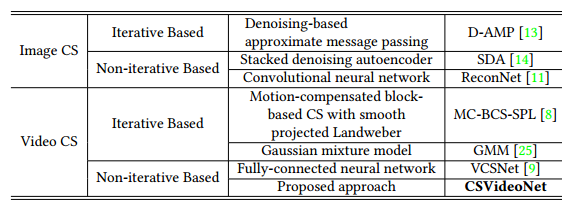
CSVideoNet: A Real-time End-to-end Learning Framework for High-frame-rate Video Compressive Sensing - implementation -

The Great Convergence continues: Compressive Sensing allowed the encoder to be non iterative and now a set of neural networks (CNNs, LSTMs) make the decoding also non iterative. Woohoo !


Fengbo who just received an interesting NSF award also sent me the following:


Dear Igor, 
Hope all is well.
Recently, we proposed a deep learning based encoding/decoding framework (CSVideoNet) for high-frame-rate video compressive sensing. We believe you and your blog’s readers would be interested in this research. The preview of the manuscript can be found here: https://arxiv.org/abs/1612.05203

CSVideoNet: A Real-time End-to-end Learning Framework for High-frame-rate Video Compressive Sensing by Kai Xu, Fengbo Ren
This paper addresses the real-time encoding-decoding problem for high-frame-rate video compressive sensing (CS). Unlike prior works that perform reconstruction using iterative optimization-based approaches, we propose a non-iterative model, named "CSVideoNet". CSVideoNet directly learns the inverse mapping of CS and reconstructs the original input in a single forward propagation. To overcome the limitations of existing CS cameras, we propose a multi-rate CNN and a synthesizing RNN to improve the trade-off between compression ratio (CR) and spatial-temporal resolution of the reconstructed videos. The experiment results demonstrate that CSVideoNet significantly outperforms the state-of-the-art approaches. With no pre/post-processing, we achieve 25dB PSNR recovery quality at 100x CR, with a frame rate of 125 fps on a Titan X GPU. Due to the feedforward and high-data-concurrency natures of CSVideoNet, it can take advantage of GPU acceleration to achieve three orders of magnitude speed-up over conventional iterative-based approaches. We share the source code at this https URL
Thanks,
================================
Fengbo​ Ren
Director, Parallel Systems and Computing Laboratory (PSCLab)
​Assistant Professor, School of Computing, Informatics, and Decision Systems Engineering (CIDSE)
Arizona State University (ASU)
========================​​=====​​===

Thanks Fengbo !


Join the CompressiveSensing subreddit or the Google+ Community or the Facebook page and post there !
Liked this entry ? subscribe to Nuit Blanche's feed, there's more where that came from. You can also subscribe to Nuit Blanche by Email, explore the Big Picture in Compressive Sensing or the Matrix Factorization Jungle and join the conversations on compressive sensing, advanced matrix factorization and calibration issues on Linkedin.

Monday, April 03, 2017

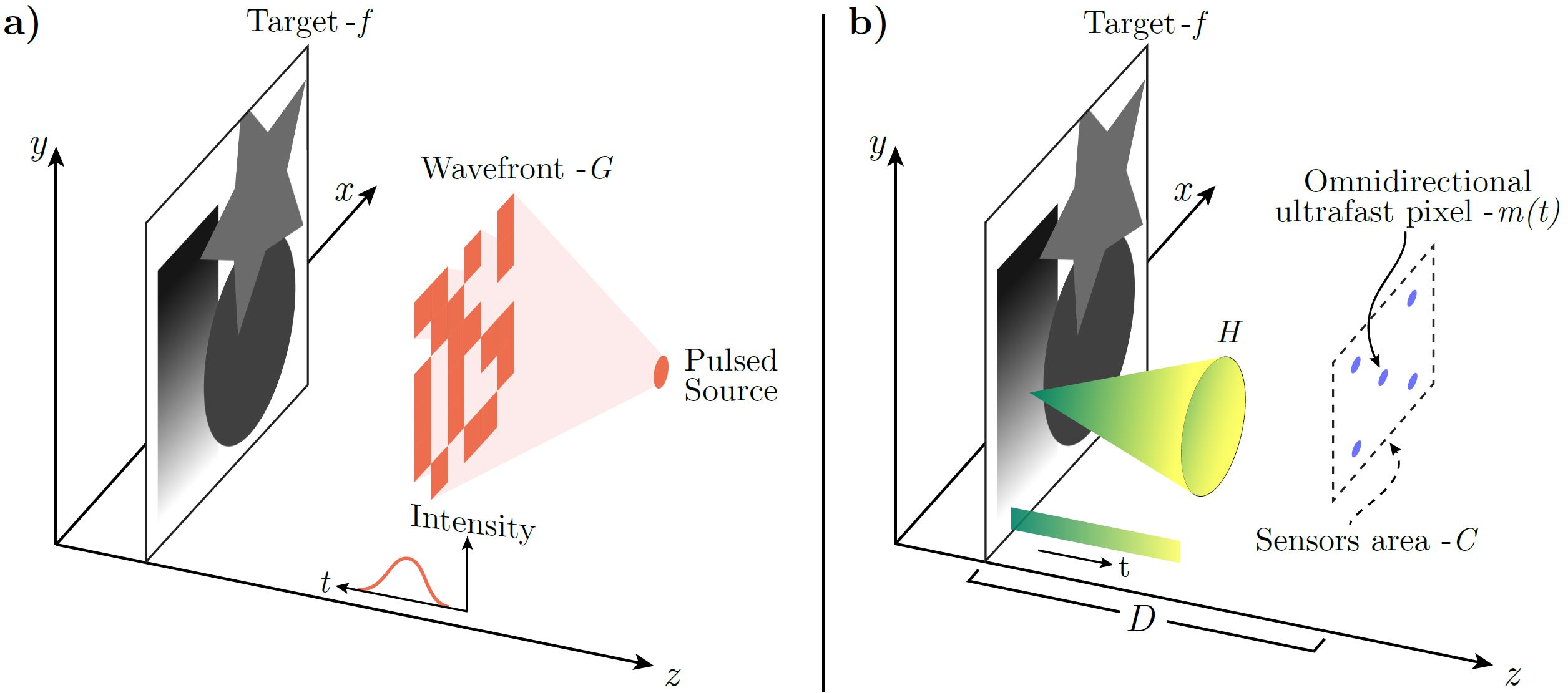
Lensless Imaging with Compressive Ultrafast Sensing

Here is a new compressive architecture that uses CMOS SPADs.


Lensless Imaging with Compressive Ultrafast Sensing by Guy Satat, Matthew Tancik, Ramesh Raskar
Lensless imaging is an important and challenging problem. One notable solution to lensless imaging is a single pixel camera which benefits from ideas central to compressive sampling. However, traditional single pixel cameras require many illumination patterns which result in a long acquisition process. Here we present a method for lensless imaging based on compressive ultrafast sensing. Each sensor acquisition is encoded with a different illumination pattern and produces a time series where time is a function of the photon's origin in the scene. Currently available hardware with picosecond time resolution enables time tagging photons as they arrive to an omnidirectional sensor. This allows lensless imaging with significantly fewer patterns compared to regular single pixel imaging. To that end, we develop a framework for designing lensless imaging systems that use ultrafast detectors. We provide an algorithm for ideal sensor placement and an algorithm for optimized active illumination patterns. We show that efficient lensless imaging is possible with ultrafast measurement and compressive sensing. This paves the way for novel imaging architectures and remote sensing in extreme situations where imaging with a lens is not possible.

The page for the projet is here: http://web.media.mit.edu/~guysatat/singlepixel/


Join the CompressiveSensing subreddit or the Google+ Community or the Facebook page and post there !

Monday, October 31, 2016

Lensless Imaging with Compressive Ultrafast Sensing

Here is some very fast compressive sensing using coded aperture.
Conventional imaging uses a set of lenses to form an image on the sensor plane. This pure hardware-based approach doesn't use any signal processing, nor the extra information in the time of arrival of photons to the sensor. Recently, modern compressive sensing techniques have been applied for lensless imaging. However, this computational approach tends to depend as much as possible on signal processing (for example, single pixel camera) and results in a long acquisition time. Here we propose using compressive ultrafast sensing for lensless imaging. We use extremely fast sensors (picosecond time resolution) to time tag photons as they arrive to an omnidirectional pixel. Thus, each measurement produces a time series where time is a function of the photon source location in the scene. This allows lensless imaging with significantly fewer measurements compared to regular single pixel imaging (33× less measurements in our experiments). To achieve this goal, we developed a framework for using ultrafast pixels with compressive sensing, including an algorithm for ideal sensor placement, and an algorithm for optimized active illumination patterns. We show that efficient lensless imaging is possible with ultrafast imaging and compressive sensing. This paves the way for novel imaging architectures, and remote sensing in extreme situations where imaging with a lens is not possible.

Join the CompressiveSensing subreddit or the Google+ Community or the Facebook page and post there !
Liked this entry ? subscribe to Nuit Blanche's feed, there's more where that came from. You can also subscribe to Nuit Blanche by Email, explore the Big Picture in Compressive Sensing or the Matrix Factorization Jungle and join the conversations on compressive sensing, advanced matrix factorization and calibration issues on Linkedin.

Tuesday, August 09, 2016

Cognitive Sub-Nyquist Hardware Prototype of a Collocated MIMO Radar


 Awesome! Kumar just sent me the following:
Hi Igor,


I hope all is well at your end. We recently built a hardware prototype of a MIMO radar that performs sub-Nyquist processing in both time and space. Your readers might be interested in this. The conference precursor to our journal paper is available at http://arxiv.org/abs/1608.01524


--
Regards,

Kumar Vijay Mishra
Here is the preprint: Cognitive Sub-Nyquist Hardware Prototype of a Collocated MIMO Radar by Kumar Vijay Mishra, Eli Shoshan, Moshe Namer, Maxim Meltsin, David Cohen, Ron Madmoni, Shahar Dror, Robert Ifraimov, Yonina C. Eldar
We present the design and hardware implementation of a radar prototype that demonstrates the principle of a sub-Nyquist collocated multiple-input multiple-output (MIMO) radar. The setup allows sampling in both spatial and spectral domains at rates much lower than dictated by the Nyquist sampling theorem. Our prototype realizes an X-band MIMO radar that can be configured to have a maximum of 8 transmit and 10 receive antenna elements. We use frequency division multiplexing (FDM) to achieve the orthogonality of MIMO waveforms and apply the Xampling framework for signal recovery. The prototype also implements a cognitive transmission scheme where each transmit waveform is restricted to those pre-determined subbands of the full signal bandwidth that the receiver samples and processes. Real-time experiments show reasonable recovery performance while operating as a 4x5 thinned random array wherein the combined spatial and spectral sampling factor reduction is 87.5% of that of a filled 8x10 array.


Join the CompressiveSensing subreddit or the Google+ Community or the Facebook page and post there !
Liked this entry ? subscribe to Nuit Blanche's feed, there's more where that came from. You can also subscribe to Nuit Blanche by Email, explore the Big Picture in Compressive Sensing or the Matrix Factorization Jungle and join the conversations on compressive sensing, advanced matrix factorization and calibration issues on Linkedin.

Monday, August 08, 2016

Adaptive foveated single-pixel imaging with dynamic super-sampling

Here is a way to design a compressive sensing measurement matrix with a single pixel camera that performs foveated imaging i.e. more details at the center of the field of view. 

Adaptive foveated single-pixel imaging with dynamic super-sampling by David B. Phillips, Ming-Jie Sun, Jonathan M. Taylor, Matthew P. Edgar, Stephen M. Barnett, Graham G. Gibson, Miles J. Padgett

As an alternative to conventional multi-pixel cameras, single-pixel cameras enable images to be recorded using a single detector that measures the correlations between the scene and a set of patterns. However, to fully sample a scene in this way requires at least the same number of correlation measurements as there are pixels in the reconstructed image. Therefore single-pixel imaging systems typically exhibit low frame-rates. To mitigate this, a range of compressive sensing techniques have been developed which rely on a priori knowledge of the scene to reconstruct images from an under-sampled set of measurements. In this work we take a different approach and adopt a strategy inspired by the foveated vision systems found in the animal kingdom - a framework that exploits the spatio-temporal redundancy present in many dynamic scenes. In our single-pixel imaging system a high-resolution foveal region follows motion within the scene, but unlike a simple zoom, every frame delivers new spatial information from across the entire field-of-view. Using this approach we demonstrate a four-fold reduction in the time taken to record the detail of rapidly evolving features, whilst simultaneously accumulating detail of more slowly evolving regions over several consecutive frames. This tiered super-sampling technique enables the reconstruction of video streams in which both the resolution and the effective exposure-time spatially vary and adapt dynamically in response to the evolution of the scene. The methods described here can complement existing compressive sensing approaches and may be applied to enhance a variety of computational imagers that rely on sequential correlation measurements.
h/t MIT TechReview

Join the CompressiveSensing subreddit or the Google+ Community or the Facebook page and post there !
Liked this entry ? subscribe to Nuit Blanche's feed, there's more where that came from. You can also subscribe to Nuit Blanche by Email, explore the Big Picture in Compressive Sensing or the Matrix Factorization Jungle and join the conversations on compressive sensing, advanced matrix factorization and calibration issues on Linkedin.

Tuesday, July 19, 2016

DeepBinaryMask: Learning a Binary Mask for Video Compressive Sensing

  The Great Convergence continues in compressive sensing hardware and machine learning:


DeepBinaryMask: Learning a Binary Mask for Video Compressive Sensing by Michael Iliadis, Leonidas Spinoulas, Aggelos K. Katsaggelos
In this paper, we propose a novel encoder-decoder neural network model referred to as DeepBinaryMask for video compressive sensing. In video compressive sensing one frame is acquired using a set of coded masks (sensing matrix) from which a number of video frames is reconstructed, equal to the number of coded masks. The proposed framework is an end-to-end model where the sensing matrix is trained along with the video reconstruction. The encoder learns the binary elements of the sensing matrix and the decoder is trained to recover the unknown video sequence. The reconstruction performance is found to improve when using the trained sensing mask from the network as compared to other mask designs such as random, across a wide variety of compressive sensing reconstruction algorithms. Finally, our analysis and discussion offers insights into understanding the characteristics of the trained mask designs that lead to the improved reconstruction quality.


Join the CompressiveSensing subreddit or the Google+ Community or the Facebook page and post there !
Liked this entry ? subscribe to Nuit Blanche's feed, there's more where that came from. You can also subscribe to Nuit Blanche by Email, explore the Big Picture in Compressive Sensing or the Matrix Factorization Jungle and join the conversations on compressive sensing, advanced matrix factorization and calibration issues on Linkedin.

Printfriendly