Showing posts with label SundayMorningInsight. Show all posts

Sunday, October 01, 2017

Sunday Morning Insight: The Demise of Cassini and the Rise of Artificial InteIligence

In the past few weeks, two events connected to the whole Artificial Intelligence narrative occurred: Cassini plunged into Saturn while NIPS conference registrations closed in an, unheard of, record amount of time.


Pretty often the Artificial Intelligence narratives revolve around one factor and then explains away why the field cannot go on because that factor is not new, not good anymore, not whatever...... That sort of narrative was pushed by Tech Review when it mentioned that AI may be plateauing because "Neural Networks" are thirty or more years old. Yes, neural networks have existed for a long time and no AI is not going to be plateauing because it actually hinges on several factors, not one.

This is the story of one of these factors. 

It started thanks in large part to Space exploration, and no, we are not talking about the awesome Deep Space 1 spacecraft [1] even though much like that spacecraft, that story also started at JPL.

When Dan Goldin became NASA administrator, he pushed a series of constraints on new space missions that had the whole NASA organisation integrate newer, better technologies faster in the design of less expensive space missions [2]. In fact, Cassini was seen as the mission to avoid in the future. From the story told on the JPL website, under the "Faster, Better Cheaper" mantra, one can read:
Without finding ways to cut costs substantially, JPL faced extinction. The NASA budget would not support enough Cassini-scale missions to keep the lab operating.
The vast majority of cameras in space missions had, until then, used CCD devices. While the technology provided high quality images, it was brittle. For one, it required cooling to get some good signal over noise ratio. That cooling in turn meant that the imagers required more power to operate and could fail more systematically during launch phases. It was also a line based design meaning that you could lose an entire line of pixels at once. In short, it was fragile and more importantly the technology made the sensor heavier, a cardinal sin in Space Exploration.

Then came Eric Fossum. This is what you can read on his Wikipedia entry:

....One of the instrument goals was to miniaturize charge-coupled device (CCD) camera systems onboard interplanetary spacecraft. In response, Fossum invented a new CMOS active pixel sensor (APS) with intra-pixel charge transfer camera-on-a-chip technology, now just called the CMOS Image Sensor or CIS[5][6] (active pixel sensors without intra-pixel charge transfer were described much earlier, by Noble in 1968.[7] As part of Goldin's directive to transfer space technology to the public sector whenever possible, Fossum led the CMOS APS development and subsequent transfer of the technology to US industry, including Eastman Kodak, AT&T Bell Labs, National Semiconductor and others. Despite initial skepticism by entrenched CCD manufacturers, the CMOS image sensor technology is now used in almost all cell-phone cameras, many medical applications such as capsule endoscopy and dental x-ray systems, scientific imaging, automotive safety systems, DSLR digital cameras and many other applications.  
Since CMOS rely on the same process as used in computing chips, it scaled big time and became very cheap. In fact, the very creation of massive image and video collections of datasets hosted by the likes of YouTube then Google, Flickr then Yahoo!, InstaGram then Facebook and most other internet companies, was uniquely enabled by the arrival of CMOS in consumer imaging, first in cameras and then in smartphones:

 The size of these datasets enabled the ability to train very large neural networks beyond toy models. New algorithm developments on top of neural networks and large datasets brought error rates down to the point where large internet companies could soon begin to utilize these techniques on the data that had been collected since the early 2000's on their servers. 
  
On September 14th 2017, Cassini was downloading it's last CCD-based images and all the registration at NIPS, one of the most well known ML/DL/AI conference, sold out three months ahead of the meeting: a feat that is unheard of for a specialist's conference. The conference will be held in Long Beach, not far from JPL where, somehow, the sensor that started it all, was born.

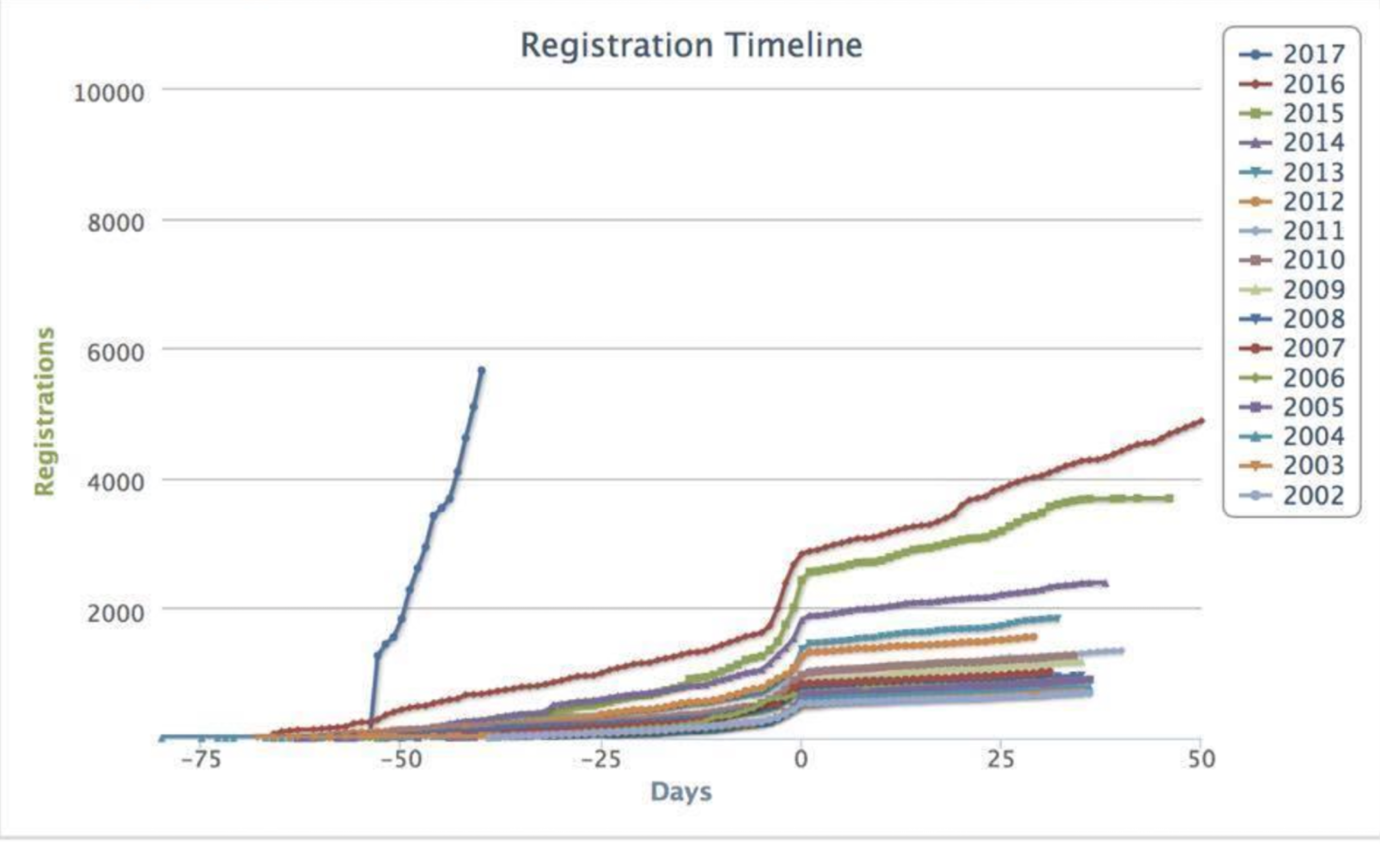
Résultat de recherche d'images pour "nips registration"
One more thing, Eric Fossum is building the QIS, the next generation imaging sensor [3] that will produce more pixels..... 

Notes.
[2] The TRL scale that everyone uses these days, ( and translated for the first time in French was here on Nuit Blanche) was born around that time so that NASA could evaluate what technology could be integrated faster into space missions. 
[3] Check our discussion on QIS and compressive sensing.

Join the CompressiveSensing subreddit or the Google+ Community or the Facebook page and post there !

Saturday, April 22, 2017

Sunday Morning Insight: "No Need for the Map of a Cat, Mr Feynman" or The Long Game in Nanopore Sequencing.


About 5 weeks ago, we wondered how we could tell if the world was changing right before our eyes ?  well, this is happening, instance #2 just got more real:


Nanopore sequencing is a promising technique for genome sequencing due to its portability, ability to sequence long reads from single molecules, and to simultaneously assay DNA methylation. However until recently nanopore sequencing has been mainly applied to small genomes, due to the limited output attainable. We present nanopore sequencing and assembly of the GM12878 Utah/Ceph human reference genome generated using the Oxford Nanopore MinION and R9.4 version chemistry. We generated 91.2 Gb of sequence data (~30x theoretical coverage) from 39 flowcells. De novo assembly yielded a highly complete and contiguous assembly (NG50 ~3Mb). We observed considerable variability in homopolymeric tract resolution between different basecallers. The data permitted sensitive detection of both large structural variants and epigenetic modifications. Further we developed a new approach exploiting the long-read capability of this system and found that adding an additional 5x-coverage of "ultra-long" reads (read N50 of 99.7kb) more than doubled the assembly contiguity. Modelling the repeat structure of the human genome predicts extraordinarily contiguous assemblies may be possible using nanopore reads alone. Portable de novo sequencing of human genomes may be important for rapid point-of-care diagnosis of rare genetic diseases and cancer, and monitoring of cancer progression. The complete dataset including raw signal is available as an Amazon Web Services Open Dataset at: https://github.com/nanopore-wgs-consortium/NA12878.
Here is some context:

And previously on Nuit Blanche:
 
Credit: NASA, JPL


Join the CompressiveSensing subreddit or the Google+ Community or the Facebook page and post there !
Liked this entry ? subscribe to Nuit Blanche's feed, there's more where that came from. You can also subscribe to Nuit Blanche by Email, explore the Big Picture in Compressive Sensing or the Matrix Factorization Jungle and join the conversations on compressive sensing, advanced matrix factorization and calibration issues on Linkedin.

Sunday, March 05, 2017

Sunday Morning Insight: How can you tell the world is changing right before your eyes ?

Predicting the future is a hard business if you don't know where to look. Sometimes seeing how the world is changing right before your eyes is a similarly difficult exercise. Here are four examples of the world changing right before our eyes:

Gene Kogan, an artist who presented an awesome talk at the Paris Machine Learning meetup this past week, writes a book on Machine Learning for artists. This, by itself, is unusual but this is not the most peculiar aspect of the story. Here is a screenshot of Gene's Github 

let me actually focus on one particular section of that text


Yes, a paper that was withdrawn from NIPS 2016 is one of these things that delays a book on Machine Learning for Artists. Artists are generally not the intended crowds of ArXiv preprints. 

Here a second instance of the future staring at you in the eyes. It came as a tweet from Nick in the British understatement of the year  this week


which led Clive Brown to state


Sequencing used to be about breaking things in small little pieces (100's of bases) and computations were required to put those information back together. Nick just called the reading of a piece with 700 000 bases! Sometimes, sensors can remove the need for computations in a major way.  Check the previous discussions on the subject.
The third item can be found in this paragraph from Google Research blog on a paper titled “Detecting Cancer Metastases on Gigapixel Pathology Images”.

...we showed that it was possible to train a model that either matched or exceeded the performance of a pathologist who had unlimited time to examine the slides....In fact, the prediction heatmaps produced by the algorithm had improved so much that the localization score (FROC) for the algorithm reached 89%, which significantly exceeded the score of 73% for a pathologist with no time constraint2. We were not the only ones to see promising results, as other groups were getting scores as high as 81% with the same dataset. Even more exciting for us was that our model generalized very well, even to images that were acquired from a different hospital using different scanners... 
It's one thing to do better than humans, it's another to have a generalization across several different sensors.  That last sentence is a confirmation that the technique isn't just an overfit of sorts.

Fourth item, Yaniv, who's been featured here on Nuit Blanche, (the last time was on Biological screens from linear codes: theory and tools) and Dina Zielinski have been working on using DNA for memory storage purposes. 


In summary,
  • an unheard of speed for ideas to be picked up by others
  • a superhuman discriminative ability in disease classification using well known sensors
  • an unheard of ability to decode the genome with a new sensor and a new way of encoding memories in that same genome.
All in a manner of a single week. Welcome to the future, it is staring at you right now. What are you waiting for ?


Join the CompressiveSensing subreddit or the Google+ Community or the Facebook page and post there !
Liked this entry ? subscribe to Nuit Blanche's feed, there's more where that came from. You can also subscribe to Nuit Blanche by Email, explore the Big Picture in Compressive Sensing or the Matrix Factorization Jungle and join the conversations on compressive sensing, advanced matrix factorization and calibration issues on Linkedin.

Sunday, January 22, 2017

Sunday Morning Insight: D'avions et d'Intelligence Artificielle en France [in French]

C'est une histoire qui se passe pendant la seconde guerre mondiale. Abraham Wald veut aider l'effort de guerre, mais parce qu'il est d'Europe centrale, il ne peut travailler ni sur les programmes ultra-secrets des radars ni dans le projet Manhattan. Il se retrouve au Statistical Research Group à New York. Quand le haut commandement Allié demande à Abe si il peut les aider, il s'empare immédiatement du projet 
 
Le problème est simple. Pendant les campagnes de France et d'Allemagne qui vise a bombarder l'effort de guerre nazie, un certain nombre d'avions de la RAF et de l'US Air Force ne reviennent pas. Ceux qui reviennent sont criblés d'impact de balles et d'obus de partout, enfin presque partout. Le haut commandement se pose la question de savoir ou et comment blinder les avions de façon a avoir plus d'avions qui survivent de ces campagnes. Leur premièr instinct est de réparer les trous des avions qui reviennent criblés.


Abe fait la remarque suivante: si les avions sont visés sur toutes les surfaces de l'avion pendant les campagnes, il faut chercher les endroits qui n'ont pas été touchés. En effet, les avions qui ne sont pas revenus sont ceux qui ont été atteints à ces endroits la: Pour répondre à la question initiale, il faut blinder les avions aux endroits qui n'ont pas été touché sur les avions qui ont survécus.
On appelle cela le biais de sélection.

Ce biais apparait quand on est en face d'un groupe et que l'on se pose la question de savoir pourquoi il n'y a pas un certain type de personne dans ce groupe. Un autre exemple plus proche est celui de faire la cartographie de l'intelligence artificielle en France a partir des listings de programme d'investissements, de startups ou d'équipes de recherche qui existent déja. Ces efforts de listing sont importants et donnent une vraie visibilité aux gouvernants. Mais la question qu'il faut aussi se poser  est de voir quels sont les endroits ou il y a une demande sociétale forte avec en face des programmes d'investissements, des startups ou des équipes de recherche qui n'existent pas en France.

PS:

Abe fera un calcul sur plus de 400 avions et trouvera qu'il faut protéger les moteurs des avions des canons de 20mm et le fuselage des mitraillettes de 7.9mm. Une copie du rapport d'Abe Wald se trouve ici: "A method of estimating plane vulnerability based on damage of survivors"

J'ai lu cette histoire très efficace pour la première fois sur le blog de John. Jordan l'a raconté de façon plus étendue ici. Nous en avions parler la première fois au meetup du Paris Machine Learning quand Léon Bottou nous avait parlé au meetup 11 de la saison 1.

Credit photo: Cameron Moll, The Counterintuitive World, Kevin Drum
 
Join the CompressiveSensing subreddit or the Google+ Community or the Facebook page and post there !
Liked this entry ? subscribe to Nuit Blanche's feed, there's more where that came from. You can also subscribe to Nuit Blanche by Email, explore the Big Picture in Compressive Sensing or the Matrix Factorization Jungle and join the conversations on compressive sensing, advanced matrix factorization and calibration issues on Linkedin.

Sunday, December 18, 2016

Sunday Morning Insight: And You, What Are You Waiting For ?


For different reasons, the winter break/solstice is a good time for getting stuff done and focusing on small or large projects. Some of them lead to discoveries and/or momentous firsts. This year is no exception with a few days before the solstice Clive Brown, the CTO of Oxford Nanopore decided to build his own genome through self sequencing. From the read me on his experiment on Github.
So far as I am aware this is the first full coverage Human Genome sequenced by the individual who provided the input sample (ONT-HG1). This may prove significant in future.
The last sentence is obviously a rather typical self-effacing affirmation also known as "British understatement". 

 And you, what are you waiting for ?
 

    Join the CompressiveSensing subreddit or the Google+ Community or the Facebook page and post there !
    Liked this entry ? subscribe to Nuit Blanche's feed, there's more where that came from. You can also subscribe to Nuit Blanche by Email, explore the Big Picture in Compressive Sensing or the Matrix Factorization Jungle and join the conversations on compressive sensing, advanced matrix factorization and calibration issues on Linkedin.

    Sunday, November 13, 2016

    Sunday Morning Insight: Antipodal Seismic Maps ?

    I really wish we had some sort of Data Science hackaton on the subject (see Sunday Morning Insight: "More F$*%(g Data" ) because I feel like this is more like a confirmation bias more than anything else. When you are on a sphere and something happen with strength somewhere, a wave moves around and peaks on the other side. We mentioned this before:


     thanks Antipodemap
     
    Join the CompressiveSensing subreddit or the Google+ Community or the Facebook page and post there !
    Liked this entry ? subscribe to Nuit Blanche's feed, there's more where that came from. You can also subscribe to Nuit Blanche by Email, explore the Big Picture in Compressive Sensing or the Matrix Factorization Jungle and join the conversations on compressive sensing, advanced matrix factorization and calibration issues on Linkedin.

    Sunday, November 06, 2016

    Sunday Morning Insight: The Clear and Present Dangers


    There is a scene in Tom Clancy's book turned into the movie "Clear and Present Danger" that struck with me when I first watched it. It goes like this. The whole intrigue of the movie starts with this exchange:
    James Cutter: Are you suggesting a course of action, sir?
    The President: The course of action I'd suggest is a course of action I can't suggest.
    James Cutter:I'm... not sure where that leaves us.
    The President: These drug cartels represent a clear and present danger to the national security of the United States.
    Every once in while you are asked questions about why are doing this or why are you doing that. The only answer expected from you is the small answer, the go-along-with-the-show answer when in fact, all along, you want to talk about the big things and you know that some of them will scare people. But then after a few seconds, you think that it will be counterproductive and the words eventually coming out of your mouth say the small things. You might have averted a long discussion in the short term but saying the big things might trigger a different journey altogether. 


    Join the CompressiveSensing subreddit or the Google+ Community or the Facebook page and post there !

    Sunday, October 23, 2016

    Sunday Morning Insight: We're the Barbarians


    In a recent blog entry ( Predicting the Future: The Steamrollers and Machine Learning) I pointed out the current limits on the use of silicon for computing. Even though the predictions show the substantial impact of computing on power generation, there is only a scattered set of initiatives or technology development that are looking into this issue.

    This was reinforced when we, at LightOn, recently filled a form to join Optics Valley, a  non-profit group representing the interest of the Optics industry here in France.. Many of our answers fell into the "Other" category. That feeling was very much reinforced last night when I watched the IEEE rebooting computing video that features a set of initiatives that aims at solving this exact problem. But if you watch the short video, you'll probably notice that our technology also falls in the "Others" category.


    Rome errr....Silicon Valley needs a solution and  we're the Barbarians....

     
    Join the CompressiveSensing subreddit or the Google+ Community or the Facebook page and post there !
    Liked this entry ? subscribe to Nuit Blanche's feed, there's more where that came from. You can also subscribe to Nuit Blanche by Email, explore the Big Picture in Compressive Sensing or the Matrix Factorization Jungle and join the conversations on compressive sensing, advanced matrix factorization and calibration issues on Linkedin.

    Sunday, October 16, 2016

    Sunday Morning Insight: Machine Learning in Paris this past week


    The most fascinating experience we've had this past week was the meetup we organized at Vente-privée one of the largest electronic store operation in Europe. It was fascinating on many grounds. First, we got to discover the business from one of the presentation by their engineers and then got a tour of the operations by Julien, the CTO. Their growth is so amazing that they now have to use machine learning to scale up not just for their operations but also for their customers. Their CTO mentioned a few facts that got our attention: 100 000 packages delivered everyday, 20 artists in residence that produces the jingles for their stores, more than 200 electronic stores created per month. The shooting of products require fashion models but at some point their operations was so large that all fashion models in Paris were booked (except for a few tops) with them. The situation led to them to creating photorealistic rendered version of new models for their stores/campaigns. They are about to open a few R&D labs at the Epita and 42 schools and they have a lots of very interesting problems. In a way they reminded me a little bit the situation described by Chris  at the New York Times, Andrei at WalmartLabs a while back (see presentations in the archives section of the meetup). The meetup itself was somewhat different as well as regards to the presentations we had: Greg spoke to us about trying grab our interaction on social networks and use this to enhance our personnalities. This is an open project and the site is here: people2vec. Arnaud  did the very unusual thing of telling us how he did to get the best actionable dataset for his Deep Learning start-up (Regaind.io). Olivier, Ivan and Antoine detailed some of the ML work at Vente-privée, Frederico talked to us about health data on the web. We also opened a small debate with François that got some reaction from the crowd. Eventually, Clementine also mentioned a Startup Weekend on AI. All the presentations and the video of the streaming is here. This coming week, we should have a new 'Hors série' meetup organized with Quantmetry with Cedric Villani, a Field's medalist among other speakers. I am not quite sure what the format will be but you can register here to attend. As usual, it's free.
    The day after the meetup, LightOn got to pitch in the semi-finals of the Hello Tomorrow Challenge. The winner of this year's edition is a flying car.


    Join the CompressiveSensing subreddit or the Google+ Community or the Facebook page and post there !
    Liked this entry ? subscribe to Nuit Blanche's feed, there's more where that came from. You can also subscribe to Nuit Blanche by Email, explore the Big Picture in Compressive Sensing or the Matrix Factorization Jungle and join the conversations on compressive sensing, advanced matrix factorization and calibration issues on Linkedin.

    Sunday, September 18, 2016

    Sunday Morning Insight: "More F$*%(g Data"


    On Friday, we had a, too short, panel discussion on the AI ecosystem here in France. At the end, Paul asked us what would be needed to have an even more dynamic ecosystem:


    After thinking about it a little while, it became clear to me that the answer was "More Data". Later that day, I met a person who wanted to organize a Hackaton in the area of Data Science. Again, it was clear that to attract local data scientists, you needed to have unheard-of and fascinating datasets. As a result of these interactions, I have been thinking of the type of datasets or access to datasets that could have large impacts in the start-up area and on our local community:

    Health: If the British NHS and Deepmind did a deal in Great Britain, it would seem a shrewd move by the French state to open the health datasets owned by the wide variety of the health stakeholders. Yes, privacy issues are central and yes they can be solved efficiently, Most importantly, if we do not use them, we are not making our health-AI ecosystem dynamic. It is important to remember that by default it is a better move by the state to not move in that direction. Until people realize that you will get better diagnostics and treatment in the UK than in France, there will not be a move to exploit these data. By that time, the game will really be over for French start-ups to really make an impact. Let me make the additional comment that current start-ups that are doing well in that realm are companies that have been able to get their data from outside french soil. It is not just a shame and it's tragic.

    Movie industry: The FranceisAI meeting took place at BPI France, a short 200 meters away from where the first public showing of a movie, at which admission was charged, took place.  The French created the movie industry and started many of the business practices and narrative used in scripts that stand to this day. Nowadays, under the reasoning that some things need to be protected, entire collections are seldom reachable by start-ups and artists types.  The database of INA is one such example but I am sure it is not the only one. What I notice is that a company like Netflix, that did not exist 15 years ago, is becoming a giant in the TV industry because of its awesome data driven work. It looks as if it is even becoming better now because of its ability to create and analyse "More F$*%(g Data". I am sure start-ups here in Paris could fast track their analytical tools based on local databases such as that of INA.

    Environment: At the last Paris Machine Learning meetup this past Wednesday, we had David Klein, a data scientist in California who helps entities like conservation metrics in quantifying conservation actions throughout the world (his presentation is here). His presentation is exciting and listed in the meetup's archives here. Go read it, I'll wait....During the Q&A, one of our audience participant asked if, like the turtles David could detect, we could do the same for bull sharks. Why bull sharks you say ?  Well these sharks have had a tremendous impact on the local economy of the Reunion island, a French "département" in the Indian Ocean, Currently the French fisheries ministry staff goes through the lengthy process of tagging the sharks which can then be detected by sparsely located offline sensors. After watching David's presentation, we were wondering about the possibility of using acoustic sensors or drones with cameras and Deep Learning to detect in time (not after the fact) if any bull sharks were getting too close to the beach/surf areas. Because of the non-responsiveness of the current detection system, the state conservation department has had to remove some sharks. While the solution might appease the contentious relations with the population, it is simply neither a guarantee for humans nor it is ideal for the shark population. Using AI/ML capabilities with an offline detection system would still detect the non tagged sharks: a capability that currently simply does not exist or would cost a lot of money if it required the tagging of every sharks in the region. I am sure that there are other wildlife issues that could be solved using some of these techniques but since the environment has mostly been the realm of the state, it is high time it opens up and provides "More F$*%(g Data".

    I could go on and on about different subject areas where the state owns more data than it can make sense of. Let me point one dataset out that does not seem to have a direct economic impact because it is looks too sciency: Earthquake detection. The Institut de physique du globe de Paris has some of the very large datasets that would be ideal for a beautiful hackaton or for start-ups that want to try their algorithms. These dataset should not be seen as just for the Science community. If the story of Kaggle is any indication, even Science can change as a result of releasing "More F$*%(g Data".

    Current models such as those used in Deep Learning /AI require large amounts of data for their training. Policymakers need to understand that if homegrown start-ups and the attendant ecosystems in general are to strive and have an edge, it is because and only because they can have access to large amounts of F$*%(g data. 


    Image Credit: NASA/JPL-Caltech
    This image was taken by Rear Hazcam: Left B (RHAZ_LEFT_B) onboard NASA's Mars rover Curiosity on Sol 1463 (2016-09-17 11:56:14 UTC).
    Full Resolution

    Join the CompressiveSensing subreddit or the Google+ Community or the Facebook page and post there !
    Liked this entry ? subscribe to Nuit Blanche's feed, there's more where that came from. You can also subscribe to Nuit Blanche by Email, explore the Big Picture in Compressive Sensing or the Matrix Factorization Jungle and join the conversations on compressive sensing, advanced matrix factorization and calibration issues on Linkedin.

    Sunday, April 03, 2016

    Sunday Morning Insight: The Uneasy Deep AI

    DeepDrumpf is a Neural Network trained on Donald Trump's transcripts. Here is one of the latest tweet:
    There is some deep truth to that argument. Similarly, last night's Saturday Night Life had a character that seemed too close to reality (Saturday Night Live's 'Full-Blown Nut Job' Donald Trump Supporter Is Too Real) because the scripts paralleled that of Trump supporters/PR. 
    To summarize, an AI using a specific text corpus from Mr. Trump provides some deeper truths while humans seem to only do well in paroting that playbook for laughs. Let that sink in for a minute ...or ten.


    Join the CompressiveSensing subreddit or the Google+ Community or the Facebook page and post there !
    Liked this entry ? subscribe to Nuit Blanche's feed, there's more where that came from. You can also subscribe to Nuit Blanche by Email, explore the Big Picture in Compressive Sensing or the Matrix Factorization Jungle and join the conversations on compressive sensing, advanced matrix factorization and calibration issues on Linkedin.

    Sunday, December 27, 2015

    Sunday Morning Insight: 10x Not 10% by Ken Norton

    Here is Ken Norton's outstanding video featuring his 10x Not 10%, Product management by orders of magnitude presentation (the link goes to Ken long form essay of that presentation). You may notice certain themes mentioned here on Nuit Blanche before and highlighted below. He mentions betting on trends while we call them the steamrollers. One should notice that while Ken marvels at the images of Pluto having been dowloaded a few hours earlier, the talk was given fifteen days too early when The Second Inflection Point in Genome Sequencing occured. Let us note that we wondered when that second inflection point back in 2014 and that it took place about a year later. In all, there are certainly elements of the strategy described by Ken we are trying to accomplish at Lighton. Enjoy the video !


    Related:


    Join the CompressiveSensing subreddit or the Google+ Community or the Facebook page and post there !
    Liked this entry ? subscribe to Nuit Blanche's feed, there's more where that came from. You can also subscribe to Nuit Blanche by Email, explore the Big Picture in Compressive Sensing or the Matrix Factorization Jungle and join the conversations on compressive sensing, advanced matrix factorization and calibration issues on Linkedin.

    Sunday, November 15, 2015

    Sunday Morning Insight: The Hard Questions

    I wanted to talk about something else today but the events that occured on Friday have made me ponder about the following questions:
    • Are there simple means of interdicting the use of high powered weapons in crowded areas or cities ?
    • Are there cheap and rapid means of detecting high explosives from a distance ?
    • Are there cheap and rapid means of interdicting the use of high explosives ?
    • Are there better technical means of enhancing monitoring capabilities in group hostage situations ?
    • Are there better ways of enabling citizen responses to emergencies without giving information ?
    • Are there efficient and privacy conscious ways of monitoring the activities of a few thousand people deemed potential threats without overburdening security forces ?
    All answers should have little impact on societies (financial, privacy). Some of these questions may look like they are impossible to answer affirmatively but we need to ask them nonetheless and we need to have places where these questions can be asked in a naive fashion. This type of exercise is still undertaken by scientists in the shape of the JASONs in the US and maybe we should have something similar here.
    Current organizations and structures which should deal with these issues seem out of touch with Science based approaches. That needs to change.

    Join the CompressiveSensing subreddit or the Google+ Community or the Facebook page and post there !
    Liked this entry ? subscribe to Nuit Blanche's feed, there's more where that came from. You can also subscribe to Nuit Blanche by Email, explore the Big Picture in Compressive Sensing or the Matrix Factorization Jungle and join the conversations on compressive sensing, advanced matrix factorization and calibration issues on Linkedin.

    Saturday, October 17, 2015

    Sunday Morning Insight: Miller's Wave and Genomics

    [Spoiler alert: if you have not seen the movie Interstellar then please do not read this post]


    There is a scene in Interstellar that parallels what we are currently seeing in genomics. As Cooper and his crew lands on Miller's planet, the audience witnesses a watery landscape with what looks like far-away mountain ridges. Two minutes later, Cooper's spacecraft is nearly destroyed by a gigantic wave. 
     A minute it was a far away mountain ridge, the next it's a hundred story wave.. 
     
    A week later, DNA.land has gathered 6000+ genomes.   

    So the next thing we ought to ask ourselves besides producing even better sensors, is: Do we have algorithms that can scale for this sort of data stream on a daily basis ?


    Join the CompressiveSensing subreddit or the Google+ Community or the Facebook page and post there !
    Liked this entry ? subscribe to Nuit Blanche's feed, there's more where that came from. You can also subscribe to Nuit Blanche by Email, explore the Big Picture in Compressive Sensing or the Matrix Factorization Jungle and join the conversations on compressive sensing, advanced matrix factorization and calibration issues on Linkedin.

    Printfriendly