Press Release (Mar 12,2011)
Impact to TEPCO's Facilities due to Miyagiken-Oki Earthquake (as of 3PM)
Below is major impact to TEPCO's facilities due to the Miyagiken-Oki Earthquake that occurred yesterday at 2:46PM.
*new items are underlined
[Nuclear Power Station]
Fukushima Daiichi Nuclear Power Station:
Units 1 to 3: shutdown due to earthquake
Units 4 to 6: outage due to regular inspection
Good only three power plants to pay attention to.
* The national government has instructed evacuation for those local residents within 10km radius of the periphery.
I am guessing this is a conservative move by the authorities. Nothing more.
* Measurement of radioactive material (Iodine, etc.) by monitoring car indicates increasing value compared to normal level. One of the monitoring posts is also indicating higher than normal level. We will continue monitoring discharge of radioactive material from exhaust stack and discharge canal, etc.
Higher than normal does not mean it is unsafe in one post. In particular, I am guessing the language would be different if the levels were above "safe" levels ( by safe I mean as set by national standards, i.e. it does not mean that one gets sick, but that's a different story). Now let's get to the meat of the press release:
* Reactor of Unit 1 has been shut down and steam in reactor has been cooled by isolation condenser, but it is now stopped. Because pressure level in reactor containment vessel is increasing, following the national government instruction, we have done the measure to reduce the pressure of the reactor containment vessels in order to fully secure safety and we understand that we have succeeded it at 2:30PM.
At present, reactor water level is becoming lower and we are injecting water accordingly.
* Reactor of Unit 2 has been shut down and we continue injecting water by Reactor Core Isolation Cooling System. Current reactor water level is lower than normal level, but the water level is steady. Following the national government instruction, we are preparing to implement a measure to reduce the pressure of the reactor containment vessels in order to fully secure safety.
* Reactor of Unit 3 has been shut down and we continue injecting water by Reactor Core Isolation Cooling System. Following the national government instruction, we are preparing to implement a measure to reduce the pressure of the reactor containment vessels in order to fully secure safety.
The main problem with shutting down a reactor is generally not in shutting down the neutron population (criticality issues) in the core but rather after that has been done, it is to remove the remaining heat produced by the decaying reactor core. The heat produced by the core is large but it is decaying. All safety systems in a reactor plant are designed to address specifically that issue. What is said above is that the three cooling systems are in play to remove that decay heat. What this also says is that the control rods have done their jobs and now we have a cooling issue only. The issue to pay attention to is whether the cooling systems would fail. I don't see any of that in the press release. Over time, this issue is slowly going away as the reactor decay heat decreases.
* We are implementing a measure to reduce the pressure of the reactor containment vessels, but, one of our employees working in the Unit 1 was irradiated at over 100mSv level(106.3mSv). He received a medical treatment by a special physician.
The high pressure is just a side effect of that large amount of heat released in the containment section of the core. With regards to the employee receiving 106mSv, that's 10.6 rem, he has received less than 50 times the annual dose of a radiation worker. See here in the
Health Physics Society website:
The most recent report (November 1999) indicates that the average annual measurable dose to a radiation worker at a commercial nuclear power plant in 1998 was 180 millirem.
That dose is also
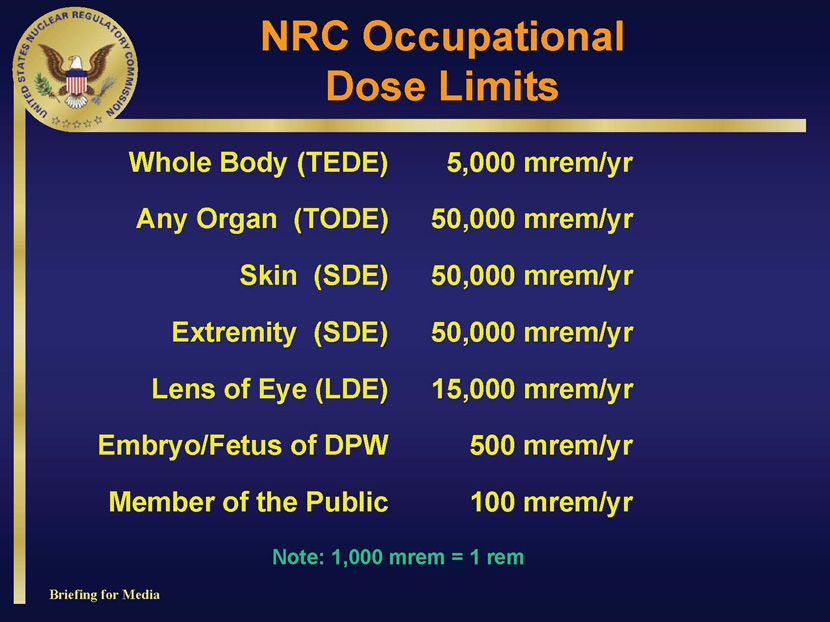
twice the legal limit for a year as defined by the U.S. Nuclear Regulatory Commission:
Title 10, Part 20, of the Code of Federal Regulations (10 CFR Part 20), "Standards for Protection Against Radiation," establishes the dose limits for radiation workers. Although the limits vary, depending on the affected part of the body, the annual total effective dose equivalent (TEDE) for the whole body is 5,000 mrem (5 rem).
So it looks like he is going on some extended paid vacation by TEPCO as a result but tit is very likely not lethal Let us go back to the press release:
Fukushima Daini Nuclear Power Station:
Units 1 to 4: shutdown due to earthquake
* The national government has instructed evacuation for those local residents within 3km radius of the periphery and indoor standby for those local residents between 3km and 10km radius of the periphery.
same as before. Authorities are being conservative.
* At present, we have decided to prepare implementing measures to reduce the pressure of the reactor containment vessel (partial discharge of air containing radioactive materials) in order to fully secure safety. These measures are considered to be implemented in Units 1, 2 and 3 and accordingly, we have reported and/or noticed the government agencies concerned.
* Unit 3 has been stopped and being "nuclear reactor cooling hot stop" at 12:15PM.
Out three units, one has its decaying heat been removed. The two other plants continue the process of removing the decaying heat from the core.
Kashiwazaki Kariwa Nuclear Power Station:
Units 1, 5, 6, 7: normal operation
Units 2 to 4: outage due to regular inspection
Good news.
[Thermal Power Station]
Hirono Thermal Power Station Units 2 and 4: shutdown due to earthquake
Hitachinaka Thermal Power Station Unit 1: shutdown due to earthquake
Kashima Thermal Power Station Units 2, 3, 5, 6: shutdown due to earthquake
Ohi Thermal Power Station Units 2, 3: shutdown due to earthquake
Higashi-Ohgishima Thermal Power Station Unit 1: shutdown due to earthquake
If anything this is not good with regards to providing some electrical baseload to the national grid.
[Hydro Power Station]
4 stations in Fukushima Prefecture were shutdown due to earthquake.
Power stations in Yamanashi Prefecture have been restored.
[Transmission System, etc.]
5 substations shown below have been shutdown:
- Naka Substation
- Shin Motegi Substation
- Joban Substation
- Ibaraki Substation
- Nishi Mito Substation
[Blackout in TEPCO's Service Area]
Total of about 0.6 million households are out of power.
Tokyo: 0
Kanagawa Pref.: 0
Tochigi Pref.: 30,389
Chiba Pref.: 36,456
Saitama Pref: 0
Gunma Pref.: 0
Ibaraki Pref: 537,288
Yamanashi Pref: 0
Shizuoka Pref: 0 (east of Fuji River)
[Supply and Demand Status within TEPCO's Service Area to Secure Stable
Power Supply]
Backup supply from Shinshinano Conversion Station: 600MW
Backup supply from Sakuma Conversion Station: 300MW
Backup supply from Higashi Shimizu Conversion Station: 100MW
Because TEPCO's facilities have been seriously damaged, power shortage may occur. TEPCO appreciates customers' cooperation in reducing electricity usage by avoiding using unnecessary lighting and electrical equipment.
With all the thermal power stations off-line, no wonder they are asking people to curb their use of electricity.
We are taking all measures to restore power, however, we expect extremely difficult situation in power supply for tomorrow as well. We kindly ask our customers to cooperate with us in reducing usage of power.
Please do NOT touch cut-off electric wires.
Words of wisdom!

 Liked this entry ? subscribe to Nuit Blanche's feed, there's more where that came from. You can also subscribe to Nuit Blanche by Email, explore the Big Picture in Compressive Sensing or the Matrix Factorization Jungle and join the conversations on compressive sensing, advanced matrix factorization and calibration issues on Linkedin.