Showing posts with label medical. Show all posts

Tuesday, August 24, 2010

CS: Sparse Brain Network Recovery under Compressed Sensing, Compressive Radar Imaging Using White Stochastic Waveforms, Compressive Sensing in the Limit

Wow! just Wow! We have two very application oriented interesting papers today:

Partial correlation is a useful connectivity measure for brain networks, especially, when it is needed to remove the confounding e ffects in highly correlated networks. Since it is difficult to estimate the exact partial correlation under the small-n large-p situation, a sparseness constraint is generally introduced. In this paper, we consider the sparse linear regression model with a l1-norm penalty, a.k.a., least absolute shrinkage and selection operator (LASSO), for estimating sparse brain connectivity. LASSO is a well-known decoding algorithm in the compressed sensing (CS). The CS theory states that LASSO can reconstruct the exact sparse signal even from a small set of noisy measurements. We briefly show that the penalized linear regression for partial correlation estimation is related with CS. It opens a new possibility that the proposed framework can be used for a sparse brain network recovery. As an illustration, we construct sparse brain networks of 97 regions of interest (ROIs) obtained from FDG-PET data for the autism spectrum disorder (ASD) children and the pediatric control (PedCon) subjects. As a model validation, we check their reproducibilities by leave-one-out cross validation and compare the clustered structures derived from the brain networks of ASD and PedCon.

I don't think I have this type of quality work in Autism related studies. Kudos to this team. On a related note,  if you are interested in going for a PhD that deals with how compressed sensing translates into medical application, you may want to check the PhD program at King's College in London. Check the title of Dr. Batchelor. More information can be found here.

In a different direction, we get to use the Donoho-Tanner phase transition to calibrate a hardware system. I like very much this idea:


In this paper, we apply the principles of compressive sampling to ultra-wideband (UWB) stochastic waveform radar. The theory of compressive sampling says that it is possible to recover a signal that is parsimonious when represented in a particular basis, by acquiring few projections on to an appropriate basis set. Drawing on literature in compressive sampling, we develop the theory behind stochastic waveformbased compressive imaging. We show that using stochastic waveforms for radar imaging, it is possible to estimate target parameters and detect targets by sampling at a rate that is considerably slower than the Nyquist rate and recovering using compressive sensing algorithms. Thus, it is theoretically possible to increase the bandwidth (and hence the spatial resolution) of an ultra-wideband radar system using stochastic waveforms, without significant additions to the data acquisition system. Further, there is virtually no degradation in the performance of a UWB stochastic waveform radar system that employs compressive sampling. We present numerical simulations to show that the performance guarantees provided by theoretical results are achieved in realistic scenarios.

Study the asymptotic behaviour of Node-Based Verification-Based (NBVB) algorithms over random regular bipartite graphs in the context of compressive sensing.

Wednesday, August 04, 2010

This is wrong on so many levels

From reading this press release, Video Game Processors Help Lower CT Scan Radiation one could get the wrong impression.. For those new readers let me provide some background, while Graphics cards bring speedier computations, they are not the reason why dose from the CT devices is decreased. The radiation dose is lower because of the framework (signal acquisition and reconstruction solvers) brought by compressive sensing allows one to take fewer measurements and therefore a lower dose.

One would only hope to see similar progress as this press release implies: Image-Processing Algorithm Reduces CT Radiation Dose by as Much as 95 Percent. There the algorithm is clearly at the center of the dose reduction. For those interested in trying this in a Compressive Sensing framework, you may want to check the actual abstract here.It looks as though one could probably use the background subtraction approach. Some of you are working in the same institution (Mayo)!

Monday, August 02, 2010

Towards a Mathematical Theory of Cortical Micro-circuits

I just noticed this paper from PLOS: Towards a Mathematical Theory of Cortical Micro-circuits by Dileep George, Jeff Hawkins. The abstract reads:
The theoretical setting of hierarchical Bayesian inference is gaining acceptance as a framework for understanding cortical computation. In this paper, we describe how Bayesian belief propagation in a spatio-temporal hierarchical model, called Hierarchical Temporal Memory (HTM), can lead to a mathematical model for cortical circuits. An HTM node is abstracted using a coincidence detector and a mixture of Markov chains. Bayesian belief propagation equations for such an HTM node define a set of functional constraints for a neuronal implementation. Anatomical data provide a contrasting set of organizational constraints. The combination of these two constraints suggests a theoretically derived interpretation for many anatomical and physiological features and predicts several others. We describe the pattern recognition capabilities of HTM networks and demonstrate the application of the derived circuits for modeling the subjective contour effect. We also discuss how the theory and the circuit can be extended to explain cortical features that are not explained by the current model and describe testable predictions that can be derived from the model.
You can create your own vision experiment or use for free some of the Vision Demos at the company created  to support this model (Numenta). I also  note from the paper:
In the case of a simplified generative model, an HTM node remembers all the coincidence patterns that are generated by the generative model. In real world cases, where it is not possible to store all coincidences encountered during learning, we have found that storing a fixed number of a random selection of the coincidence patterns is sufficient as long as we allow multiple coincidence patterns to be active at the same time. Motivation for this method came from the field of compressed sensing [20]. The HMAX model of visual cortex [21] and some versions of convolutional neural networks [22] also use this strategy. We have found that reasonable results can be achieved with a wide range of the number of coincidences stored.
Compressed Sensing and HMAX in the same sentence, uhh..., this echoes some of the observation made a while back here:
This is absolutely outstanding!

By the way, I still own a Handspring Visor, a machine created by Jeff Hawkins. Let us hope that this software breaks a new market like the Visor did in its time.
He is a video of Jeff at TED back in 2003. When are we going to have a speaker at TED on Compressed Sensing proper ? Hey I volunteer on any one of the tech featured in These Technologies Do Not Exist.


Photo: Lincoln from afar and closeby, Dali Museum in Rosas.

Saturday, July 17, 2010

CS: These Technologies Do Not Exist: Compressive MultiChannel Radiation Analyzers

Radiation detectors are the basis of many medical imaging techniques, yet I believe not much attention is being paid to them in terms of rethinking the way they are designed to include the new techniques developed on the  compressive sensing framework. Let me give you an simple example. But first before thinking about a new technology, one really needs to see what has been done before. Probably not the extent of being an expert but at least to the point where one gets a sense of the gist of what is being performed. I am taking some of the figures from this presentation on  Radiation Detection & Measurement II, Pulse height spectroscopy which takes most of its material from The Essential Physics of Medical Imaging by Jerrold Bushberg. As a nuclear engineer, one of the textbook I had and can recommend is Radiation Detection and Measurement by Glenn Knoll (the errata sheet is here ). If you recall I asked Glenn two years ago about coded aperture ( CS: Coded Mask Imagers: What are they good for ? The George Costanza "Do the Opposite" Sampling Scheme). These two books are a good starting point and provide a very good shelf book for practicing engineers and physicists alike. They definitely provide a good vocabulary if you end up talking to a radiation detector designer.

One of the simplest configuration for detecting radiation is detecting Gamma ray photons. As shown in the figure below, a photon source provides undirected gammas which interact with the NaI(TI) material which will transform a high energy photon (gamma) into a photon in the visible light range that can be converted into an electron and then into a electrical current. 


One also notices that the gamma rays also interact with the rest of the detector. Some of the interaction processes were already described in These Technologies Do Not Exist: A Random Anger Coding Scheme for PET/SPECT cameras entry. The figure below lists all kinds of interactions the gamma source eventually have with the detector (A, B, C, D, E, F):


Specifically as mentioned in the text of the presentation and the associated book:

Interactions of photons with a spectrometer
•An incident photon can deposit its full energy by:
–A photoelectric interaction (A)
–One or more Compton scatters followed by a photoelectric interaction (B)
•A photon will deposit only a fraction of its energy if it interacts by Compton scattering and the scattered photon escapes the detector (C)
–Energy deposited depends on scattering angle, with larger angle scatters depositing larger energies
Even if the incident photon interacts by the photoelectric effect, less than its total energy will be deposited if the inner-shell electron vacancy created by the interaction results in emission of a characteristic x-ray that escapes the detector (D)
 Detectors normally shielded to reduce effects of natural background radiation and nearby radiation sources
•An x-ray or gamma-ray may interact in the shield of the detector and deposit energy in the detector:
–Compton scatter in the shield, with the scattered photon striking the detector (E)
–A characteristic x-ray from the shield may interact with the detector (F)

In the end, the spectrogram for this source is shown in its ideal form on the left hand side of the next figure and  its real shape in the real configuration.

In other words, the two diracs have now been transformed into a much smoother function as a result of the interaction of the source with the detector. It so happens that the past 60-70 years, most detectors have been built in order to get the real figure (on the right) as close as possible to the left one. In effect, any new improvement of the technology (for instance replacing the NaI material with Silicon Drift Detectors (SDD) as in HICAM) is trying to make the right peak as close to a dirac as possible ( I am sure some of you are already seeing where I am going  to say but nevertheless let us continue.) How bad is the interaction with the rest of the detector ? It can be made very bad, as shown in the figure below where the difference between the two spectra is directly dependent on the shape of the container surrounding the detector.


Another important characteristics of these sensors is that in order to provide spectral resolution, a gating system is put in place. The result of these spectra is generally given on Multi Channel Analyzers (MCA) that are natural extension of Single Channel Analysers (SCA) shown below.


Given all this background, what would look like a Compressive MultiChannel Analyzer ? and what would be its purpose compared to current established technology ?

A natural compressive sensing approach to this problem would probably revolve around a stronger smoothing of the real dirac figure making the detector measurement a direct incoherent measurement of the spectrum. How would we go about this ? After some thoughts, there are probably two paths to be investigated:
  • change the arrangement of the material in front of the detector so that more Compton scattering occur (recall in current radiation detector technology we want to so the opposite of that)
  • change the \Delta E so that it is a random set as opposed to a unique value.
By changing the structure of the material in front of the detector, this new type of detector may be providing directional sensitivity for a similar energy resolution. By changing the \Delta E, one might  also provide a better control over the noise of the scattered signal. A way to investigate all this phase space would be to use some forward modeling using codes like MCNP or GEANT. After having created a concept, one can check the design using the Random coding for forward modeling  as recently presented by Justin Romberg recently. This entry will be added to the These Technologies Do Not Exist page.

Saturday, February 13, 2010

CS: Acoustic Kaleidoscope, reducing interference in EEG and visual resolution and cone spacing in the human fovea.


While attending the seminar of Maxime Dahan on Fluorescence imaging using compressed sensing, one of the audience member - I'm told it was Mickael Tanter - mentioned the time reversal kaleidoscope that has some very eery similarity with other concepts of using random materials to perform measurements like the Random Lens Imager. The paper that talks about it (behind a paywall) is The time reversal kaleidoscope: a new concept of smart transducers for 3d ultrasonic imaging by Gabriel Montaldo, Delphine Palacio, Mickael Tanter and Matthias Fink. The abstract reads:
The design of 2D arrays for 3D ultrasonic imaging is a major challenge in medical and non-destructive applications. Thousands of transducers are typically needed for beam focusing and steering in 3D volumes. Here, we report a completely new approach for producing 3D images with a small number of transducers using the combined concepts of time reversal mirrors and chaotic reverberating cavities. Due to multiple reverberations inside the cavity, a “kaleidoscopic” transducer array is created with thousands of virtual transducers equivalent to 2D matrices. Beyond the scope of 3D medical imaging, this work leads to the new concept of “smart” transducer.
It is interesting that they can do imaging in some analog fashion, I am sure that a compressive sensing step could provide a computational element that would (dramatically) enhance the resulting images and even provide some superresolution. We'll see.

As some of you know I am interested in a compressive sensing EEG system. This past week, the following interesting reference showed up on my radar screen: High-quality recording of bioelectric events. Part 1 Interference reduction, theory and practice. by A. C. Metting van Rijn A. Pepar C. A Grimbergen.

My webcrawler found the following paper published in Nature: The relationship between visual resolution and cone spacing in the human fovea by Ethan Rossi, Austin Roorda. [supplemental information] [video1][video2] [video3]. The abstract reads:
Visual resolution decreases rapidly outside of the foveal center. The anatomical and physiological basis for this reduction is unclear. We used simultaneous adaptive optics imaging and psychophysical testing to measure cone spacing and resolution across the fovea, and found that resolution was limited by cone spacing only at the foveal center. Immediately outside of the center, resolution was worse than cone spacing predicted and better matched the sampling limit of midget retinal ganglion cells.
This paper led me to another older one: Psychophysical estimate of extrafoveal cone spacing by Nancy J. Coletta and David R. Williams. The abstract reads:
In the extrafoveal retina, interference fringes at spatial frequencies higher than the resolution limit look like twodimensional spatial noise, the origin of which has not been firmly established. We show that over a limited range of high spatial frequencies this noise takes on a striated appearance, with the striations running perpendicular to the true fringe orientation. A model of cone aliasing based on anatomical measurements of extrafoveal cone position predicts that this orientation reversal should occur when the period of the interference fringe roughly equals the spacing between cones, i.e., when the fringe spatial frequency is about twice the cone Nyquist frequency. Psychophysical measurements of the orientation reversal at retinal eccentricities from 0.75 to 10 deg are in quantitative agreement with this prediction. This agreement implies that at least part of the spatial noise observed under these conditions results from aliasing by the cone mosaic. The orientation reversal provides a psychophysical method for estimating spacing in less regular mosaics, complementing another psychophysical technique for measuring spacing in the more regular mosaic of foveal cones [D. R. Williams, Vision Res. 25, 195 (1985); Vision Res. (submitted)].
In it one can read:
Previously, Yellott16 had proposed that disorder of the cone lattice prevents aliasing by smearing high spatial frequencies into broadband noise. The present data confirm that, although the aliasing noise is indeed smeared, it is still accessible to psychophysical observation. In fact, this aliasing noise can be used to draw inferences about the spacing of cones.
In light of this entry on Tilings, Islamic Art, Our Retina, Papoulis Sub-Nyquist Theorem, I had talked to Austin Roorda but never made that discussion into a blog entry. I am such a putz. I should unearth it sometimes.

Credit: NASA / JPL, pale blue dot, earth as seen from Voyager.

Thursday, February 07, 2008

NIPS 2007 Tutorial videos: Visual Recognition in Primates and Machines and Sensory Coding and Hierarchical Representations


Some of the NIPS tutorials are out. Of interest are that of Tomaso Poggio who with Thomas Serre has devised a feedforward model of the visual cortex and that of Michael Lewicki on Sensory Coding and Hierarchical Representations when looked in relation to this entry. In the first presentation I note an interesting paper that begins the work of defining a norm based on the hierarchical structure underlying the visual cortex model of Poggio and Serre. It is entitled Derived Distance: towards a mathematical theory of visual cortex by Steve Smale, Tomaso Poggio, Andrea Caponnetto and Jake Bouvrie. And as we have begun to learn, never underestimate when a Fields medalist write about things that we little people can understand. I need to come back to this later.

Visual Recognition in Primates and Machines by Tomaso Poggio. The slides are here. The abstract of the presentation reads:
Understanding the processing of information in our cortex is a significant part of understanding how the brain works and of understanding intelligence itself, arguably one of the greatest problems in science today. In particular, our visual abilities are computationally amazing and we are still far from imitating them with computers. Thus, visual cortex may well be a good proxy for the rest of the cortex and indeed for intelligence itself. But despite enormous progress in the physiology and anatomy of the visual cortex, our understanding of the underlying computations remains fragmentary. I will briefly review the anatomy and the physiology of primate visual cortex and then describe a class of quantitative models of the ventral stream for object recognition, which, heavily constrained by physiology and biophysics, have been developed during the last two decades and which have been recently shown to be quite successful in explaining several physiological data across different visual areas. I will discuss their performance and architecture from the point of view of state-of-the-art computer vision system. Surprisingly, such models also mimic the level of human performance in difficult rapid image categorization tasks in which human vision is forced to operate in a feedforward mode. I will then focus on the key limitations of such hierarchical feedforward models for object recognition, discuss why they are incomplete models of vision and suggest possible alternatives focusing on the computational role of attention and its likely substrate – cortical backprojections. Finally, I will outline a program of research to attack the broad challenge of understanding in terms of brain circuits the process of image inference and in particular recognition tasks beyond simple scene classification.

  • Flash Movie Session A

  • Flash Movie Session B


    Sensory Coding and Hierarchical Representations by Michael Lewicki. The slides are here. The abstract description reads:

    The sensory and perceptual capabilities of biological organisms are still well beyond what we have been able to emulate with machines, and the brain devotes far more neural resources to the problems of sensory coding and early perception than we give credit in our algorithms. What is it all doing? Although a great deal has been learned about anatomical structure and physiological properties, insights into the underlying information processing algorithms have been difficult to obtain. Recent work, however, that has begun to elucidate some of the underlying computational principles and processes that biology uses to transform the raw sensory signal into a hierarchy of representations that subserve higher-level perceptual tasks. A central hypothesis in this work is that biological representations are optimal from the viewpoint of statistical information processing, and adapt to the statistics of the natural sensory environment. In this tutorial, I will review work on learning sensory codes that are optimal for the statistics of the natural sensory environment and show how these results provide theoretical explanations for a variety of physiological data in both the auditory and visual systems. This will include work that that has extended these results to provide functional explanations for many non-linear aspects of early auditory and visual processing. I will focus on work on the auditory and visual systems but also emphasize the generality of these approaches and how they can be applied to any sensory domain. I will also discuss work that generalizes the basic theory and shows how neural representations optimally compensate for sensory distortion and noise in neural populations. Finally, I will review work that goes beyond sensory coding and investigates the computational problems involved in computing more abstract sensory properties and invariant features that can subserve higher-level tasks such as perceptual organization and analysis of complex, natural scenes.

  • Flash Movie Session A
  • Flash Movie Session B
  • Thursday, January 10, 2008

    Human Cognition and Biological Regulation of the Neural Network: Advances in X-fragile Syndrome and Alzheimer and a Machine Learning Contest


    Wow.

    Some people don't realize it but as we stand, we currently do not understand why people with Down Syndrome have lower cognitive ability. Talk about something important, we can detect if an embryo has this condition, but we don't know why they will on average have a lower than average cognitive ability. Similarly, in the X-fragile syndrome, that is linked to Autism, we also don't know why people have lower cognitive abilities. This seems to change according to some new findings by Kimberly Huber and her team :

    Dr. Huber previously co-discovered that mice genetically engineered to lack Fmr1 have a defective signaling system in the brain that controls learning in the hippocampus. This system relies on a chemical messenger called glutamate, which under normal circumstances causes nerve cells to make proteins and change their electrical firing patterns in response to learning situations. Without a properly working Fmr1 gene, the glutamate signaling system malfunctions. In 2007 she and colleagues at UT Southwestern found that acetylcholine, another specific signaling chemical, affects the same protein-making factory that glutamate does....

    “We suggest that treatment that affects the acetylcholine system might be a supplement or alternative to drugs targeting the glutamate pathway,” Dr. Huber said.

    In the current study, she and postdoctoral researcher Dr. Jennifer Ronesi investigated a protein, called Homer, which serves as a kind of structural support for the glutamate system. The Homer–glutamate support system is disconnected in Fragile X syndrome. Dr. Huber’s group discovered that this disconnection results in an inability of brain cells to make the new proteins important for learning and memory.

    So while BERT and ERNI seem to be important in controlling brain development, Homer is central to enabling the learning process, who knew ? :-) In light of this finding, I hope that at some point we get a consistent story on why statins seem to be doing a great job for recovering cognitive abilities. In some unrelated story, a

    If you think you have a good machine learning scheme, you might want to try it out on the Neuron Modeling Challenge organized by EPFL. The deadline is beginning of February and they give out cash rewards, something like 10 000 swiss francs, or about 6091 euros and like a million dollars these days :-)

    Photo Credits: Wikipedia.

    Tuesday, August 28, 2007

    Deadly resonance

    Anne Fouillet, Grégoire Rey, Eric Jougla, Philippe Frayssinet, Pierre Bessemoulin and Denis Hémon just released a paper on the correlation between weather temperature and mortality rate. This is in part due to the 2003 abnormal death rate sustained in France during a heat wave that killed upward 18,000 people above what would have been expected. In recent memory, there were 4 other hot weather incident in France: summer 1975, 1976, 1983 and 2003. The figures shown below are from the paper and they tell a story:


    When I saw these graphs, I could not but notice the following, there seems to be a resonance when the maximum temperature goes above 35 C (35 degree Celsius = 95 degree Fahrenheit). The average body temperature is 37 degree Celsius (or 98.6 degree Fahrenheit), skin temperature is an average of 34 C and we also know that water is very anomalous, and in particular that the specific heat capacity (CP) has a minimum at 36°C.
    .
    One can always imagine the following, between 34C and 37 C, the body (made of 90 % water) starts taking in heat from the surrounding (mainly from radiation) and it does so more quickly at around 36 C. Since, we are only accustomed to heat warming the body slowly at lower temperature (higher Cp at T less than 30 C), there is a compounding effect taking place above 34 C that yields catastrophes on populations not accustomed to these heat fluxes. One also wonder, if a lower-tech version of DARPA cooling glove would not be an efficient tool in these situations (besides drinking and air conditioning).

    [1] A predictive model relating daily fluctuations in summer temperatures and mortality rates.

    Friday, May 11, 2007

    HCI as a way to quantify Autism in infants ? Part I.

    HCI stands for Human-Computer Interaction and is the computer science field devoted to enable a better connection between computers and humans. David Knossow at INRIA just released his PhD thesis to the TEL server. It is in French but his thesis summary reads:

    Markerless Human Motion Capture with Multiple Cameras My Ph.D manuscript deals with the problem of markerless human motion capture. We propose an approach that relies on the use of multiple cameras and that avoids most of the constraints on the environment and the use of markers to perform the motion capture, as it is generally the case for industrial systems. The absence of markers makes harder the problem of extracting relevant information from images but also to correlate this information between. Moreover, interpreting this extracted information in terms of joint parameters motion is not an easy task. We propose an approach that relies on occluding contours of the human body. We studied the link between motion parameters and the apparent motion of the edges in images. Minimizing the error between the extracted edges and the projection of the 3D model onto the images allows to estimate the motion parameters of the actor. Among the opened issues, we show that using video based motion capture allows to provide additional hints such as contacts between body parts or between the actor and its environment. This information is particularly relevant for improving character animation.


    While the initial interest is in capturing human motion at low cost (as opposed to current systems which cost up to $400,000), I believe this is the beginning of technology development that is central to the study and detection of autism in infants (3-6 months old). The current state of the affairs with regards to Autism detection is that one waits until speech is shown to be very late (about 2 year old) to begin diagnosing the disease even though it has been shown that the brain growth has been abnormal from 0 to 2 as shown by Eric Courchesne. With the advent of the digital world, home movies are beginning to be records of the state of knowledge on the condition of people. Some studies have shown at the same time that home movies could be used to figure out very early that something is not right (search Pub Med with the keywords: Autism movies). For instance, in

    "Early recognition of 1-year-old infants with autism spectrum disorder versus mental retardation" by Osterling JA,Dawson G,Munson JA (Dev Psychopathol. 2002 Spring;14(2):239-51.), one can read the following:

    Results indicated that 1-year-olds with autism spectrum disorder can be distinguished from 1-year-olds with typical development and those with mental retardation. The infants with autism spectrum disorder looked at others and oriented to their names less frequently than infants with mental retardation. The infants with autism spectrum disorder and those with mental retardation used gestures and looked to objects held by others less frequently and engaged in repetitive motor actions more frequently than typically developing infants.

    Tuesday, March 06, 2007

    It's the palm cooling, stupid.


    When I was reading Tony Tether's interview on the cool glove, I could not shake the thought that it is connected to several areas of interest I have. In this Stanford paper, it is shown that cooling through the palms of your hand is really important for most physical exhaustive activity as well as for people who suffer from MS. The principle is that palms are the main radiators for the body.

    What Heller and Grahn were seeing was the return trip: when externally applied heat shocked open the radiators in the cold palms of anesthesia patients, warmed blood was returned straight to the heart, and the body was reheated from the inside out. Applying a mild vacuum to the hand intensified this effect.


    But this part of the entry stuck me
    Grahn’s latest homemade version features soft vinyl against the hand instead of metal. One design challenge is obvious—how to create a vacuum-bearing glove flexible enough so that its wearers can use their hands, not just sit cooling their palms.

    what he is describing is an element of an reversed advanced spacesuit.

    This quote
    Heller and Grahn have found in the lab that the temperature under which the radiators shut down in humans is highly individual.

    strucks me as requiring some type of system to evaluate the radiator capacity for every potential customer. The RTX device using this concept is currently made by Avacore.


    While reading this, I could not shake the fact that it was doing the reverse of the heat pipe glove and wonder how Bejan's work can be used to figure out an optimal cooling/heating solution that does not require a compressor.

    Wednesday, January 31, 2007

    Thermodynamics of Muscle


    In the unpublished work of E.T Jaynes I came accross an interesting statement on muscle and thermodynamics, namely:

  • Jaynes, E. T. 1983, `The Muscle As An Engine ,' an unpublished manuscript
  • Jaynes, E. T., 1989, `Clearing up Mysteries - The Original Goal,' in Maximum-Entropy and Bayesian Methods, J. Skilling (ed.), Kluwer, Dordrecht, p. 1;


  • whereby Jaynes shows that in effect, the muscle is not violating the Second Law of thermodynamics because the work in a muscle is being performed on a very small scale using only one (in any event few) degree of freedom from a large molecule. Jaynes passed away in 1998 but he made a statement that his views on biology and thermodynamics would not be acknowledged until 20 years from the time he wrote his paper. This would be 2009.

    Fuel powered muscles have already made the headlines (here) but they do not use large molecules to produce work. It is also interesting to note that some shape memory alloys metals (Ti-Ni) are considered for devising muscles . However since they are conductors, they are not, according to Jaynes' statement, optimal to provide the highest efficiency (since heat gets to spread easily). All this should point to a MEMS based solution.

    Sharp panoramic view of the tiny


    It looks like making panoramas is not just for the big stuff. I just came accross an interesting paper on image stitching and microscopy. They do not seem to have evaluated algorithms based on SIFT and Ransac to do the stitching like Autostich or Autopano Pro. In the paper, Thevenaz and Unser mention that they obtain some type of superresolution. In this field, one is interested in removing unfocused objects whereas in other fields, some people are interested in surprising occurences (like a jet flying by) or in inserting new artifacts.

    Thursday, January 25, 2007

    Another link between cognition deficit and diabetes: The case of Autism.

    In a previous entry, I mentioned the recent breakthrough making the connection between Diabetes and the Central Nervous System where it was shown that the nervous system was stopping insulin from being efficiently used leading to type 2 diabetes. It looks as though the connection is not one way. According to this paper, using an hormone that affects insulin sensitivity has some affect on subjects with Autism. From the paper:

    The exact causes for autism are largely unknown, but is has been speculated that immune and inflammatory responses, particularly those of Th2 type, may be involved. Thiazolidinediones (TZDs) are agonists of the peroxisome proliferator activated receptor gamma (PPARgamma), a nuclear hormone receptor which modulates insulin sensitivity, and have been shown to induce apoptosis in activated T-lymphocytes and exert anti-inflammatory effects in glial cells. The TZD pioglitazone (Actos) is an FDA-approved PPARgamma agonist used to treat type 2 diabetes, with a good safety profile, currently being tested in clinical trials of other neurological diseases including AD and MS.
    ...
    There were no adverse effects noted and behavioral measurements revealed a significant decrease in 4 out of 5 subcategories (irritability, lethargy, stereotypy, and hyperactivity). Improved behaviors were inversely correlated with patient age, indicating stronger effects on the younger patients. CONCLUSIONS: Pioglitazone should be considered for further testing of therapeutic potential in autistic patients.


    This is very surprising, because it has been shown that similar medication (like Lovastatin) could improve substantially the cognitive abilities of people with NF1. That drug (Lovastatin) is generally used for reducing the amount of cholesterol and certain fatty substances in the blood.

    What's the link between Neurofribromatisis and Autism ? Genetically, Nf-1 and some form of Autism have been linked through the breakdown of the nervous system signaling in the brain. Matthew Belmonte and Thomas Bourgeron explain:

    It is often tacitly assumed that the relation between gene expression and cellular phenotype, or the relation between individual neuronal properties and emergent neural phenotype, is monotonic and independent. That is to say, we assume that (i) an abnormal loss of function in a gene or in a cellular process ought to produce a phenotype opposite to that found in the case of an abnormal gain of function, and (ii) this relation between dosage and phenotype is the same regardless of the individual's genetic, environmental or developmental context. We make these assumptions of monotonicity and independence for the same practical reason that a physicist posits a frictionless surface, a statistician contrives a stationary process, or a novelist invents thematic characters and plots: they simplify complex relationships for which we have no exact models, and they are often close enough to reality to make useful predictions about real-world processes. They are, however, fictions.

    For counterexamples to such assumptions, we can look to pharmacology, where the classic dose-response curve is the strongly non-monotonic 'inverted-U' surrounding an optimal dosage, and where a drug's kinetics and therapeutic effect can depend strongly on competitive or synergistic factors arising from other drugs or from individual variation. Careful characterization of neurodevelopmental disorders suggests similar dose-response relations between genes and developmental processes. Such relations are especially likely to exist, and to evoke profound effects, in the case of genes that regulate the activity of large networks of genes or proteins. Several instances of such genes are relevant to autism.

    The tumor suppressors TSC1/TSC2 and NF1 are GTPase-activating proteins with widespread effects on cell survival, cell structure and cell function, whose disruption causes tuberous sclerosis and type-1 neurofibromatosis, both of which are comorbid with autism. Knocking out Kras in Nf1-deficient mice (an Nf1+/- and Kras+/- double-knockout) restores the wild phenotype, illustrating the importance of interactions at the network level. Both NF1 and the TSC complex negatively regulate the phosphoinositide-3 kinase pathway, as does the tumor suppressor PTEN. Mutations in PTEN, a regulator of cell size and number, have been identified in people with autism and macrocephaly, and PTEN knockouts produce anxiety behaviors, deficits in social behaviors and increased spine density reminiscent of the FXS phenotype. These cases illustrate the crucial nature of appropriate gene dosage in establishing optimal numbers of neurons and synapses during development.


    The fact that pioglitazone is more capable in kids early on would fit with the idea that the plastiticty of the brain/central nervous system signaling can made more normal early on and that it becomes more difficult as time passes.

    References:
    [1] Boris M, Kaiser C, Golblatt A, Elice MW, Edelson SM, Adams JB, Feinstein DL. Effect of pioglitazone treatment on behavioral symptoms in autistic children. J Neuroinflammation. 2007 Jan 5;4(1):3

    [2] Matthew K Belmonte, Thomas Bourgeron,
    Fragile X syndrome and autism at the intersection of genetic and neural networks Nature Neuroscience - 9, 1221 - 1225 (2006)

    Sunday, December 17, 2006

    Diabetes and Central Nervous System breakthrough

    A recent study shows that Diabetes seems to be linked to the nervous system. This is indeed a surprise. However, the most surprising fact is that it was not discovered earlier as it is known that mental illness is linked to diabetes. More specifically, according to several studies dating back fifty years ago we could see the following :
    ... based on a retrospective review of medical data for 569 randomly selected patients with the two disorders admitted to a state psychiatric hospital between 1940 and 1950—before antipsychotic medications were available-found that metabolic disturbances were significantly greater in those patients than among the general population...

    Thursday, December 01, 2005

    Quantifying WOWs and Autism: How many units of WOW can one handle ?


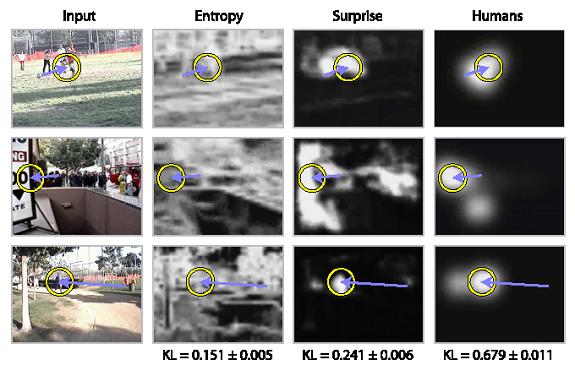
    Pierre Baldi and Laurent Itti describe a way to go about quantifying surprise. Their approach is to evaluate the Kullback-Liebler (KL) distance between the Bayesian prior and posterior probability distribution of an event. This seems to work very well.

    Using this framework we measure the extent to which humans direct their gaze towards surprising items while watching television and video games. We find that subjects are strongly attracted towards surprising locations, with 72 percent of all human gaze shifts directed towards locations more surprising than the average, a figure which rises to 84 percent when considering only gaze targets simultaneously selected by all subjects

    I especially like their "Wow" units.

    If you recall, in a previous entry, I mentionned the work of Kevin Pelphrey on gaze following deficiency in autism where he mentions:

    On congruent trials, subjects watched as a virtual actor looked towards a checkerboard that appeared in her visual field, confirming the subject's expectation regarding what the actor ‘ought to do’ in this context. On incongruent trials, she looked towards empty space, violating the subject's expectation. Consistent with a prior report from our laboratory that used this task in neurologically normal subjects, ‘errors’ (incongruent trials) evoked more activity in the STS and other brain regions linked to social cognition, indicating a strong effect of intention in typically developing subjects (n = 9). The same brain regions were activated during observation of gaze shifts in subjects with autism (n = 10), but did not differentiate congruent and incongruent trials, indicating that activity in these regions was not modulated by the context of the perceived gaze shift.


    So somehow, the autistic subjects are not surprised by the incongruent test. Either the STS is not doing the processing of determining what a surprise is or it is paying too much attention and overwhelmed by details.
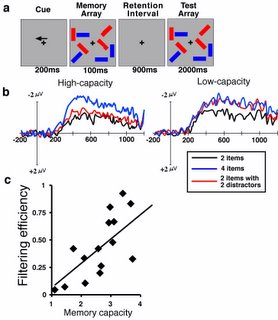
    Indeed, as shown by Edward Vogel, an assistant professor of cognitive neuroscience at the University of Oregon, it looks like awareness, or "visual working memory," depends on one's ability to filter out irrelevant information.

    Until now, it's been assumed that people with high capacity visual working memory had greater storage but actually, it's about the bouncer – a neural mechanism that controls what information gets into awareness," Vogel said.
    ....
    Working with two of his graduate students, Andrew McCollough and Maro Machizawa, Vogel recorded brain activity as people performed computer tasks asking them to remember arrays of colored squares or rectangles. In one experiment, researchers told subjects to hold in mind two red rectangles and ignore two blue ones. Without exception, high-capacity individuals excelled at dismissing blue, but low-capacity individuals held all of the rectangles in mind.

    Wednesday, November 09, 2005

    Wiping NF1 ?

    It is facinating, in a matter of four days, one hears about two drugs that could have a significant impact on neurofibromatosis (NF-1.) First there is this announcement that fumagillin could be used to dramatically shrink tumors associated with the the NF1 condition. And second, that Lovastatin, a drug used for reducing the amount of cholesterol and certain fatty substances in the blood could be used to bring back some fo the major cognitive impairements of people affected by NF1. There are other clinical trials for other drugs. This is a stunning development for what is considered a orphan disease.

    Tuesday, February 10, 2004

    On diets

    So much for the atkins diet. The worst part of the story is that you will always have people telling you that specific foods are bad or good in great quantities when one knows that one should always be on the safe side. The other part of the equation is just plain thermodynamics, one simply needs to eliminate more than one consumes. Actually, studies on animals show that the more starved (within reason) you are the longer you live

    Printfriendly