
 Liked this entry ? subscribe to Nuit Blanche's feed, there's more where that came from. You can also subscribe to Nuit Blanche by Email, explore the Big Picture in Compressive Sensing or the Matrix Factorization Jungle and join the conversations on compressive sensing, advanced matrix factorization and calibration issues on Linkedin.
Thursday, January 24, 2013
Signal reconstruction in linear mixing systems with additive error metrics (video introduction)
ITA 2013 asks its presenters for a video introduction of their talks ahead of time. Here is Dror Baron and Jin Tan's video (see also All hopes may not be crushed all at once and It's not a bad reconstruction, just the end of an illusion...)
Join the CompressiveSensing subreddit or the Google+ Community and post there !
Liked this entry ? subscribe to Nuit Blanche's feed, there's more where that came from. You can also subscribe to Nuit Blanche by Email, explore the Big Picture in Compressive Sensing or the Matrix Factorization Jungle and join the conversations on compressive sensing, advanced matrix factorization and calibration issues on Linkedin.
Liked this entry ? subscribe to Nuit Blanche's feed, there's more where that came from. You can also subscribe to Nuit Blanche by Email, explore the Big Picture in Compressive Sensing or the Matrix Factorization Jungle and join the conversations on compressive sensing, advanced matrix factorization and calibration issues on Linkedin.
Structure-Based Bayesian Sparse Reconstruction - implementation -

Sparse signal reconstruction algorithms have attracted research attention due to their wide applications in various fields. In this paper, we present a simple Bayesian approach that utilizes the sparsity constraint and a priori statistical information (Gaussian or otherwise) to obtain near optimal estimates. In addition, we make use of the rich structure of the sensing matrix encountered in many signal processing applications to develop a fast sparse recovery algorithm. The computational complexity of the proposed algorithm is relatively low compared with the widely used convex relaxation methods as well as greedy matching pursuit techniques, especially at a low sparsity rate.
Liked this entry ? subscribe to Nuit Blanche's feed, there's more where that came from. You can also subscribe to Nuit Blanche by Email, explore the Big Picture in Compressive Sensing or the Matrix Factorization Jungle and join the conversations on compressive sensing, advanced matrix factorization and calibration issues on Linkedin.Wednesday, January 23, 2013
Around the blogs in 80 summer hours

The counts for communities gravitating around Nuit Blanche are:
- Google+ Community (191),
- CompressiveSensing subreddit (69),
- LinkedIn Matrix Factorization (516)
- Gaussian Belief Propagation: Theory and Practice (81
- Robust Mathematical Modeling / Modélisation Mathématique Robuste (68)
- The Calibration Club (29)
Please, join the conversations !
Suresh tells us about an unexpected sampling gem: sampling from ℓp balls. while Vladimir let us know that Analog Devices Applies for Image Sensor Patents, yes Analog Devices. It's always CMOS baby.
we also have:
Larry: Bootstrapping and Subsampling: Part I and Review of “Antifragile” by Nassim Taleb (a.k.a. Doc Savage)
Danny: Graph Database Resources. Danny also let us know that GraphChi 2.0 is out.
MathBlogging: Mathematical Instruments: John Baez
- Correspondence Differential Ghost Imaging
- Metamaterial Apertures for Computational Imaging
- Phased Array 2013 announcement
- Fast Food: Approximating Kernel Expansion in Loglinear Time
- Where are we now ?
- Fête Parisienne in Computation, Inference and Optimization: A Young Researchers' Forum
- The #NIPS2012 Videos are out
- Compressed Sensing with Correlation Between Measurements and Noise - implementation -
- Convergence Speed of a Dynamical System for Sparse Recovery - implementation -
- SVDFeature: A Toolkit for Feature-based Collaborative Filtering - implementation -
- CSJob: Faculty at University of Wisconsin-Madison
- Agents of Change
- The Technical Side of the Nuclear Rockets Option
- All hopes may not be crushed all at once
- It's not a bad reconstruction, just the end of an illusion...
- Fast Functions via Randomized Algorithms: Linear Regression with Random Projections
- Improving Dictionary Learning: Multiple Dictionary Updates and Coefficient Reuse - implementation -
- #Spars13 announcements and clarifications
Image Credit: NASA/JPL/Space Science Institute
N00200866.jpg was taken on January 20, 2013 and received on Earth January 21, 2013. The camera was pointing toward SATURN-RINGS at approximately 552,510 miles (889,179 kilometers) away, and the image was taken using the CL1 and GRN filters.
Liked this entry ? subscribe to Nuit Blanche's feed, there's more where that came from. You can also subscribe to Nuit Blanche by Email, explore the Big Picture in Compressive Sensing or the Matrix Factorization Jungle and join the conversations on compressive sensing, advanced matrix factorization and calibration issues on Linkedin.Tuesday, January 22, 2013
Correspondence Differential Ghost Imaging
Another day. another compressive imaging instance:

Correspondence Differential Ghost Imaging by Ming-Fei Li, Yu-Ran Zhang, Kai-Hong Luo, Ling-An Wu, and Heng Fan. The abstract reads:
Experimental data with digital masks and a theoretical analysis are presented for a nonlocal imaging scheme that we name correspondence differential ghost imaging (CDGI). It is shown that by conditional averaging of the information from the reference detector but with the negative signals inverted, the quality of the reconstructed images is, in general, superior to all other ghost imaging (GI) methods to date. The advantages of both differential GI and correspondence GI are combined, plus less data and shorter computation time are required to obtain equivalent quality images under the same conditions. This CDGI method offers a general approach applicable to all GI techniques, especially when objects with continuous gray tones are involved.
 Liked this entry ? subscribe to Nuit Blanche's feed, there's more where that came from. You can also subscribe to Nuit Blanche by Email, explore the Big Picture in Compressive Sensing or the Matrix Factorization Jungle and join the conversations on compressive sensing, advanced matrix factorization and calibration issues on Linkedin.
Monday, January 21, 2013
Metamaterial Apertures for Computational Imaging

By leveraging metamaterials and compressive imaging, a low-profile aperture capable of microwave imaging without lenses, moving parts, or phase shifters is demonstrated. This designer aperture allows image compression to be performed on the physical hardware layer rather than in the postprocessing stage, thus averting the detector, storage, and transmission costs associated with full diffraction-limited sampling of a scene. A guided-wave metamaterial aperture is used to perform compressive image reconstruction at 10 frames per second of two-dimensional (range and angle) sparse still and video scenes at K-band (18 to 26 gigahertz) frequencies, using frequency diversity to avoid mechanical scanning. Image acquisition is accomplished with a 40:1 compression ratio.

the thing to keep in mind is that even our current "conventional" imaging system are already compressive of the plenoptic function (they take a 3d scene of an inifinite set of colors and make it a 2-d scene made up of a combination of three colors)

From Mark Neifeld's presentation made at the Duke-AFRL Meeting on Adaptation for Task-Specific Compressive Imaging
Liked this entry ? subscribe to Nuit Blanche's feed, there's more where that came from. You can also subscribe to Nuit Blanche by Email, explore the Big Picture in Compressive Sensing or the Matrix Factorization Jungle and join the conversations on compressive sensing, advanced matrix factorization and calibration issues on Linkedin.Sunday, January 20, 2013
Phased Array 2013 announcement
Hi Igor,
Wondering if you could help me get the word out that we've extended the abstract deadline to 2/1 and will work with those who need to await government approvals for their abstracts:Our last convention in 2010 was amazing! Approximately 500 attendees, 200 papers, and nearly 40% of attendees were from Europe. Should be a good time again this year.If any of your readers want to e-mail me directly about this they can feel free to do so, i will reply to every message: charvatg@gmail.com.....
Greg
Sure Greg , the readers of the blog are now aware.
Liked this entry ? subscribe to Nuit Blanche's feed, there's more where that came from. You can also subscribe to Nuit Blanche by Email, explore the Big Picture in Compressive Sensing or the Matrix Factorization Jungle and join the conversations on compressive sensing, advanced matrix factorization and calibration issues on Linkedin.Friday, January 18, 2013
Fast Food: Approximating Kernel Expansion in Loglinear Time
You probably recall Fast Functions via Randomized Algorithms: Fastfood versus Random Kitchen Sinks, well Ana at VideoLectures.net just informed me that the video of Alex Smola´s presentation is now available from the NIPS video site. We may have to wait for the presentation 9some of it is here) though. In the meantime, but here it is:

Fast Food: Approximating Kernel Expansion in Loglinear Time by Alexander Smola. Description of the talk:
The ability to evaluate nonlinear function classes rapidly is crucial for nonparametric estimation. We propose an improvement to random kitchen sinks that offers O(n log d) computation and O(n) storage for n basis functions in d dimensions without sacrificing accuracy. We show how one may adjust the regularization properties of the kernel simply by changing the spectral distribution of the projection matrix. Experiments show that we achieve identical accuracy to full kernel expansions and random kitchen sinks 100x faster with 1000x less memory.
Liked this entry ? subscribe to Nuit Blanche's feed, there's more where that came from. You can also subscribe to Nuit Blanche by Email, explore the Big Picture in Compressive Sensing or the Matrix Factorization Jungle and join the conversations on compressive sensing, advanced matrix factorization and calibration issues on Linkedin.Where are we now ?
Here is what I gleaned in the past two days that ought to give us a snapshot of what's coming and what it is we do not know.
In the same vein, I don't know what Kool-aid the folks at TechCrunch are drinking but it does wonders: Here are two unconnected headlines
Tim Gowers let us know that he is joining the good guys in that there is a group in Grenoble, that has institutional support and is willing to go after this arxiv-overlay idea. We mentioned this idea here previously because this is the only way post peer review publishing can gain some traction and eventually become the norm. (h/t Thomas)
In the same vein, I don't know what Kool-aid the folks at TechCrunch are drinking but it does wonders: Here are two unconnected headlines
We mentioned the passing of Aaron Swartz recently (Agents of Change), Philip Greenspun states correctly the central question of this case Can we get government out of the copyright enforcement business?
If you recall Predicting the Future: The Steamrollers and its attendant part 2, you'll probably notice that a simple consequence of exome sequencing and dirt cheap sequencers is the very new capability to identify and even cure first what used to be called orphan diseases (Researchers Study Mystery of the Toddler Who Won't Grow). Cheap sequencing means the ability to pinpoint more rapidly genes that are outside of some "normal" envelope. It sounds plausible that some of these orphan diseases might be attended to faster than some more common ones. In the same vein, Brian tells us why CCD sensors will become obsolete. We are not surprised, (Do not mess with CMOS)
But as advanced as we think we are, we still don't know how batteries really work (Grounded Boeing 787 Dreamliners Use Batteries Prone to Overheating), we slowly realize that our fear is our worst enemy ( Fukushima's Fallout of Fear) but that it is still the way we do business (Germany Repatriating Gold From NY, Paris 'In Case Of A Currency Crisis'), that some disease for which phenotype classification is extremely hard (On the difficulty of Autism diagnosis: Can we plot this better ?) yields very different outcomes (Can Some Children 'Lose' Autism Diagnosis? New Evidence Says Yes) and that sometimes we don't know shit but we certainly ought to.
Finally, group testing (a subset of compressive sensing) that is one of the first problem looked at for delineating what works and what doesn't in agriculture and the basis of much statistical theory, may soon get a boost by the gathering of more data (Kickstarting an Internet-of-Things for your garden). Rapsberry, the new 35$ computer is getting to use Python (Pi-A-Sketch code review) and 3D printing is on collision course with many societal issues (NY Congressman Introducing Ban On 3D-Printed High Capacity Gun Magazines), which also include copyrights....
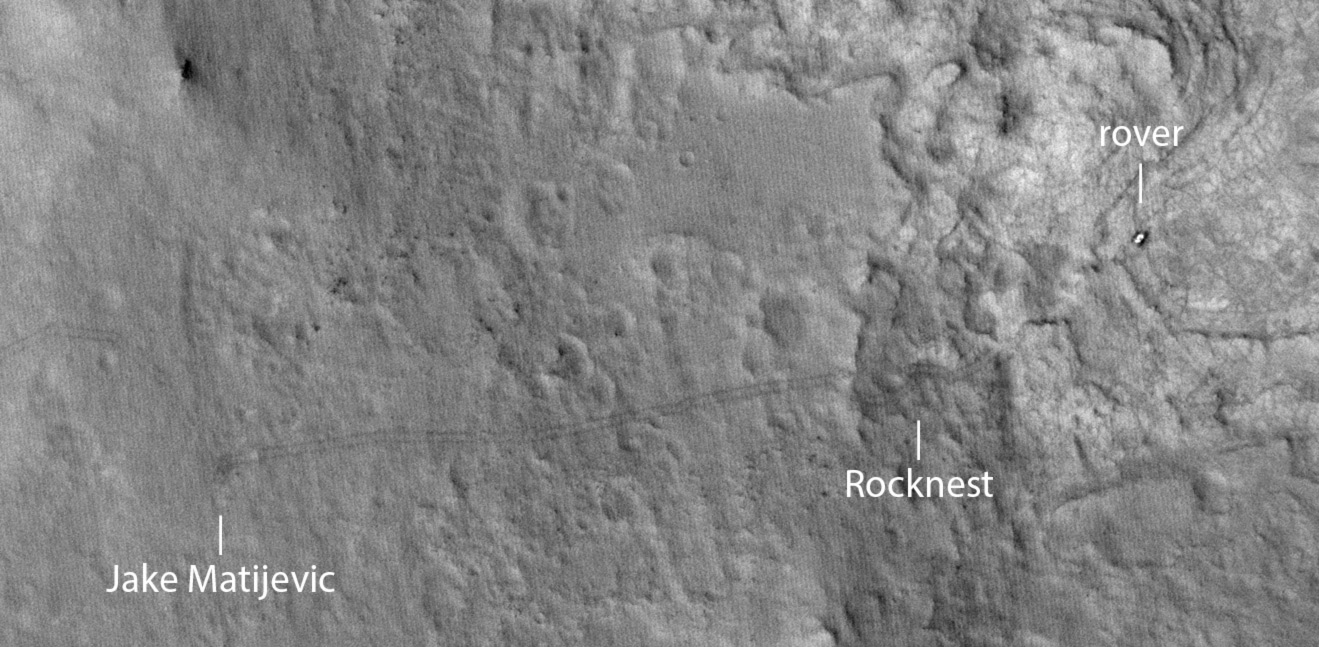
Meantime, on Mars, Hirise took a photo of Curiosity and its tracks (Pretty picture: new HiRISE view of Curiosity, sol 145). wow.
|utmccn=(direct)|utmcmd=(none)&__utmv=-&__utmk=198284911)
Thursday, January 17, 2013
Fête Parisienne in Computation, Inference and Optimization: A Young Researchers' Forum
Francis Bach just sent me the following:
Sure Francis ! Here is the announcement:
Join the CompressiveSensing subreddit or the Google+ Community and post there !
Liked this entry ? subscribe to Nuit Blanche's feed, there's more where that came from. You can also subscribe to Nuit Blanche by Email, explore the Big Picture in Compressive Sensing or the Matrix Factorization Jungle and join the conversations on compressive sensing, advanced matrix factorization and calibration issues on Linkedin.
Hi Igor,
Mike Jordan and I are organizing a workshop that may be of interest to the Nuit Blanche community. Could you feature it in your blog?
Thanks!
Francis
Sure Francis ! Here is the announcement:
Fête Parisienne in Computation, Inference and Optimization: A Young Researchers' ForumOne-day workshop, March 20, 2013, at IHES, Bures-sur-Yvette, France Organized by Francis Bach (INRIA - ENS) and Michael Jordan (U.C. Berkeley)Many modern data analysis problems lead to inference based on high-dimensional structured models, typically with large amounts of observed data. In these situations, often referred to as "Big Data" problems, computation, inference and optimization need to be studied together.The workshop will focus on various facets of this challenging problem.The emerging links among the computational and inferential disciplines have led to the emergence of a new generation of researchers whoseapproach is multi-disciplinary: this workshop aims to highlight their recent work and bring together international participants who wish to contribute to further developments.The workshop will be held on March 20, 2013, at the Institute des Hautes Etudes Scientifiques (http://www.ihes.fr/), located in Bures-sur-Yvette, close to Paris. It will be composed of talks by the following invited speakers as well as a lunch-time poster session.
- Sylvain Arlot (CNRS - Ecole Normale Supérieure)
- Francois Caron (INRIA Bordeaux - Sud-Ouest)
- Nicolas Chopin (CREST - ENSAE)
- Aurélien Garivier (Institut Mathématique de Toulouse, Université Paul Sabatier)
- Zaid Harchaoui (INRIA Grenoble - Rhône-Alpes)
- Guillaume Obozinski (Ecole des Ponts - Paristech)
- Igor Prünster (University of Torino)
- Peter Richtarik (University of Edinburgh)
- Aarti Singh (Carnegie Mellon University)
- Yee Whye Teh (Oxford University)
Participants have to registered on the workshop website
(http://www.ihes.fr/jsp/site/Portal.jsp?document_id=3270&portlet_id=14)
that contains all details regarding the meeting.
Liked this entry ? subscribe to Nuit Blanche's feed, there's more where that came from. You can also subscribe to Nuit Blanche by Email, explore the Big Picture in Compressive Sensing or the Matrix Factorization Jungle and join the conversations on compressive sensing, advanced matrix factorization and calibration issues on Linkedin.The #NIPS2012 Videos are out

Videolectures came through earlier than last year. woohoo! Presentations relevant to Nuit Blanche were featured earlier here. Videos for the presentations for the Posner Lectures, Invited Talks and Oral Sessions of the conference are here. Videos for the presentations for the different Workshops are here. Some videos are not available because the presenters have not given their permission to the good folks at Videolectures. If you know any of them, let them know the world is waiting.
Liked this entry ? subscribe to Nuit Blanche's feed, there's more where that came from. You can also subscribe to Nuit Blanche by Email, explore the Big Picture in Compressive Sensing or the Matrix Factorization Jungle and join the conversations on compressive sensing, advanced matrix factorization and calibration issues on Linkedin.
Subscribe to:
Posts (Atom)