Saturday, November 12, 2016

Saturday Morning Video: Random Projections for Probabilistic Inference, Stefano Ermon


Here is another talk given at the Uncertainty in Computation workshop at the Simons Institute
 
Probabilistic inference in high-dimensional probabilistic models (i.e., with many variables) is one of the central problems of statistical machine learning and stochastic decision making. To date, only a handful of distinct methods have been developed, most notably (MCMC) sampling, decomposition, and variational methods. In this talk, I will introduce a new approach where random projections are used to simplify a high-dimensional model while preserving some of its key properties. These random projections can be combined with traditional variational inference methods (information projections) and combinatorial optimization tools. These novel randomized approaches provide provable guarantees on the accuracy, and outperform traditional methods in a range of domains.
Recent papers by Stefano include

  1. Xiaoyue Duan, Feifei Yang, Erin Antono, Wenge Yang, Piero Pianetta, Stefano Ermon, Apurva Mehta, Yijin Liu.
    Unsupervised Data Mining in Nanoscale X-ray Spectro-Microscopic Study of NdFeB Magnet [PDF]
    Scientific Reports. Scientific Reports, 6, 34406, 2016.
  2. Neal Jean, Marshall Burke, Michael Xie, Matthew Davis, David Lobell, Stefano Ermon
    Combining Satellite Imagery and Machine Learning to Predict Poverty [PDF] [Project Website] [Commentary] [Nature Research Highlights] [Code]
    Science. Science, 353(6301), 790-794, 2016.
  3. Jonathan Ho, Stefano Ermon
    Generative Adversarial Imitation Learning [PDF]
    NIPS-16. In Proc. 30th Annual Conference on Neural Information Processing Systems, December 2016.
  4. Aditya Grover, Stefano Ermon
    Variational Bayes on Monte Carlo Steroids [PDF]
    NIPS-16. In Proc. 30th Annual Conference on Neural Information Processing Systems, December 2016.
  5. Shengjia Zhao, Enze Zhou, Ashish Sabharwal, Stefano Ermon
    Adaptive Concentration Inequalities for Sequential Decision Problems [PDF]
    NIPS-16. In Proc. 30th Annual Conference on Neural Information Processing Systems, December 2016.
  6. Yexiang Xue, Zhiyuan Li, Stefano Ermon, Carla Gomes, Bart Selman
    Solving Marginal MAP Problems with NP Oracles and Parity Constraints [PDF]
    NIPS-16. In Proc. 30th Annual Conference on Neural Information Processing Systems, December 2016.
  7. Mitchell McIntire, Daniel Ratner, Stefano Ermon
    Sparse Gaussian Processes for Bayesian Optimization [PDF]
    UAI-16.
  8. Jonathan Ho, Jayesh Gupta, Stefano Ermon
    Model-Free Imitation Learning with Policy Optimization [PDF]
    ICML-16. In Proc. 33rd International Conference on Machine Learning, 2016.
  9. Yexiang Xue, Stefano Ermon, Ronan Le Bras, Carla Gomes, Bart Selman
    Variable Elimination in the Fourier Domain [PDF]
    ICML-16. In Proc. 33rd International Conference on Machine Learning, 2016.
  10. Steve Mussmann, Stefano Ermon
    Learning and Inference via Maximum Inner Product Search [PDF]
    ICML-16. In Proc. 33rd International Conference on Machine Learning, 2016.
  11. Tudor Achim, Ashish Sabharwal, Stefano Ermon
    Beyond Parity Constraints: Fourier Analysis of Hash Functions for Inference [PDF]
    ICML-16. In Proc. 33rd International Conference on Machine Learning, 2016.
  12. Lun-Kai Hsu, Tudor Achim, Stefano Ermon
    Tight Variational Bounds via Random Projections and I-Projections [PDF]
    AISTATS-16.
  13. Michael Xie, Neal Jean, Marshall Burke, David Lobell, Stefano Ermon
    Transfer Learning from Deep Features for Remote Sensing and Poverty Mapping [PDF] [Stanford Report] [NYTimes]
    AAAI-16. In Proc. 30th AAAI Conference on Artificial Intelligence, 2016.
  14. Shengjia Zhao, Sorathan Chaturapruek, Ashish Sabharwal, Stefano Ermon
    Closing the Gap Between Short and Long XORs for Model Counting [PDF] [Code]
    AAAI-16. In Proc. 30th AAAI Conference on Artificial Intelligence, 2016.
  15. Carolyn Kim, Ashish Sabharwal, Stefano Ermon
    Exact Sampling with Integer Linear Programs and Random Perturbations [PDF] [Code]
    AAAI-16. In Proc. 30th AAAI Conference on Artificial Intelligence, 2016.


Join the CompressiveSensing subreddit or the Google+ Community or the Facebook page and post there !
Liked this entry ? subscribe to Nuit Blanche's feed, there's more where that came from. You can also subscribe to Nuit Blanche by Email, explore the Big Picture in Compressive Sensing or the Matrix Factorization Jungle and join the conversations on compressive sensing, advanced matrix factorization and calibration issues on Linkedin.

Saturday Morning Video: Error error error correcting correcting correcting codes codes codes, Mary Wootters


 Error error error correcting correcting correcting codes codes codes by Mary Wootters 
The abstract reads:

Abstract: Suppose you wish to send a message, but you know that whatever you say will get slightly garbled before it reaches the recipient. What should you do? You'd like to add some redundancy, to make sure you are understood despite the errors. For example, as in the title of this talk, if you repeat yourself enough times, probably the message will get through. But there are other ways to add redundancy. For example, the English language has a lot of redundancy built in: u can prbably undrstnd ths sentnce, evn tho mny lettrs r mssing. In this talk, we'll explore some more principled ways of adding redundancy, which are ubiquitous in modern communication and storage systems: the use of error-correcting codes. We'll introduce error-correcting codes and discuss the basic theory behind them, and we'll see how they can be used to do a much better job protecting communication from errors than the title of this talk does.
 connection to compressive sensing is mentionned in the QA at 55 minutes into the talk.

Mary's recent work include:

Drafts/ Manuscripts

One-bit compressed sensing of dictionary-sparse signals.
Richard Baraniuk, Simon Foucart, Deanna Needell, Yaniv Plan, Mary Wootters.
[ arXiv ]

Biological screens from linear codes: theory and tools.
Yaniv Erlich, Anna Gilbert, Hung Ngo, Atri Rudra, Nicolas Thierry-Mieg, Mary Wootters, Dina Zielinski, Or Zuk.
[ biorXiv ]


Exponential decay of reconstruction error from binary measurements of sparse signals.
Richard Baraniuk, Simon Foucart, Deanna Needell, Yaniv Plan, Mary Wootters.
[ PDF ][ arXiv ]

Journal Publications

Local correctibility of expander codes.
Brett Hemenway, Rafail Ostrovsky, and Mary Wootters.
Information and Computation (2015). 
ICALP 2013 special issue.

One-Bit Matrix Completion.  
Mark A. Davenport, Yaniv Plan, Ewout van den Berg, and Mary Wootters.  
Information and Inference (2014).
[ arXiv ][ journal version ][ bibTeX ]

On optimal entanglement assisted one-shot classical communication. 
Brett Hemenway, Carl A. Miller, Yaoyun Shi, and Mary Wootters.  
Physical Review A, 87, 062301 (2013).

Conference and Workshop Publications


2016.

Repairing Reed-Solomon Codes.
Venkatesan Guruswami and Mary Wootters.
STOC 2016, to appear.
[ arXiv ]

Strategic Classification.
Moritz Hardt, Nimrod Megiddo, Christos Papadimitriou, Mary Wootters.
ITCS 2016.
[ arXiv ]

2015.

Linear-time list recovery of high-rate expander codes.
Brett Hemenway and Mary Wootters.
ICALP 2015, to appear.
Invited to ICALP 2015's special issue of Information and Computation.
[ arXiv ]

It'll probably work out: improved list-decoding through random operations.
Atri Rudra and Mary Wootters.
ITCS 2015.  
[ PDF ][ arXiv ]


Join the CompressiveSensing subreddit or the Google+ Community or the Facebook page and post there !
Liked this entry ? subscribe to Nuit Blanche's feed, there's more where that came from. You can also subscribe to Nuit Blanche by Email, explore the Big Picture in Compressive Sensing or the Matrix Factorization Jungle and join the conversations on compressive sensing, advanced matrix factorization and calibration issues on Linkedin.

Friday, November 11, 2016

ICLR2017: Identity and Invariance

Identity reproduction (Sunday Morning Insight: A Quick Panorama of Sensing from Direct Imaging to Machine Learning) and invariance are very important topics in engineering and science. It is therefore no surprise these themes appear in models trying to figure out the world. Here are a few I noticed in the the 500 submissions at the ICLR 2017 conference that are in the open review process.


Join the CompressiveSensing subreddit or the Google+ Community or the Facebook page and post there !
Liked this entry ? subscribe to Nuit Blanche's feed, there's more where that came from. You can also subscribe to Nuit Blanche by Email, explore the Big Picture in Compressive Sensing or the Matrix Factorization Jungle and join the conversations on compressive sensing, advanced matrix factorization and calibration issues on Linkedin.

Thursday, November 10, 2016

Stochastic CoSaMP: Randomizing Greedy Pursuit for Sparse Signal Recovery


Dipan just sent me the following:

Hi Igor,

I had contacted you a while back regarding this. I m pleased to bring to your attention some of our recent work on randomizing a greedy pursuit for sparse signal recovery published at ECML-PKDD 2016. We specifically focus on CoSaMP and introduce a simple modification to the algorithm leading to Stochastic CoSaMP. The modification although looks simple, we believe, has far reaching consequences, leading to gains in both performance and computation time.

Here is the Springer link
http://link.springer.com/chapter/10.1007/978-3-319-46128-1_48
And here is the link to the free version hosted on my website:
https://dkpal.github.io/StoCoSaMP_cameraready.pdf


And here is the abstract:

In this paper, we formulate the K-sparse compressed signal recovery problem with the L0 norm within a Stochastic Local Search (SLS) framework. Using this randomized framework, we generalize the popular sparse recovery algorithm CoSaMP, creating Stochastic CoSaMP (StoCoSaMP). Interestingly, our deterministic worst case analysis shows that under the Restricted Isometric Property (RIP), even a purely random version of StoCoSaMP is guaranteed to recover a notion of strong components of a sparse signal, thereby leading to support convergence. Empirically, we find that StoCoSaMP outperforms CoSaMP, both in terms of signal recoverability and computational cost, on different problems with up to 1 million dimensions. Further, StoCoSaMP outperforms several other popular recovery algorithms, including StoGradMP and StoIHT, on large real-world gene-expression datasets.


We hope that your subscribers might find the work useful, and we look forward to your response.

Best
Dipan K. Pal
Thanks Dipal !

Wednesday, November 09, 2016

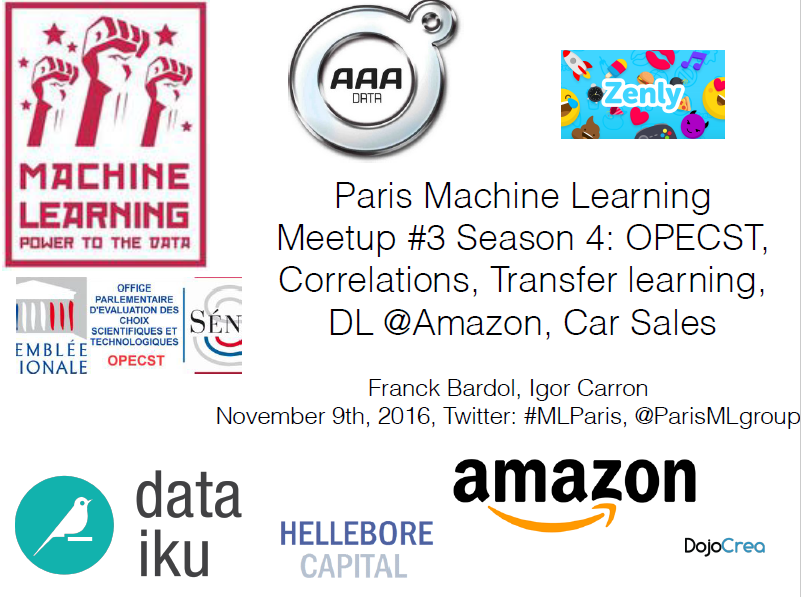
Paris Machine Learning Meetup #3 Season 4: OPECST, Correlations, Transfer Learning, DL @Amazon, Car Sales


Video of the streaming is here:
 

The meetup will be hosted by AAA-data / Comité des Constructeurs Français d'Automobiles and the networking event is sponsored by Zen.ly . A big thank you to them.

The program for this third regular meetup of the season (and the fifth total for season 4) is a little extraordinary this time and will feature the following:


You may have already read many times that the job of a Data Scientist is to skim through a huge amount of data searching for correlations between some variables of interest. And also, that one of his worst enemies (besides correlation doesn't imply causation) is spurious correlation. But what really is correlation? Are there several types of correlations? Some "good", some "bad"? What about their estimation? This talk will be a very visual presentation around the notion of correlation and dependence. I will first illustrate how the standard linear correlation is estimated (Pearson coefficient), then some more robust alternative: the Spearman coefficient. Building on the geometric understanding of their nature, I will present a generalization that can help Data Scientists to explore, interpret, and measure the dependence (not necessarily linear or comonotonic) between the variables of a given dataset. Financial time series (stocks, credit default swaps, fx rates), and features from the UCI datasets are considered as use cases. 

Dataiku recently worked on an e-business vacation retailer recommender system based on users' previously visited products. We created a meta model on top of classical recommender system that generated an increase of 7% in revenue during the A/B test. For this type of business, the content of the product image is paramount. The next step was obviously to add image information in the recommender. The key take away is this: you don’t need a deep learning expert to solve the tagging problem. Because labeled datasets and corresponding pre-trained neural network are available on the Internet, you can use “transfer learning” and map your problem to an existing one. The post processing step consists in grouping labels to get features associated to more global visual themes. For instance, "theme beach" = coast + ocean + sandbar. We use them to recommend customer personalized products or to address marketing issues such as : what kind of image should I propose for this product?

La base de données AAA DATA comptabilise plus de 300 millions d’événements avérés avec un historique unique de plus de 15 ans qui permet de valider la solution prédictive proposée à ses clients. Le challenge a été d’appliquer du machine learning sur ces 300 millions d’événements


Join the CompressiveSensing subreddit or the Google+ Community or the Facebook page and post there !
Liked this entry ? subscribe to Nuit Blanche's feed, there's more where that came from. You can also subscribe to Nuit Blanche by Email, explore the Big Picture in Compressive Sensing or the Matrix Factorization Jungle and join the conversations on compressive sensing, advanced matrix factorization and calibration issues on Linkedin.

Tuesday, November 08, 2016

An Interesting Policy Event Tomorrow at the Paris Machine Learning meetup

So tomorrow, the Paris Machine Learning meetup will host the third regular meetup of the season (and the fifth overall for this season). As usual we will feature several technical presentations and we will also have an introduction to the current work by the "Office parlementaire d'évaluation des choix scientifiques et technologiques (OPECST)" of the French Parliament by none other than a former minister and current Senator Dominique Gillot. The bipartisan commission (OPECST) was tasked by the French Parliament to do a report on Artificial Intelligence and they are coming to the meetup as part of their fact finding mission. Here is a generic introduction of the work being asked from the commission:
La commission étudie l'état de la recherche en intelligence artificielle et en technologies informatiques, les opportunités et les risques que représentent l’accélération des techniques d'IA, les relations entre recherche publique et recherche privée, ainsi que les enjeux éthiques, économiques, éducatifs et juridiques de l’intelligence artificielle. 

Pour celles et ceux qui ne pourraient pas parler à la sénatrice, un questionnaire en ligne est disponible et les réponses seront adressées aux deux rapporteurs et à l'administrateur qui suit le dossier IA.


 As the Chinese say, may we live in interesting times.
Join the CompressiveSensing subreddit or the Google+ Community or the Facebook page and post there !
Liked this entry ? subscribe to Nuit Blanche's feed, there's more where that came from. You can also subscribe to Nuit Blanche by Email, explore the Big Picture in Compressive Sensing or the Matrix Factorization Jungle and join the conversations on compressive sensing, advanced matrix factorization and calibration issues on Linkedin.
Monday, November 07, 2016

ICLR 2017: Lighter Networks


So the ICLR 2017 conference has garnered about 500 submissions and they are in the open review process. Here are few within the generic theme of "How do we change the architecture of Deep Learning models so that they can better fit other metrics such as lighter architecture" or more succintly Mapping ML to Hardware. I went through the submissions and looked at the titles and some abstracts so I am surely missing a few (kind feedback is welcome). Anyway, tonight will be a reading Nuit Blanche for sure. 


Credit photo: Image Credit: NASA/JPL-Caltech/Space Science Institute
Image of SATURN

W00101892.jpg was taken on 2016-11-04 17:39 (UTC) and received on Earth 2016-11-06 00:39(UTC). The camera was pointing toward SATURN, and the image was taken using the MT3 and CL2filters. This image has not been validated or calibrated. A validated/calibrated image will be archived with the NASA Planetary Data System.


Join the CompressiveSensing subreddit or the Google+ Community or the Facebook page and post there !
Liked this entry ? subscribe to Nuit Blanche's feed, there's more where that came from. You can also subscribe to Nuit Blanche by Email, explore the Big Picture in Compressive Sensing or the Matrix Factorization Jungle and join the conversations on compressive sensing, advanced matrix factorization and calibration issues on Linkedin.

Sunday, November 06, 2016

Sunday Morning Insight: The Clear and Present Dangers


There is a scene in Tom Clancy's book turned into the movie "Clear and Present Danger" that struck with me when I first watched it. It goes like this. The whole intrigue of the movie starts with this exchange:
James Cutter: Are you suggesting a course of action, sir?
The President: The course of action I'd suggest is a course of action I can't suggest.
James Cutter:I'm... not sure where that leaves us.
The President: These drug cartels represent a clear and present danger to the national security of the United States.
Every once in while you are asked questions about why are doing this or why are you doing that. The only answer expected from you is the small answer, the go-along-with-the-show answer when in fact, all along, you want to talk about the big things and you know that some of them will scare people. But then after a few seconds, you think that it will be counterproductive and the words eventually coming out of your mouth say the small things. You might have averted a long discussion in the short term but saying the big things might trigger a different journey altogether. 


Join the CompressiveSensing subreddit or the Google+ Community or the Facebook page and post there !

Friday, November 04, 2016

Lets keep it simple: using simple architectures to outperform deeper architectures

I wanted to include more ICLR 2017 submissions  with the following paper as regards to how we should size neural networks, but as the deadline nears, the website is not responsive. I'll get back to some of these submissions later. In the meantime, here is this very interesting paper. The second section is a great summary of where we stand in terms of architectures. Enjoy ! (And good luck for those of you frantically submitting to ICLR).


Lets keep it simple: using simple architectures to outperform deeper architectures by Seyyed Hossein HasanPour, Mohammad Rouhani, Javad Vahidi

In recent years, all winning architectures that achieved state of the art results have been very deep and had parameters ranging from tens to hundreds of millions. While an optimal depth has yet to be discovered, it is known that these deep architectures are far from being optimal. Very deep and heavy architecture such as VGGNet, GoogleNet, ResNet and the likes, are very demanding in terms of hardware requirements, and so their practical use has become very limited and costly. The computational and memory overhead caused by such architectures has a negative effect on the expansion of methods and applications utilizing deep architectures. In order to overcome this issues, some thinned architectures such as Squeezenet are proposed that are computationally light-weight and useful for embedded systems. However their usage is also hindered by the low accuracy they provide. While deep architectures do provide good accuracy, we empirically show that a well-crafted yet simple and reasonably deep architecture can equally perform. This allows for more practical uses, especially in embed systems, or systems with computational and memory limitations. In this work, we present a very simple fully convolutional network with 13 layers that outperforms almost all deeper architectures to date such as ResNet, GoogleNet,WRN, etc with 2 to 25 times fewer number of parameters, and rarely when it does not supersede an architecture, it performs on par. We achieved state of the art results and very close to it on datasets such as CIFAR10/100, MNIST and SVHN with simple or no data-augmentation.


Join the CompressiveSensing subreddit or the Google+ Community or the Facebook page and post there !
Liked this entry ? subscribe to Nuit Blanche's feed, there's more where that came from. You can also subscribe to Nuit Blanche by Email, explore the Big Picture in Compressive Sensing or the Matrix Factorization Jungle and join the conversations on compressive sensing, advanced matrix factorization and calibration issues on Linkedin.

Printfriendly