Friday, October 07, 2016

Course: Stat212b: Topics Course on Deep Learning by Joan Bruna, UC Berkeley, Stats Department. Spring 2016.

Joan Bruna released the detailed syllabus and lectures of his recent Stat212b: Topics Course on Deep Learning that he did at UC Berkeley in the Statistics Department during the Spring 2016. From the page:
 

Topics in Deep Learning

This topics course aims to present the mathematical, statistical and computational challenges of building stable representations for high-dimensional data, such as images, text and audio. We will delve into selected topics of Deep Learning, discussing recent models from both supervised and unsupervised learning. Special emphasis will be on convolutional architectures, invariance learning, unsupervised learning and non-convex optimization.

Detailed Syllabus and Lectures


Join the CompressiveSensing subreddit or the Google+ Community or the Facebook page and post there !
Liked this entry ? subscribe to Nuit Blanche's feed, there's more where that came from. You can also subscribe to Nuit Blanche by Email, explore the Big Picture in Compressive Sensing or the Matrix Factorization Jungle and join the conversations on compressive sensing, advanced matrix factorization and calibration issues on Linkedin.

Thursday, October 06, 2016

The Famine of Forte: Few Search Problems Greatly Favor Your Algorithm

From the conclusion of the paper:
The search framework we propose is general enough to be applied to many problem areas, such as machine learning, evolutionary search, security and hyperparameter optimization. The results are not just of theoretical importance, but help explain real-world phenomena, such as the need for exploitable dependence in machine learning and the empirical diffi culty of automated learning [12]. Our results help us understand the growing popularity of deep learning methods and unavoidable interest in automated hyperparameter tuning methods. Extending the framework to continuous settings and other problem areas (such as active learning and regression) is the focus of ongoing research.


The Famine of Forte: Few Search Problems Greatly Favor Your Algorithm by George D. Montanez

No Free Lunch theorems show that the average performance across any closed-under-permutation set of problems is fixed for all algorithms, under appropriate conditions. Extending these results, we demonstrate that the proportion of favorable problems is itself strictly bounded, such that no single algorithm can perform well over a large fraction of possible problems. Our results explain why we must either continue to develop new learning methods year after year or move towards highly parameterized models that are both flexible and sensitive to their hyperparameters.


Join the CompressiveSensing subreddit or the Google+ Community or the Facebook page and post there !
Liked this entry ? subscribe to Nuit Blanche's feed, there's more where that came from. You can also subscribe to Nuit Blanche by Email, explore the Big Picture in Compressive Sensing or the Matrix Factorization Jungle and join the conversations on compressive sensing, advanced matrix factorization and calibration issues on Linkedin.

Wednesday, October 05, 2016

Universal microbial diagnostics using random DNA probes

Using compressive sensing for pathogen detection.


Universal microbial diagnostics using random DNA probes by Amirali Aghazadeh, Adam Y. Lin, Mona A. Sheikh, Allen L. Chen, Lisa M. Atkins, Coreen L. Johnson, Joseph F. Petrosino, Rebekah A. Drezek and  Richard G. Baraniuk

Early identification of pathogens is essential for limiting development of therapy-resistant pathogens and mitigating infectious disease outbreaks. Most bacterial detection schemes use target-specific probes to differentiate pathogen species, creating time and cost inefficiencies in identifying newly discovered organisms. We present a novel universal microbial diagnostics (UMD) platform to screen for microbial organisms in an infectious sample, using a small number of random DNA probes that are agnostic to the target DNA sequences. Our platform leverages the theory of sparse signal recovery (compressive sensing) to identify the composition of a microbial sample that potentially contains novel or mutant species. We validated the UMD platform in vitro using five random probes to recover 11 pathogenic bacteria. We further demonstrated in silico that UMD can be generalized to screen for common human pathogens in different taxonomy levels. UMD’s unorthodox sensing approach opens the door to more efficient and universal molecular diagnostics.


Join the CompressiveSensing subreddit or the Google+ Community or the Facebook page and post there !
Liked this entry ? subscribe to Nuit Blanche's feed, there's more where that came from. You can also subscribe to Nuit Blanche by Email, explore the Big Picture in Compressive Sensing or the Matrix Factorization Jungle and join the conversations on compressive sensing, advanced matrix factorization and calibration issues on Linkedin.

Tuesday, October 04, 2016

Thesis: Faster algorithms for convex and combinatorial optimization by Yin Tat Lee.

Congratulations Dr. Lee !

Here is some amazing work: Faster algorithms for convex and combinatorial optimization  by Yin Tat Lee.
In this thesis, we revisit three algorithmic techniques: sparsification, cutting and collapsing. We use them to obtain the following results on convex and combinatorial optimization: 
  • Linear Programming: We obtain the first improvement to the running time for linear programming in 25 years. The convergence rate of this randomized algorithm nearly matches the universal barrier for interior point methods. As a corollary, we obtain the first ... time randomized algorithm for solving the maximum flow problem on directed graphs with m edges and n vertices. This improves upon the previous fastest running time of achieved over 15 years ago by Goldberg and Rao. 
  • Maximum Flow Problem: We obtain one of the first almost-linear time randomized algorithms for approximating the maximum flow in undirected graphs. As a corollary, we improve the running time of a wide range of algorithms that use the computation of maximum flows as a subroutine. 
  • Non-Smooth Convex Optimization: We obtain the first nearly-cubic time randomized algorithm for convex problems under the black box model. As a corollary, this implies a polynomially faster algorithm for three fundamental problems in computer science: submodular function minimization, matroid intersection, and semidefinite programming.
  • Graph Sparsification: We obtain the first almost-linear time randomized algorithm for spectrally approximating any graph by one with just a linear number of edges. This sparse graph approximately preserves all cut values of the original graph and is useful for solving a wide range of combinatorial problems. This algorithm improves all previous linear-sized constructions, which required at least quadratic time. 
  • Numerical Linear Algebra: Multigrid is an efficient method for solving large-scale linear systems which arise from graphs in low dimensions. It has been used extensively for 30 years in scientific computing. Unlike the previous approaches that make assumptions on the graphs, we give the first generalization of the multigrid that provably solves Laplacian systems of any graphs in nearly-linear expected time.
Yin Tat's publications are here.


Join the CompressiveSensing subreddit or the Google+ Community or the Facebook page and post there !
Liked this entry ? subscribe to Nuit Blanche's feed, there's more where that came from. You can also subscribe to Nuit Blanche by Email, explore the Big Picture in Compressive Sensing or the Matrix Factorization Jungle and join the conversations on compressive sensing, advanced matrix factorization and calibration issues on Linkedin.

Fastfood Dictionary Learning for Periocular-Based Full Face Hallucination

Inpainting with FastFood. I put the faces reconstructed from the slides presentation because our discriminative human vision is far more informative at devising how good this technique is than any figure of merit.
  
Fastfood Dictionary Learning for Periocular-Based Full Face Hallucination by Felix Juefei-Xu and Marios Savvides
The kernel trick becomes a burden for some machine learning tasks such as dictionary learning, where a huge amount of training samples are needed, making the kernel matrix gigantic and infeasible to store or process. In this work, we propose to alleviate this problem and achieve Gaussian RBF kernel expansion explicitly for dictionary learning using Fastfood transform, which is an approximation of full kernel expansion. We have shown, in the context of missing data recovery through joint dictionary learning i.e. periocular-based full face hallucination, that the approximated kernel expansion using Fastfood transform for joint dictionary learning yields much better results than its image space counterparts. Also, explicit kernel expansion through Fastfood allows us to de-kernelize the reconstructed image in the feature space back to the image space, enabling applications that require reconstructive dictionaries such as cross-domain reconstruction, image super-resolution, missing data recovery, etc.
Slides are also available.


Join the CompressiveSensing subreddit or the Google+ Community or the Facebook page and post there !
Liked this entry ? subscribe to Nuit Blanche's feed, there's more where that came from. You can also subscribe to Nuit Blanche by Email, explore the Big Picture in Compressive Sensing or the Matrix Factorization Jungle and join the conversations on compressive sensing, advanced matrix factorization and calibration issues on Linkedin.

Sunday, October 02, 2016

Nuit Blanche in Review (September 2016)

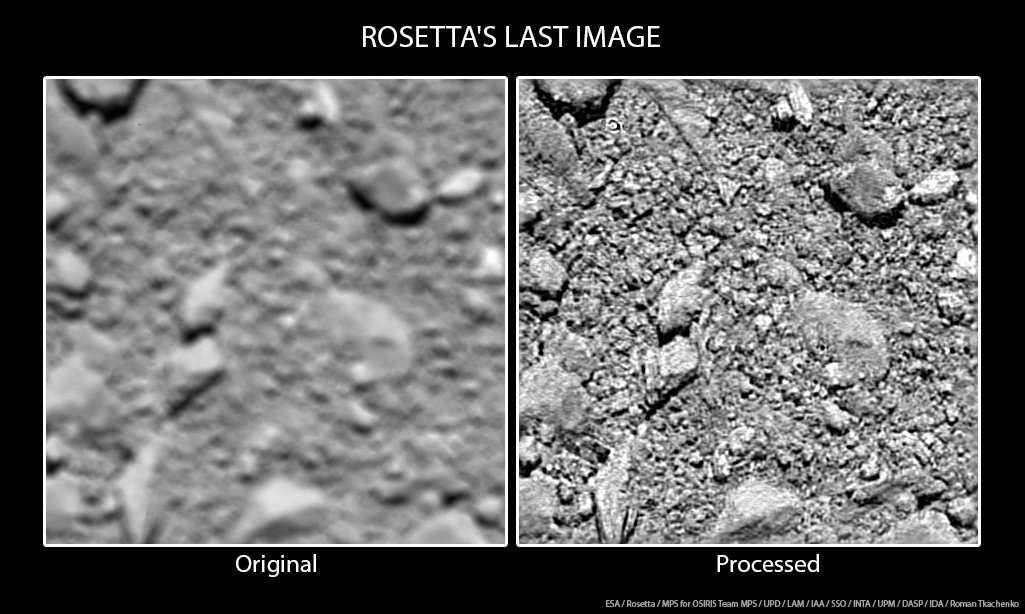
Since the last Nuit Blanche in Review (August 2016), Rosetta landed on a comet but we also had three Paris Machine Learning meetups, three reviews, two sunday morning insights, and many more in-depth entries. Enjoy !


In-depth:


Paris Machine Learning Meetups
Book/reviews/courses

LightOn

Hamming's time


Meetings


CfP:

Videos

Jobs:


credit: ESA, Roman Tkachenko


Join the CompressiveSensing subreddit or the Google+ Community or the Facebook page and post there !
Liked this entry ? subscribe to Nuit Blanche's feed, there's more where that came from. You can also subscribe to Nuit Blanche by Email, explore the Big Picture in Compressive Sensing or the Matrix Factorization Jungle and join the conversations on compressive sensing, advanced matrix factorization and calibration issues on Linkedin.
Friday, September 30, 2016

CfP: ESANN2017 Special sessions, 26 - 28 April 2017

 
Matthieu just sent me the following:
 
 
Dear Igor, 

I hope you are doing well. I am writing you because I would really appreciate if you could share some information which should interest your blog readers.

Gilles Delmaire, Gilles Roussel, and myself are organizing a special session on Environmental Signal Processing for the 25th European Symposium on Artificial Neural Networks, Computational Intelligence and Machine Learning (ESANN https://www.elen.ucl.ac.be/esann/) but it would be fairer to promote all the special sessions (https://www.elen.ucl.ac.be/esann/index.php?pg=specsess), as all of them may interest the Nuit Blanche readers. I think it will really be worth attending ESANN in April 2017, in the magnificent city of Brugge!
All the special session organizers sent submission invitations to potential participants but, at least in our case, if we forget a Nuit Blanche reader who wish to submit a paper in our session, we would appreciate to be firstly contacted.
Thank you in advance for your help.
Best regards,
Matthieu
-- Matthieu PUIGT, Ph.D.
 
Thanks Matthieu ! according to the main page, prospective authors are invited to submit their contributions before 19 November 2016.

 The following special sessions will be organized at ESANN2017:
 
 
 Photo Copyright ESA/Rosetta/MPS for OSIRIS Team MPS/UPD/LAM/IAA/SSO/INTA/UPM/DASP/IDA
 
 
Join the CompressiveSensing subreddit or the Google+ Community or the Facebook page and post there !
Liked this entry ? subscribe to Nuit Blanche's feed, there's more where that came from. You can also subscribe to Nuit Blanche by Email, explore the Big Picture in Compressive Sensing or the Matrix Factorization Jungle and join the conversations on compressive sensing, advanced matrix factorization and calibration issues on Linkedin.

L1-PCA, Online Sparse PCA and Discretization and Minimization of the L1 Norm on Manifolds

Coming back to some of the themes around Matrix Factorizations, the L1 norm and phase transitions:


Iteratively Reweighted Least Squares Algorithms for L1-Norm Principal Component Analysis by Young Woong Park, Diego Klabjan
Principal component analysis (PCA) is often used to reduce the dimension of data by selecting a few orthonormal vectors that explain most of the variance structure of the data. L1 PCA uses the L1 norm to measure error, whereas the conventional PCA uses the L2 norm. For the L1 PCA problem minimizing the fitting error of the reconstructed data, we propose an exact reweighted and an approximate algorithm based on iteratively reweighted least squares. We provide convergence analyses, and compare their performance against benchmark algorithms in the literature. The computational experiment shows that the proposed algorithms consistently perform best.


Online Learning for Sparse PCA in High Dimensions: Exact Dynamics and Phase Transitions by Chuang Wang, Yue M. Lu

We study the dynamics of an online algorithm for learning a sparse leading eigenvector from samples generated from a spiked covariance model. This algorithm combines the classical Oja's method for online PCA with an element-wise nonlinearity at each iteration to promote sparsity. In the high-dimensional limit, the joint empirical measure of the underlying sparse eigenvector and its estimate provided by the algorithm is shown to converge weakly to a deterministic, measure-valued process. This scaling limit is characterized as the unique solution of a nonlinear PDE, and it provides exact information regarding the asymptotic performance of the algorithm. For example, performance metrics such as the cosine similarity and the misclassification rate in sparse support recovery can be obtained by examining the limiting dynamics. A steady-state analysis of the nonlinear PDE also reveals an interesting phase transition phenomenon. Although our analysis is asymptotic in nature, numerical simulations show that the theoretical predictions are accurate for moderate signal dimensions.


Consistent Discretization and Minimization of the L1 Norm on Manifolds by Alex Bronstein, Yoni Choukroun, Ron Kimmel, Matan Sela

The L1 norm has been tremendously popular in signal and image processing in the past two decades due to its sparsity-promoting properties. More recently, its generalization to non-Euclidean domains has been found useful in shape analysis applications. For example, in conjunction with the minimization of the Dirichlet energy, it was shown to produce a compactly supported quasi-harmonic orthonormal basis, dubbed as compressed manifold modes. The continuous L1 norm on the manifold is often replaced by the vector l1 norm applied to sampled functions. We show that such an approach is incorrect in the sense that it does not consistently discretize the continuous norm and warn against its sensitivity to the specific sampling. We propose two alternative discretizations resulting in an iteratively-reweighed l2 norm. We demonstrate the proposed strategy on the compressed modes problem, which reduces to a sequence of simple eigendecomposition problems not requiring non-convex optimization on Stiefel manifolds and producing more stable and accurate results.


Join the CompressiveSensing subreddit or the Google+ Community or the Facebook page and post there !
Liked this entry ? subscribe to Nuit Blanche's feed, there's more where that came from. You can also subscribe to Nuit Blanche by Email, explore the Big Picture in Compressive Sensing or the Matrix Factorization Jungle and join the conversations on compressive sensing, advanced matrix factorization and calibration issues on Linkedin.

Thursday, September 29, 2016

A Randomized Tensor Singular Value Decomposition based on the t-product


A Randomized Tensor Singular Value Decomposition based on the t-product by Jiani Zhang, Arvind K. Saibaba, Misha Kilmer, Shuchin Aeron

The tensor Singular Value Decomposition (t-SVD) for third order tensors that was proposed by Kilmer and Martin~\cite{2011kilmer} has been applied successfully in many fields, such as computed tomography, facial recognition, and video completion. In this paper, we propose a method that extends a well-known randomized matrix method to the t-SVD. This method can produce a factorization with similar properties to the t-SVD, but is more computationally efficient on very large datasets. We present details of the algorithm, theoretical results, and provide numerical results that show the promise of our approach for compressing and analyzing datasets. We also present an improved analysis of the randomized subspace iteration for matrices, which may be of independent interest to the scientific community.


Join the CompressiveSensing subreddit or the Google+ Community or the Facebook page and post there !
Liked this entry ? subscribe to Nuit Blanche's feed, there's more where that came from. You can also subscribe to Nuit Blanche by Email, explore the Big Picture in Compressive Sensing or the Matrix Factorization Jungle and join the conversations on compressive sensing, advanced matrix factorization and calibration issues on Linkedin.

Printfriendly