Thursday, August 27, 2015

Comparative Analysis of Scattering and Random Features in Hyperspectral Image Classification

The great convergence is happening right under our eyes. Here is a comparison between Random Features and Scattering Transform features for classification of hyperspectral datasets:

Hyperspectral images (HSI) contains extremely rich spectral and spatial information that offers great potential to discriminate between various land cover classes. The inherent high dimensionality and insufficient training samples in such images introduces Hughes phenomenon. In order to deal with this issue, several preprocessing techniques have been integrated in processing chain of HSI prior to classification. Supervised feature extraction is one such method which mitigates the curse of dimensionality induced by Hughes effect. In recent years, new strategies for feature extraction based on scattering transform and Random Kitchen Sink have been introduced, which can be used in context of hyperspectral image classification. This paper presents a comparative analysis of scattering and random features in hyperspectral image classification. The classification is performed using simple linear classifier such as Regularized Least Square (RLS) accessed through Grand Unified Regularized Least Squares (GURLS) library. The proposed approach is tested on two standard hyperspectral datasets namely, Salinas-A and Indian Pines subset scene captured by NASAs AVIRIS sensor (Airborne Visible Infrared Imaging Spectrometer). In order to show the effectiveness of proposed method, a comparative analysis is performed based on feature dimension, classification accuracy measures and computational time. From the comparative assessment, it is evident that classification using random features achieve excellent classification results with less computation time when compared with raw pixels(without feature extraction) and scattering features for both the datasets.
 
 
Join the CompressiveSensing subreddit or the Google+ Community or the Facebook page and post there !
Liked this entry ? subscribe to Nuit Blanche's feed, there's more where that came from. You can also subscribe to Nuit Blanche by Email, explore the Big Picture in Compressive Sensing or the Matrix Factorization Jungle and join the conversations on compressive sensing, advanced matrix factorization and calibration issues on Linkedin.

Wednesday, August 26, 2015

Slides: Beating the Perils of Non-Convexity: Training Neural Networks using Tensor Methods


Join the CompressiveSensing subreddit or the Google+ Community or the Facebook page and post there !
Liked this entry ? subscribe to Nuit Blanche's feed, there's more where that came from. You can also subscribe to Nuit Blanche by Email, explore the Big Picture in Compressive Sensing or the Matrix Factorization Jungle and join the conversations on compressive sensing, advanced matrix factorization and calibration issues on Linkedin.

Thesis: Message Passing and Combinatorial Optimization, Siamak Ravanbakhsh


Message Passing and Combinatorial Optimization by Siamak Ravanbakhsh

Graphical models use the intuitive and well-studied methods of graph theory to implicitly represent dependencies between variables in large systems. They can model the global behaviour of a complex system by specifying only local factors. This thesis studies inference in discrete graphical models from an algebraic perspective and the ways inference can be used to express and approximate NP-hard combinatorial problems.
We investigate the complexity and reducibility of various inference problems, in part by organizing them in an inference hierarchy. We then investigate tractable approximations for a subset of these problems using distributive law in the form of message passing. The quality of the resulting message passing procedure, called Belief Propagation (BP), depends on the influence of loops in the graphical model. We contribute to three classes of approximations that improve BP for loopy graphs A) loop correction techniques; B) survey propagation, another message passing technique that surpasses BP in some settings; and C) hybrid methods that interpolate between deterministic message passing and Markov Chain Monte Carlo inference.
We then review the existing message passing solutions and provide novel graphical models and inference techniques for combinatorial problems under three broad classes: A) constraint satisfaction problems such as satisfiability, coloring, packing, set / clique-cover and dominating / independent set and their optimization counterparts; B) clustering problems such as hierarchical clustering, K-median, K-clustering, K-center and modularity optimization; C) problems over permutations including assignment, graph morphisms and alignment, finding symmetries and traveling salesman problem. In many cases we show that message passing is able to find solutions that are either near optimal or favourably compare with today's state-of-the-art approaches.


Join the CompressiveSensing subreddit or the Google+ Community or the Facebook page and post there !
Liked this entry ? subscribe to Nuit Blanche's feed, there's more where that came from. You can also subscribe to Nuit Blanche by Email, explore the Big Picture in Compressive Sensing or the Matrix Factorization Jungle and join the conversations on compressive sensing, advanced matrix factorization and calibration issues on Linkedin.

Tuesday, August 25, 2015

Distributed Compressive Sensing: A Deep Learning Approach

Much like last week's "Deep Learning Approach to Structured Signal Recovery", we are beginning to see some folks who use deep learning as a way of crafting reconstruction solvers. In the case presented below, I am not sure they are solving a true MMV problem as they seem to solve an even tougher problem (elements have similar sparsity as opposed to exactly the same sparsity pattern). Way to go !
 

Distributed Compressive Sensing: A Deep Learning Approach by Hamid Palangi, Rabab Ward, Li Deng
We address the problem of compressed sensing with Multiple Measurement Vectors (MMVs) when the structure of sparse vectors in different channels depend on each other. "The sparse vectors are not necessarily joint sparse". We capture this dependency by computing the conditional probability of each entry of each sparse vector to be non-zero given "residuals" of all previous sparse vectors. To compute these probabilities, we propose to use Long Short-Term Memory (LSTM) [1], a bottom up data driven model for sequence modelling. To compute model parameters we minimize a cross entropy cost function. We propose a greedy solver that uses above probabilities at the decoder. By performing extensive experiments on two real world datasets, we show that the proposed method significantly outperforms general MMV solver Simultaneous Orthogonal Matching Pursuit (SOMP) and model based Bayesian methods including Multitask Compressive Sensing [2] and Sparse Bayesian Learning for Temporally Correlated Sources [3]. Nevertheless, we emphasize that the proposed method is a data driven method where availability of training data is important. However, in many applications, train data is indeed available, e.g., recorded images or video.

Related:

 
Join the CompressiveSensing subreddit or the Google+ Community or the Facebook page and post there !
Liked this entry ? subscribe to Nuit Blanche's feed, there's more where that came from. You can also subscribe to Nuit Blanche by Email, explore the Big Picture in Compressive Sensing or the Matrix Factorization Jungle and join the conversations on compressive sensing, advanced matrix factorization and calibration issues on Linkedin.

Monday, August 24, 2015

Random Noise in the GoogleLeNet Architecture

Back in 1996, Sparse coding made a big splash in Science and Engineering because the elements of a dictionary looked very much like the wavelet functions that had been discovered a few years earlier. For the first time, there was a sense that an algorithm could produce some simple insight on how the machinery of the visual cortex. 

Roelof Pieters investigates, in his spare time, how random noise applied to different layers of current deep neural architectures produces different types of imagery. In the past few month, this process has been called DeepDreaming and has produced a few dog pictures. It is fascinating because as Pierre Sermanet speculated yesterday, some of this imagery might constitute a good detection clue for degenerative disease.

All that is well, but yesterday, Roelof mentioned that applying random noise on a particular GoogleLeNet layer (2012) produced something else than dogs. Here are a few examples of what he calls "Limited deep dreaming" that starts with random noise activating single units from a particular layer of GoogLeNet (3a output) -all the other images are listed in this Flickr album -


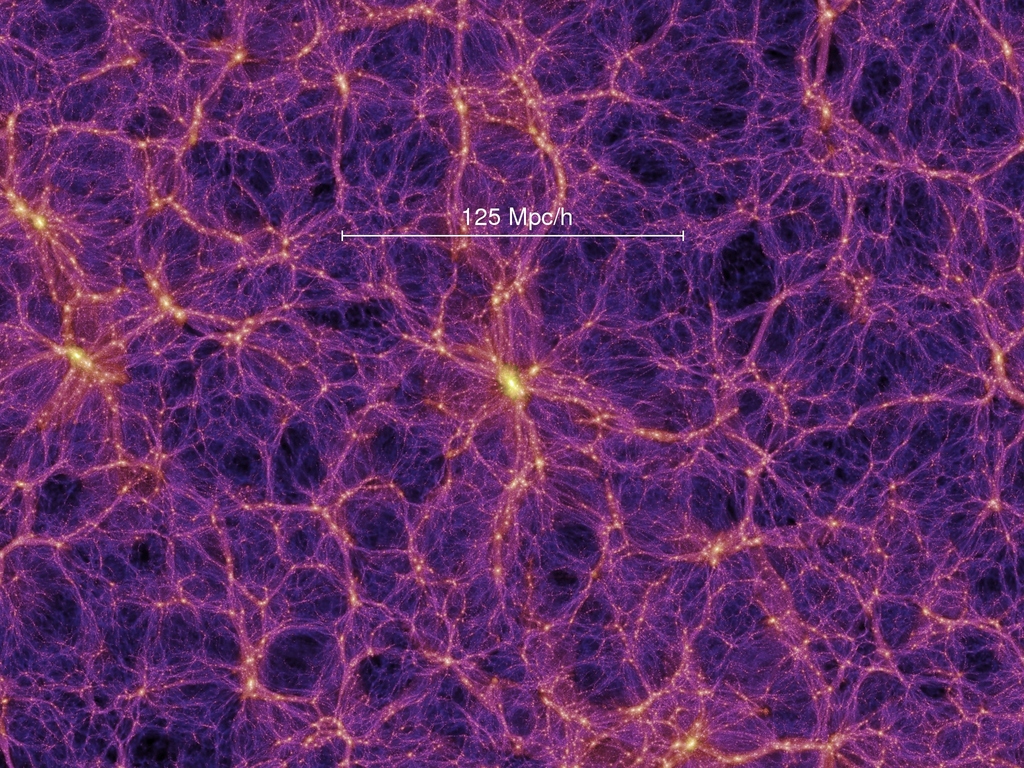
They certainly look very natural to me: Sometimes they look like structures found in electron microscopy, sometimes, they look like the structures found in numerical simulation of our universe:


Join the CompressiveSensing subreddit or the Google+ Community or the Facebook page and post there !
Liked this entry ? subscribe to Nuit Blanche's feed, there's more where that came from. You can also subscribe to Nuit Blanche by Email, explore the Big Picture in Compressive Sensing or the Matrix Factorization Jungle and join the conversations on compressive sensing, advanced matrix factorization and calibration issues on Linkedin.

Saturday, August 22, 2015

Slides: KDD2015 Tutorials

From the KDD website, here are most of the slides for the tutorials that occured during KDD 2015.
 
 
From  Big Data Analytics: Optimization and Randomization  by Tianbao Yang, Qihang Lin, Rong Jin
 
3-Hour Tutorials

1.5-Hour Tutorials


Join the CompressiveSensing subreddit or the Google+ Community or the Facebook page and post there !
Liked this entry ? subscribe to Nuit Blanche's feed, there's more where that came from. You can also subscribe to Nuit Blanche by Email, explore the Big Picture in Compressive Sensing or the Matrix Factorization Jungle and join the conversations on compressive sensing, advanced matrix factorization and calibration issues on Linkedin.

Proceedings SIGGRAPH 2015 and interesting papers


The Proceedings of SIGGRAPH 2015 are probably available for donwload for free for one more day. Here is the location to download it.

Ke-Sen Huang has listed all the SIGGRAPH paper directly available on the web. It is here:
 
Of interest to the readership of Nuit Blanche:

 
Join the CompressiveSensing subreddit or the Google+ Community or the Facebook page and post there !
Liked this entry ? subscribe to Nuit Blanche's feed, there's more where that came from. You can also subscribe to Nuit Blanche by Email, explore the Big Picture in Compressive Sensing or the Matrix Factorization Jungle and join the conversations on compressive sensing, advanced matrix factorization and calibration issues on Linkedin.

Light Field Reconstruction Using Sparsity in the Continuous Fourier Domain - implementation -


Light Field Reconstruction Using Sparsity in the Continuous Fourier Domain by Lixin Shi Haitham Hassanieh Abe Davis Dina Katabi Fredo Durand

Sparsity in the Fourier domain is an important property that enables the dense reconstruction of signals, such as 4D light fields, from a small set of samples. The sparsity of natural spectra is often derived from continuous arguments, but reconstruction algorithms typically work in the discrete Fourier domain. These algorithms usually assume that sparsity derived from continuous principles will hold under discrete sampling. This paper makes the critical observation that sparsity is much greater in the continuous Fourier spectrum than in the discrete spectrum. This difference is caused by a windowing effect. When we sample a signal over a finite window, we convolve its spectrum by an infinite sinc, which destroys much of the sparsity that was in the continuous domain. Based on this observation, we propose an approach to reconstruction that optimizes for sparsity in the continuous Fourier spectrum. We describe the theory behind our approach and discuss how it can be used to reduce sampling requirements and improve reconstruction quality. Finally, we demonstrate the power of our approach by showing how it can be applied to the task of recovering non- Lambertian light fields from a small number of 1D viewpoint trajectories.


The project page and the implementation are here: http://groups.csail.mit.edu/netmit/LFSparseRecon/
 
Join the CompressiveSensing subreddit or the Google+ Community or the Facebook page and post there !
Liked this entry ? subscribe to Nuit Blanche's feed, there's more where that came from. You can also subscribe to Nuit Blanche by Email, explore the Big Picture in Compressive Sensing or the Matrix Factorization Jungle and join the conversations on compressive sensing, advanced matrix factorization and calibration issues on Linkedin.

Friday, August 21, 2015

ranger: A Fast Implementation of Random Forests for High Dimensional Data in C++ and R - implementation

You know what is strange ? the URL for the C++ or the CRAN repository of this software is not listed once in this preprint while all other competing URLs are.


ranger: A Fast Implementation of Random Forests for High Dimensional Data in C++ and R  by Marvin N. Wright, Andreas Ziegler

We introduce the C++ application and R package ranger. The software is a fast implementation of random forests for high dimensional data. Ensembles of classification, regression and survival trees are supported. We describe the implementation, provide examples, validate the package with a reference implementation, and compare runtime and memory usage with other implementations. The new software proves to scale best with the number of features, samples, trees, and features tried for splitting. Finally, we show that ranger is the fastest and most memory efficient implementation of random forests to analyze data on the scale of a genome-wide association study.
 
The C++ implementation is here: http://www.imbs-luebeck.de/imbs/de/node/313 , the R implementation is on CRAN at: http://CRAN.R-project.org/package=ranger

Other packages mentioned:

. 
 
 
Join the CompressiveSensing subreddit or the Google+ Community or the Facebook page and post there !
Liked this entry ? subscribe to Nuit Blanche's feed, there's more where that came from. You can also subscribe to Nuit Blanche by Email, explore the Big Picture in Compressive Sensing or the Matrix Factorization Jungle and join the conversations on compressive sensing, advanced matrix factorization and calibration issues on Linkedin.

SAFFRON: A Fast, Efficient, and Robust Framework for Group Testing based on Sparse-Graph Codes

I am surprised to not see a reference to some other similar work in that area featured here back two years ago


SAFFRON: A Fast, Efficient, and Robust Framework for Group Testing based on Sparse-Graph Codes by  Kangwook Lee, Ramtin Pedarsani, Kannan Ramchandran

Group testing tackles the problem of identifying a population of $K$ defective items from a set of $n$ items by pooling groups of items efficiently in order to cut down the number of tests needed. The result of a test for a group of items is positive if any of the items in the group is defective and negative otherwise. The goal is to judiciously group subsets of items such that defective items can be reliably recovered using the minimum number of tests, while also having a low-complexity decoding procedure.
We describe SAFFRON (Sparse-grAph codes Framework For gROup testiNg), a non-adaptive group testing paradigm that recovers at least a $(1-\epsilon)$-fraction (for any arbitrarily small $\epsilon > 0$) of $K$ defective items with high probability with $m=6C(\epsilon)K\log_2{n}$ tests, where $C(\epsilon)$ is a precisely characterized constant that depends only on $\epsilon$. For instance, it can provably recover at least $(1-10^{-6})K$ defective items with $m \simeq 68 K \log_2{n}$ tests. The computational complexity of the decoding algorithm of SAFFRON is $\mathcal{O}(K\log n)$, which is order-optimal. Further, we robustify SAFFRON such that it can reliably recover the set of $K$ defective items even in the presence of erroneous or noisy test results. We also propose Singleton-Only-SAFFRON, a variant of SAFFRON, that recovers all the $K$ defective items with $m=2e(1+\alpha)K\log K \log_2 n$ tests with probability $1-\mathcal{O}{\left(\frac{1}{K^\alpha}\right)}$, where $\alpha>0$ is a constant. By leveraging powerful design and analysis tools from modern sparse-graph coding theory, SAFFRON is the first approach to reliable, large-scale probabilistic group testing that offers both precisely characterizable number of tests needed (down to the constants) together with order-optimal decoding complexity.
 
Join the CompressiveSensing subreddit or the Google+ Community or the Facebook page and post there !
Liked this entry ? subscribe to Nuit Blanche's feed, there's more where that came from. You can also subscribe to Nuit Blanche by Email, explore the Big Picture in Compressive Sensing or the Matrix Factorization Jungle and join the conversations on compressive sensing, advanced matrix factorization and calibration issues on Linkedin.
Printfriendly