Tuesday, January 31, 2006

Optical Illusion

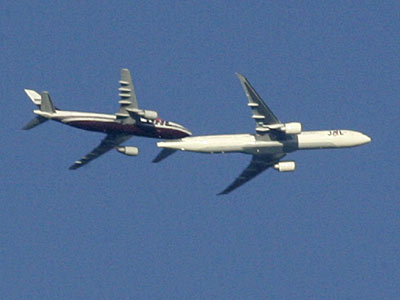
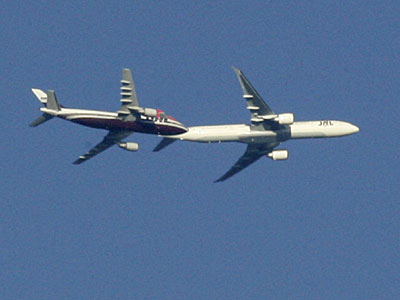
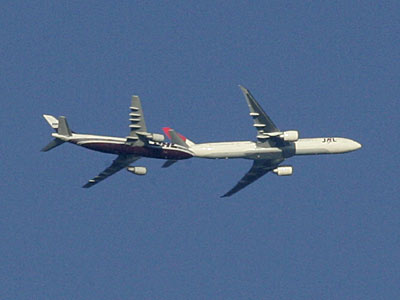
Here is a very interesting optical illusion borne out of the lack of other types of cues than the one provided by the planes themselves yielding a lack of depth perception. Depth perception is not just coming from stereo (two eyes) imaging, it is a combination of texture, colors that allows the brain to evaluate depth. In this case, all these information are lacking yielding this impression that the planes are about to collide.


Saturday, January 28, 2006

Prompt Critical Junk


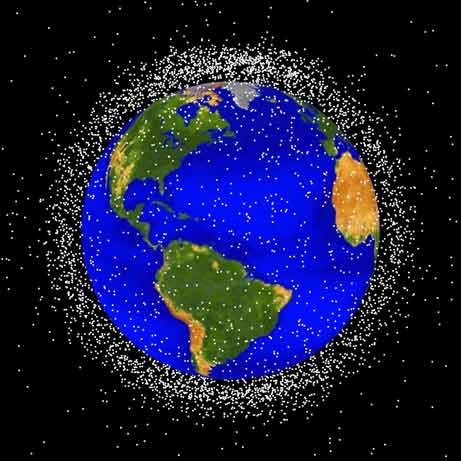
It looks like, if computations were done correctly, space junk in Low Earth Orbit will increase after 2055 even if we do not add to the stack. So far we seem to continue on adding to the stack with this spacesuit.

Friday, January 27, 2006

Imagine: Autonomous Blimps


I just saw this on Lemonodor and I thought it was cool: Autonomous blimps. They just need to put a micro-camera on these.

How long before we have a weight loss program based on this ?

Researchers at UT have found that if you stay in darkness about 48 hours, you begin to burn fat.

Thinking outside of our world


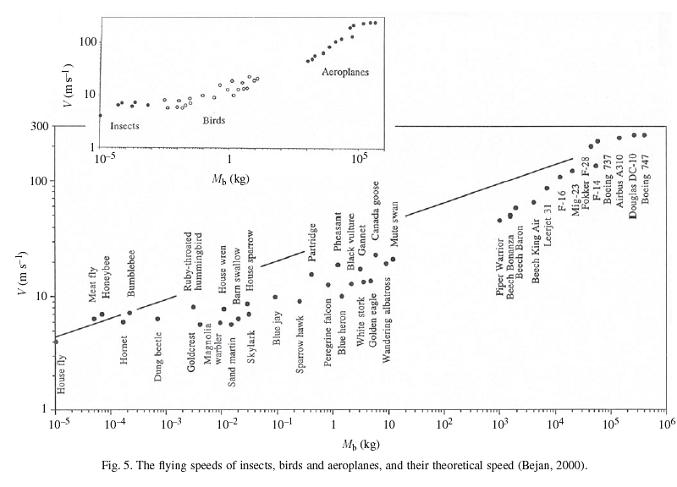
Adrian Bejan, a noted heat transfer researcher, believes that he has found laws that would explain locomotion on the ground, in the air and in water. This is pretty significant since it does not seem obvious on how to connect swimming behavior to walking on the ground. Most of his argument revolves around what he calls constructal theory which as far as I understand says that nature allows for different shapes to occur as a result of optimizing heat transfer at different scales. That results allows for a clear explanation of tree like structures for the lungs, veins, trees, roots which has mostly being looked at as being an ad-hoc assumption. This is a also a result that explains why Nature is not made of fractals. In 2000, he showed you could draw a line through meat flies on 747s on the same graph (the x-axis is the mass, the y-axis is their theoretical speed). This time he shows how, given gravity, density of the body, air and water he can fit pretty much all living things in log-log straight lines.


This is very interesting on many levels. Obviously, our brain says it OK when we see shapes that follow these principles:

  • In the MEMS world, gravity becomes less important compared to Van der Waals forces. Why should normal shapes found at the human scale world be found at these microscales ?


  • On other planets, such as Europa, where there is an expectation of prospects of life, how does different gravity levels (1/6th of a g) changes the shapes of the living bodies there ? Similarly, while most current spacecrafts look like airplanes or cylinders (rocket parts), is there an optimum shaping mechanism in zero-g, how will future spacecrafts built in space look like ?

  • Can we make out the muscle structure of dinosaurs from these types of consideration ? and what is the largest animal we could ever find when digging since every year, there is an announcement of finding larger and larger prehistoric animals ?
  • Return to the Future

    From Hackaday, Bogdan Marinescu shows off his inventive ReVaLuaTe which stands for Renesas Valuable Lua Terminal. This a LUA based microcontroller. The catch: no PC required.
    It uses the the high level LUA programming language. This looks like using BASIC on the Sinclair ZX Spectrum computer.

    Tuesday, January 24, 2006

    Tex-MEMS VIII in San Antonio


    Tex-MEMS VIII will occur in San Antonio on September 21-22, 2006. The conference will include presentations of some of the most prominent experts in the fields of Microfluidics, Microfabrication, Sensors and Nanotechnology. Check their site out.


    For information, previous meetings were held at the following locations/dates:
  • Tex-MEMS I : August 23, 1999, Texas A&M University, College station, TX

  • Tex-MEMS II : May 6, 2000, Southern Methodist University, Dallas, TX

  • Tex-MEMS III : Jun 7, 2001, UT-Dallas, Dallas, TX

  • Tex-MEMS IV : July 11, 2002, Texas Tech University, Lubbock, TX

  • Tex-MEMS V : May 6, 2003, UT-Arlington, Fort Worth, TX

  • Tex-MEMS VI : September 9, 2004, Texas A&M University, College Station, TX

  • Tex-MEMS VII : September 21-22, 2005, UT-El Paso, El Paso, TX

  • Tex-MEMS VIII : International Conference on Micro & Nano Systems, Spetember 21, 2006, UT-San Antonio, San Antonio, TX
  • Saturday, January 14, 2006

    Eye tracking and Autism: part III

    Hackaday pointed to an effort on how to build an eye tracker by Jeff Pelz at RIT (paper here.) This is problaby a good way for obtaining a larger amount of data on autism and eye tracking than currently exist. I have had entries on this before (part 1, part 2).

    Friday, January 13, 2006

    Bayesian cognition: a core subject


    This coming monday, a workshop will take place in Paris on Bayesian Cognition. There is an interesting list of speakers. To name of few: Sebastian Thrun, the winner of DARPA's Grand Challenge, Rajesh Rao, Pierre Bessiere (Cycab project), Daniel Wolpert and others that I am sure I will mention in this blog...

    Thursday, December 01, 2005

    Quantifying WOWs and Autism: How many units of WOW can one handle ?


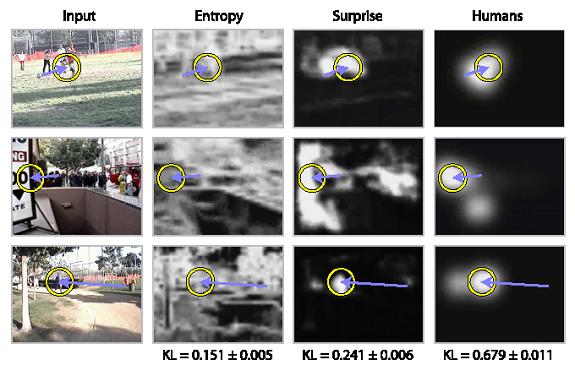
    Pierre Baldi and Laurent Itti describe a way to go about quantifying surprise. Their approach is to evaluate the Kullback-Liebler (KL) distance between the Bayesian prior and posterior probability distribution of an event. This seems to work very well.

    Using this framework we measure the extent to which humans direct their gaze towards surprising items while watching television and video games. We find that subjects are strongly attracted towards surprising locations, with 72 percent of all human gaze shifts directed towards locations more surprising than the average, a figure which rises to 84 percent when considering only gaze targets simultaneously selected by all subjects

    I especially like their "Wow" units.

    If you recall, in a previous entry, I mentionned the work of Kevin Pelphrey on gaze following deficiency in autism where he mentions:

    On congruent trials, subjects watched as a virtual actor looked towards a checkerboard that appeared in her visual field, confirming the subject's expectation regarding what the actor ‘ought to do’ in this context. On incongruent trials, she looked towards empty space, violating the subject's expectation. Consistent with a prior report from our laboratory that used this task in neurologically normal subjects, ‘errors’ (incongruent trials) evoked more activity in the STS and other brain regions linked to social cognition, indicating a strong effect of intention in typically developing subjects (n = 9). The same brain regions were activated during observation of gaze shifts in subjects with autism (n = 10), but did not differentiate congruent and incongruent trials, indicating that activity in these regions was not modulated by the context of the perceived gaze shift.

    So somehow, the autistic subjects are not surprised by the incongruent test. Either the STS is not doing the processing of determining what a surprise is or it is paying too much attention and overwhelmed by details.
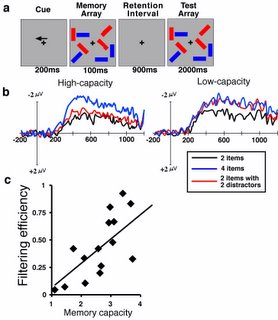
    Indeed, as shown by Edward Vogel, an assistant professor of cognitive neuroscience at the University of Oregon, it looks like awareness, or "visual working memory," depends on one's ability to filter out irrelevant information.

    Until now, it's been assumed that people with high capacity visual working memory had greater storage but actually, it's about the bouncer – a neural mechanism that controls what information gets into awareness," Vogel said.
    ....
    Working with two of his graduate students, Andrew McCollough and Maro Machizawa, Vogel recorded brain activity as people performed computer tasks asking them to remember arrays of colored squares or rectangles. In one experiment, researchers told subjects to hold in mind two red rectangles and ignore two blue ones. Without exception, high-capacity individuals excelled at dismissing blue, but low-capacity individuals held all of the rectangles in mind.

    Printfriendly