browsing through the sparse signal recovery solver list on your (great!) CS blog, I noticed that ours is missing, so I figured I'd write you an email. :-)
Namely, it's the "Infeasible-Point Subgradient Algorithm for L1-Minimization", or "ISAL1" for short, that by Dirk Lorenz, Marc Pfetsch and I developed. It can be found on the homepage of our "SPEAR" (Sparse Exact and Approximate Recovery" project, which is www.math.tu-bs.de/mo/spear ; a direct link to the (current) Matlab toolbox is
On that project page, there's also the accompanying papers (theoretical background and solver comparison) and a testset for L1 problems, etc.
I'd much appreciate it, if you could include the ISAL1 solver in the list on Nuit Blanche's CS pages! Currently, ISAL1 solves only standard basis pursuit problems, but it is planned to be extended to other similar problems (e.g. denoising) in the not-too-far future. (so maybe a link to the project page instead of the direct link would make more sense, due to likely version changes)
I need some insight ... From what I read in your paper and attendant presentations, It looks like you are solving a blind deconvolution problem i.e y = A x and you don't know both A and x but have the ability to test it through several x's. Am I right ? It looks the reason you can actually make that fast of an evaluation of both A and x (once A is known) is that you are using several signals x that are sparse in some structured way. Did I understand correctly your thesis ? In the affirmative, I could not locate A in your paper. If not, please show me the light.
the OFDM-based blind convolution problem that we're solving can be stated as y = Diag(s) A x + n. here, Diag(s) is the diagonal matrix created from the vector s of symbols from a finite alphabet, with some elements known as "pilot" symbols, and the rest (the "data" symbols) are unknown. A is a tall matrix constructed from the left columns of the DFT matrix, x is sparse or compressible, and n is additive white Gaussian noise.
in traditional compressed sensing, which performs only channel estimation (not data detection), the pilot measurements are extracted to get y_p = Diag(s_p) A_p x + n_p, where now s_p are completely known and A_p is a wide matrix. this yields a traditional sparse reconstruction problem that can be attacked by any of the standard solvers. but the performance is limited by the fact that many measurements (i.e., those corresponding to data symbols) have been ignored.
in our approach, we keep the original model y = Diag(s) A x + n, which contains more measurements, but whose data-symbol measurements are each complicated by a finite-alphabet multiplicative uncertainty. fortunately, there are a couple of algorithms that can be modified to handle this kind of uncertainty: GAMP and RBP.
furthermore, the unknown data symbols within s are structured, since the bits underlying those symbols have been generated using some error-correction coding scheme. moreover, the channel coefficients x are not only sparse, but structured-sparse, since the large coefficients come in clusters. we exploit the structures in both s and x using the "turbo" approach, by mating GAMP (or RBP) with apropriate soft-input soft-output processing blocks. these additional structures help significantly with the joint estimation of s and x.
i hope that answers your questions. thanks again for your interest.
thanks,
phil
But then I was too dim, so I had to ask:
Phil,
I am sorry if this sounds like an ignorant question but can you be more specific when you say " Diag(s) is the diagonal matrix created from the vector s of symbols from a finite alphabet, with some elements known as "pilot" symbols, and the rest (the "data" symbols) are unknown. ", I don't understand that sentence.
Cheers,
Igor.
Phil then patiently went back to communication 101 and kindly replied:
Sorry, I was assuming too much background knowledge. Let me try to give you a brief primer on digital communications which leads up to the model.
In digital communications, the goal is to communicate a sequence of information bits from the transmitter to the receiver. This is done as follows. The information bits are first processed by an "error control coder" that structures them in a way that makes the coded bit sequence very robust to errors. These coded bits are then grouped to form a sequence of "symbols", which are scalar numbers from a (usually non-binary) finite set or "alphabet" (e.g., {-3, -1, 1, 3}). Among these data symbols, the transmitter interleaves reference ("pilot") symbols that are known apriori by the receiver, and used by the receiver to aid in data-symbol recovery. The complete symbol sequence (with data and pilots) is then converted into a continuous waveform by modulating a sequence of smooth pulses according to the symbol values. In the "OFDM" system that I am considering, this latter procedure is best described in the frequency domain. The symbol sequence [-1, 3, -3, -1...], for example, would yield a waveform taking the value -1 at frequency zero, smoothly transitioning to the value 3 at frequency one, smoothly transitioning to the value -3 at frequency two, and so on. This continuous waveform then propagates through a "channel" that is assumed to be well modeled as a linear time-invariant system, corrupted by additive white Gaussian noise.
At the receiver, the noisy channel output waveform is sampled to give a sequence of measurements that are later processed in order to extract the symbol values. In the OFDM system that I am considering, the sampling is done in the frequency domain, yielding
y = Diag(s) h + n
where 's' denotes the vector of (data and pilot) symbols, whose elements live in some finite set (e.g., {-3, -1, 1, 3}); where 'h' is a vector of frequency-domain channel gains; and where 'n' is a vector of frequency-domain noise samples. Notice that 'Diag(s) h' implements a point-wise multiplication between the vectors s and h. So far, however, there is nothing "sparse" about the model. To expose the sparsity, we transform the frequency-domain channel gains into the time domain via 'h = A x', where A is a DFT matrix, and x is the channel impulse response. Finally, due to the physics of signal propagation, we know that x is sparse (and, in fact, clustered-sparse).
After all of this, we have the model
y = Diag(s) A x + n
where the frequency-domain received samples y are known, the DFT matrix A is known, and certain elements in the vector s (i.e., the pilots) are known. The other elements in the vector s (the information-bearing data symbols), the sparse channel impulse response x, and the Gaussian noise n, are all unknown.
Let me know if that makes sense now.
It does now. Thanks Phil for being a good sports and patient a the same time. I note that this is not a full blind deconvolution where the measurment matrix is totally unknown. I also note the need to have part of the message known in advance in order to perform this blind deconvolution, I wonder how this could be applied to imaging systems....
Mark Davenport and I have just completed a paper that aims to help bridge the gap between the problem of analog signal acquisition and the discrete, finite framework of Compressive Sensing (CS). To do this, we exploit the Discrete Prolate Spheroidal Sequences (DPSS's), a collection of functions that trace back to the seminal work by Slepian, Landau, and Pollack on the effects of timelimiting and bandlimiting operations. Very few of these classical ideas have appeared in the CS literature, however, and so one goal of this paper is to carefully explain--from a CS perspective--the natural role that these ideas can indeed play in CS.
To be more specific, we use DPSS's to construct a dictionary that provides sparse approximations of sampled multiband signals. This dictionary is far more efficient than the conventional DFT basis. In other words, this is one way of overcoming the "DFT leakage" problem that one encounters when dealing with finite-length sample vectors from analog signals.
If you are interested in learning more, our paper is available here:
Compressive sensing (CS) has recently emerged as a framework for efficiently capturing signals that are sparse or compressible in an appropriate basis. While often motivated as an alternative to Nyquist-rate sampling, there remains a gap between the discrete, finite-dimensional CS framework and the problem of acquiring a continuous-time signal. In this paper, we attempt to bridge this gap by exploiting the Discrete Prolate Spheroidal Sequences (DPSS's), a collection of functions that trace back to the seminal work by Slepian, Landau, and Pollack on the effects of time-limiting and bandlimiting operations. DPSS's form a highly efficient basis for sampled bandlimited functions; by modulating and merging DPSS bases, we obtain a dictionary that offers high-quality sparse approximations for most sampled multiband signals. This multiband modulated DPSS dictionary can be readily incorporated into the CS framework. We provide theoretical guarantees and practical insight into the use of this dictionary for recovery of sampled multiband signals from compressive measurements.
So today we have some example of blind deconvolution as Phil Schniter just sent me the following:
Dear Igor,
I'm writing to tell you of an exciting body of work that we have recently produced on the topic of Communication over Channels with Sparse Impulse Responses. As you know, this application is frequently cited as one of the motivating examples for Compressive Sensing. While most previous works on "Compressed Channel Sensing" focus solely on sparse-channel estimation, we focus on the larger problem of jointly estimating the sparse-channel, equalizing the sparse-channel, and decoding the bits.
In brief, our work started with an information-theoretic analysis of communication over sparse channels, where we established the following: for an L-length S-sparse N-block-fading channel, the prelog factor of the high-SNR ergodic capacity equals 1-S/N. Since this factor depends on the sparsity S and not the length L, the effect of channel sparsity on link performance becomes clear.
Next, we showed that recent message-passing algorithms to compressed sensing, such as Relaxed Belief Propagation and Generalized-AMP, can be embedded in a larger factor-graph via the "turbo" framework, where they not only estimate the sparse channel, but also jointly equalize and decode the bits. Amazingly, our simulations show that such an approach achieves exactly the pre-log factor predicted by the information theory.
We then further extended our message-passing approach to enable exploitation of structured sparsity, as exhibited by real-world communication channels, and we demonstrated that the resulting approach offers huge gains over the traditional "compressed channel sensing" approach based on LASSO, even when LASSO is embedded in a turbo loop.
I have talked about how imaging changed the Space Race before. Here is a video of a one-day public showing of the KH-9 satellites that were a direct competitors to the Almaz space stations on the Russian side. KH9 are the unmanned spacecrafts that competed directly with the manned spacecafts for observations. The main reason there was a competition between the two technologies is because of the cloud cover. The unmanned approach pushed for developing software onboard to remove cloudy images and then process the rest on Earth while the manned or human-in-the-loop approach bet on the capability of humans for adaptively track targets in order to only transmit important information on the ground.
more videos and photos of this one day only showing at the Smithsonian can be seen here.
Variables in high-dimensional data sets common in neuroimaging, spatial statistics, time series and genomics often exhibit complex dependencies that can arise, for example, from spatial and/or temporal processes or latent network structures. Conventional multivariate analysis techniques often ignore these relationships. We propose a generalization of the singular value decomposition that is appropriate for transposable matrix data, or data in which neither the rows nor the columns can be considered independent instances. By nding the best low rank approximation of the data with respect to a transposable quadratic norm, our decomposition, entitled the Generalized least squares Matrix Decomposition (GMD), directly accounts for dependencies in the data. We also regularize the factors, introducing the Generalized Penalized Matrix Factorization (GPMF). We develop fast computational algorithms using the GMD to perform generalized PCA (GPCA) and the GPMF to perform sparse GPCA and functional GPCA on massive data sets. Through simulations we demonstrate the utility of the GMD and GPMF for dimension reduction, sparse and functional signal recovery, and feature selection with high-dimensional transposable data
Here is the attendant poster. Back two weeks ago, Genevera let me know that an implementation of the algorithm should soon be out. And sure enough, it is out now and it is here. This algorithm has also been added to the Matrix Factorization Jungle.
Xiaobo Qu just sent me the following outstanding e-mail. I say outstanding because he provides context and even references of others who have been doing similar work.
Hi... ... One of our papers was published recently. It is about the sparsity-based random sampling and reconstruction of NMR spectra. NMR spectra analysis is an important tool for chemistry and data acquisition is slow for multidimensional NMR spectra. Here is the information for our work:
Abstract: Reducing the acquisition time for two-dimensional nuclear magnetic resonance (2D NMR) spectra is important. One way to achieve this goal is reducing the acquired data. In this paper, under the framework of compressed sensing, we proposed to undersample the data in the indirect dimension for a type of self-sparse 2D NMR spectra, that is, only a few meaningful spectral peaks occupy partial locations, while the rest locations own very small or even no peaks. The spectrum is reconstructed by enforcing its sparsity in an identity matrix domain with Lp (p = 0.5) norm optimization algorithm. Both theoretical analysis and simulation results show that the proposed method can reduce the reconstruction error compared with the wavelet-based L1 norm optimization.Keywords: NMR; spectral reconstruction; sparsity; undersampling; compressed sensing
Drori, I. Fast l1 minimization by iterative thresholding for multidimensional NMR Spectroscopy. Eurasip J. Adv. Sig. Pr. 2007, Article ID 20248.
Stern, A.S.; Donoho, D.L.; Hoch, J.C. NMR data processing using iterative thresholding and minimum l1-norm reconstruction. J. Magn. Reson. 2007, 188, 295-300.
Kazimierczuk, K.; Orekhov, V.Y. Accelerated NMR spectroscopy by using compressed sensing. Angewandte Chemie International Edition 2011, 50, 5556-5559.
Holland, D.J.; Bostock, M.J.; Gladden, L.F.; Nietlispach, D. Fast multidimensional NMR spectroscopy using compressed sensing.Angewandte Chemie International Edition 2011, 50, 6548-6551.
Shrot, Y.; Frydman, L. Compressed sensing and the reconstruction of ultrafast 2D NMR data: Principles and biomolecular applications.J. Magn. Reson. 2011, 209, 352-358.
The phase transition is a performance measure of the sparsity-undersampling tradeoff in compressed sensing (CS). This letter reports, for the first time, the existence of an exact phase transition for the $\ell_1$ minimization approach to the complex valued CS problem. This discovery is not only a complementary result to the known phase transition of the real valued CS but also shows considerable superiority of the phase transition of complex valued CS over that of the real valued CS. The results are obtained by extending the recently developed ONE-L1 algorithms to complex valued CS and applying their optimal and iterative solutions to empirically evaluate the phase transition.
This paper studies the problem of support recovery of sparse signals based on multiple measurement vectors (MMV). The MMV support recovery problem is connected to the problem of decoding messages in a Single-Input Multiple-Output (SIMO) multiple access channel (MAC), thereby enabling an information theoretic framework for analyzing performance limits in recovering the support of sparse signals. Sharp sufficient and necessary conditions for successful support recovery are derived in terms of the number of measurements per measurement vector, the number of nonzero rows, the measurement noise level, and especially the number of measurement vectors. Through the interpretations of the results, in particular the connection to the multiple output communication system, the benefit of having MMV for sparse signal recovery is illustrated providing a theoretical foundation to the performance improvement enabled by MMV as observed in many existing simulation results. In particular, it is shown that the structure (rank) of the matrix formed by the nonzero entries plays an important role on the performance limits of support recovery.
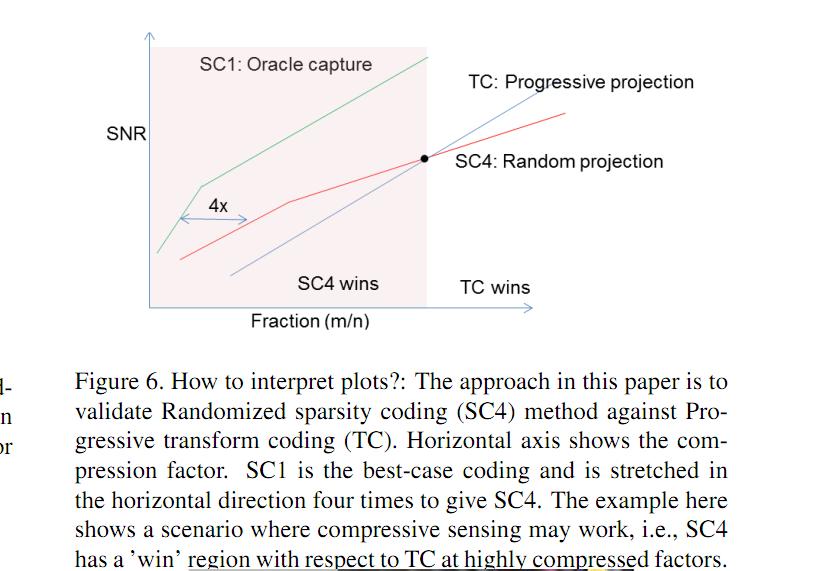
Computational photography involves sophisticated capture methods. A new trend is to capture projection of higher dimensional visual signals such as videos, multi-spectral data and lightfields on lower dimensional sensors. Carefully designed capture methods exploit the sparsity of the underlying signal in a transformed domain to reduce the number of measurements and use an appropriate reconstruction method. Traditional progressive methods may capture successively more detail using a sequence of simple projection basis, such as DCT or wavelets and employ straightforward backprojection for reconstruction. Randomized projection methods do not use any specific sequence and use L0 minimization for reconstruction. In this paper, we analyze the statistical properties of natural images, videos, multi-spectral data and light-fields and compare the effectiveness of progressive and random projections. We define effectiveness by plotting reconstruction SNR against compression factor. The key idea is a procedure to measure best-case effectiveness that is fast, independent of specific hardware and independent of the reconstruction procedure. We believe this is the first empirical study to compare different lossy capture strategies without the complication of hardware or reconstruction ambiguity. The scope is limited to linear non-adaptive sensing. The results show that random projections produce significant advantages over other projections only for higher dimensional signals, and suggest more research to nascent adaptive and non-linear projection methods.
Sparse coding algorithms trained on natural images can accurately predict the features that excite visual cortical neurons, but it is not known whether such codes can be learned using biologically realistic plasticity rules. We have developed a biophysically motivated spiking network, relying solely on synaptically local information, that can predict the full diversity of V1 simple cell receptive field shapes when trained on natural images. This represents the first demonstration that sparse coding principles, operating within the constraints imposed by cortical architecture, can successfully reproduce these receptive fields. We further prove, mathematically, that sparseness and decorrelation are the key ingredients that allow for synaptically local plasticity rules to optimize a cooperative, linear generative image model formed by the neural representation. Finally, we discuss several interesting emergent properties of our network, with the intent of bridging the gap between theoretical and experimental studies of visual cortex.
In this paper, we address the problem of discriminative dictionary learning (DDL), where sparse linear representation and classification are combined in a probabilistic framework. As such, a single discriminative dictionary and linear binary classifiers are learned jointly. By encoding sparse representation and discriminative classification models in a MAP setting, we propose a general optimization framework that allows for a data-driven tradeoff between faithful representation and accurate classification. As opposed to previous work, our learning methodology is capable of incorporating a diverse family of classification cost functions (including those used in popular boosting methods), while avoiding the need for involved optimization techniques. We show that DDL can be solved by a sequence of updates that make use of well-known and well-studied sparse coding and dictionary learning algorithms from the literature. To validate our DDL framework, we apply it to digit classification and face recognition and test it on standard benchmarks.
I caught this one thanks to the Linkedin group (that has more than 1066 members now) Jerome Gilles has written the bregman cookbook toolbox for l1 minimization, from the page:
The Bregman Cookbook
The Bregman Cookbook is a collection of Matlab functions which use the different Bregman Iteration methods to solve some particular algorithms based on sparsity via L1-norm minimization. Except some generalities, the Bregman Cookbook is not devoted to the theoretical aspects of Bregman iteration methods but is more focused on their numerical implementations.
Feel free to contact me if you need some help, report a bug or any other suggestions.If you want to contribute to the Bregman Cookbook, you can send me your code + a LateX file containing explanations on the numerical aspects of your algorithm (eventually with some references to specific publications).
Although wireless sensor networks (WSNs) are powerful in monitoring physical events, the data collected from a WSN are almost always incomplete if the surveyed physical event spreads over a wide area. The reason for this incompleteness is twofold: i) insufficient network coverage and ii) data aggregation for energy saving. Whereas the existing recovery schemes only tackle the second aspect, we develop Dual-lEvel Compressed Aggregation (DECA) as a novel framework to address both aspects. Specifically, DECA allows a high fidelity recovery of a widespread event, under the situations that the WSN only sparsely covers the event area and that an in-network data aggregation is applied for traffic reduction. Exploiting both the low-rank nature of real-world events and the redundancy in sensory data, DECA combines matrix completion with a fine-tuned compressed sensing technique to conduct a dual-level reconstruction process. We demonstrate that DECA can recover a widespread event with less than 5% of the data, with respect to the dimension of the event, being collected. Performance evaluation based on both synthetic and real data sets confirms the recovery fidelity and energy efficiency of our DECA framework.
The aim of the present paper is to demonstrate the impact of low-pass filter non-idealities on compressed sensing signal reconstruction in the random demodulator (RD) architecture. The random demodulator is a compressed sensing (CS) acquisition scheme capable of acquiring signals in continuous time. One of the main advantages of the system is the possibility to use off-the-shelf components to implement this subNyquist framework. Low-pass filtering plays an important role in the RD analog acquisition process, which needs to be modeled carefully in the digital part of the compressive sensing reconstruction. Having a complete model of the analog front-end, CS algorithms conduct almost perfect reconstruction taking far less samples than for traditional Nyquist-rate sampling. This paper investigates reconstruction sensitivity to distortion in the impulse response of the low-pass filter caused by passive component value fluctuations. The authors simulate common CS recovery algorithms and show that the worst-case performance degradation due to filter component tolerances can be substantial, which requires special attention when designing reconstruction algorithms for RD.
In this paper, we consider topology identification of large-scale interconnected dynamical systems. The system topology under study has the structure of a directed graph. Each edge of the directed network graph represents a Finite Impulse Response (FIR) filter with a possible transport delay. Each node is a summer, whose inputs are the signals from the incoming edges, while the output of the summer is sent to outgoing edges. Edges of the graph can be of different unknown orders and delays. Both the graph topology and the FIR filters and delays that make up the edges are unknown. We aim to do the topology identification from the smallest possible number of node observations when there is limited data available and for this reason, we call this problem Compressive Topology Identification (CTI). Inspired by Compressive Sensing (CS) which is a recent paradigm in signal processing for sparse signal recovery, we show that in cases where network interconnections are suitably sparse (i.e., the network contains sufficiently few links), it is possible to perfectly identify the network topology along with the filter orders and delays from small numbers of node observations, even though this leaves an apparently illconditioned identification problem. The main technical novelty of our approach is in casting the identification problem as the recovery of a clustered-sparse signal z 2 RN from the measurements b = Az 2 R M with M \lt N, where the measurement matrix A is a block-concatenation of Toeplitz matrices. To this end, we introduce a greedy algorithm called Clustered Orthogonal Matching Pursuit (COMP) that tackles the problem of recovering clustered-sparse signals from few measurements. In a clustered-sparse model, in contrast to block-sparse models, there is no prior knowledge of the locations or the sizes of the clusters. We discuss the COMP algorithm and support our discussions with simulations.
In this paper, we consider identifying Auto Regressive with eXternal input (ARX) models for both Linear Time-Invariant (LTI) and Linear Time-Variant (LTV) systems. We aim at doing the identification from the smallest possible number of observations. This is inspired by the field of Compressive Sensing (CS), and for this reason, we call this problem Compressive System Identification (CSI). In the case of LTI ARX systems, a system with a large number of inputs and unknown input delays on each channel can require a model structure with a large number of parameters, unless input delay estimation is performed. Since the complexity of input delay estimation increases exponentially in the number of inputs, this can be difficult for high dimensional systems. We show that in cases where the LTI system has possibly many inputs with different unknown delays, simultaneous ARX identification and input delay estimation is possible from few observations, even though this leaves an apparently illconditioned identification problem. We discuss identification guarantees and support our proposed method with simulations. We also consider identifying LTV ARX models. In particular, we consider systems with parameters that change only at a few time instants in a piecewise-constant manner where neither the change moments nor the number of changes is known a priori. The main technical novelty of our approach is in casting the identification problem as recovery of a block-sparse signal from an underdetermined set of linear equations. We suggest a random sampling approach for LTV identification, address the issue of identifiability and again support our approach with illustrative simulations.
We consider the problem of compressed sensing and propose new deterministic constructions of compressive sampling matrices based on finite-geometry generalized polygons. For the noiseless measurements case, we develop a novel recovery algorithm for strictly sparse signals that utilizes the geometry properties of generalized polygons and exhibits complexity linear in the sparsity value. In the presence of measurement noise, recovery of the generalized-polygon sampled signals can be carried out most effectively using a belief propagation algorithm. Experimental studies included in this report illustrate our theoretical developments.
Compressed sensing aims at reconstructing sparse signals from significantly reduced number of samples, and a popular reconstruction approach is `1-norm minimization. In this correspondence, a method called orthonormal expansion is presented to reformulate the basis pursuit problem for noiseless compressed sensing. Two algorithms are proposed based on convex optimization: one exactly solves the problem and the other is a relaxed version of the first one. The latter can be considered as a modified iterative soft thresholding algorithm and is easy to implement. Numerical simulation shows that, in dealing with noise-free measurements of sparse signals, the relaxed version is accurate, fast and competitive to the recent state-of-the-art algorithms. Its practical application is demonstrated in a more general case where signals of interest are approximately sparse and measurements are contaminated with noise.
Phase space tomography estimates correlation functions entirely from multiple snapshots in the evolution of the system, rather than traditional interferometric methods requiring measurement of multiple two-point correlations. However, as in every tomographic formulation, undersampling poses a severe limitation. In the context of quantum correlation function measurements, a new theory utilizing compressive sensing was recently established [D. Gross et al. Phys. Rev. Lett. 105, 150401 (2010), M. Cramer et al. Nat. Comm. 1, 149 (2010)] whereby both measurement and post-processing dimensionality are reduced without giving up reconstruction fidelity. Here we present the first, to our knowledge, experimental demonstration of compressive reconstruction of the classical optical correlation function, i.e. the mutual intensity function which is of course the analogue to a conservative quantum state. We show that using explicitly physics-based assumptions we obtain substantial quantitative improvements in the reconstruction.
A central problem in the operation of large wireless networks is how to deal with interference -- the unwanted signals being sent by transmitters that a receiver is not interested in. This thesis looks at ways of combating such interference.
In Chapters 1 and 2, we outline the necessary information and communication theory background, including the concept of capacity. We also include an overview of a new set of schemes for dealing with interference known as interference alignment, paying special attention to a channel-state-based strategy called ergodic interference alignment.
In Chapter 3, we consider the operation of large regular and random networks by treating interference as background noise. We consider the local performance of a single node, and the global performance of a very large network.
In Chapter 4, we use ergodic interference alignment to derive the asymptotic sum-capacity of large random dense networks. These networks are derived from a physical model of node placement where signal strength decays over the distance between transmitters and receivers. (See also arXiv:1002.0235 and arXiv:0907.5165.)
In Chapter 5, we look at methods of reducing the long time delays incurred by ergodic interference alignment. We analyse the tradeoff between reducing delay and lowering the communication rate. (See also arXiv:1004.0208.)
In Chapter 6, we outline a problem that is equivalent to the problem of pooled group testing for defective items. We then present some new work that uses information theoretic techniques to attack group testing. We introduce for the first time the concept of the group testing channel, which allows for modelling of a wide range of statistical error models for testing. We derive new results on the number of tests required to accurately detect defective items, including when using sequential `adaptive' tests.
As I was reading John Langford's blog, I came across a reference to an implementation of a matrix factorization module within Vowpal Wabbit by Jake Hofman. I asked Jake about the specifics of the matrix factorization since as we all know, with the advent of new regularizers and the jungle that comes with it, we may need to be a little bit more accurate in stating what algorithm and the type of regularization is implemented. Here is what Jake sent me.
hi igor
...the matrix factorization that's currently in VW is quite simple:stochastic gradient descent with L2 regularization. the main departure from "vanilla" approaches is that features are hashed into the weight vector, as is done in all of VW, to keep a fixed memory footprint.i don't have anything formal written at the moment, but the specifics that you're probably interested in are in the mf_inline_train function(lines 120 to 163 here): https://github.com/JohnLangford/vowpal_wabbit/blob/master/gd_mf.cc we'll likely try to improve performance in the future, but as of right now it's relatively straightforward and performing reasonably well.the approach is similar to that in "collaborative filtering on abudget", which might be a useful reference: http://jmlr.csail.mit.edu/proceedings/papers/v9/karatzoglou10a/karatzoglou10a.pdf you can find a wiki page on example usage here: https://github.com/JohnLangford/vowpal_wabbit/wiki/Matrix-factorization-example let me know if i can answer any other questions.
Here is a list of papers and code I have noticed over the past week. It ranges from application to theoretical investigation of a replacement of the trace norm regularizer, a subject I'll cover soon since we have seen more than one replacement since that entry.
When data is sampled from an unknown subspace, principal component analysis (PCA) provides an e ective way to estimate the subspace and hence reduce the dimension of the data. At the heart of PCA is the Eckart-Young-Mirsky theorem, which characterizes the best rank k approximation of a matrix.In this paper, we prove a generalization of the Eckart-Young-Mirsky theorem under all unitarily invariant norms. Using this result, we obtain closed-form solutions for a set of rank/norm regularized problems, and derive closed-form solutions for a general class of subspace clustering problems (where data is modelled by unions of unknown subspaces). From these results we obtain new theoretical insights and promising experimental results.
Trace-norm regularization is a widely-used and successful approach for collaborative fi ltering and matrix completion. However, its theoretical understanding is surprisingly weak, and despite previous attempts, there are no distribution-free, non-trivial learning guarantees currently known. In this paper, we bridge this gap by providing such guarantees, under mild assumptions which correspond to collaborative filtering as performed in practice. In fact, we claim that previous di fficulties partially stemmed from a mismatch between the standard learning-theoretic modeling of collaborative fi ltering, and its practical application. Our results also shed some light on the issue of collaborative fi ltering with bounded models, which enforce predictions to lie within a certain range. In particular, we provide experimental and theoretical evidence that such models lead to a modest yet signi ficant improvement.
We consider the problem of approximately reconstructing a partially-observed, approximately low-rank matrix. This problem has received much attention lately, mostly using the trace-norm as a surrogate to the rank. Here we study low-rank matrix reconstruction using both the trace-norm, as well as the less-studied max-norm, and present reconstruction guarantees based on existing analysis on the Rademacher complexity of the unit balls of these norms. We show how these are superior in several ways to recently published guarantees based on specialized analysis.
Recommendation system has been used more and more frequently in many applications recent years. With the increasing information available, not only in quantities but also in types, how to leverage these rich information to build a better recommendation system becomes a natural problem. Most traditional approaches try to design a specific model for each scenario, which demands great efforts in developing and modifying models. In this technical report, we describe our implementation of feature-based matrix factorization. This model is an abstract of many variants of matrix factorization models, and new types of information can be utilized by simply defining new features, without modifying any line of code.
Matrix completion is a new paradigm in signal processing that seeks to recover a low-rank matrix based on small number of observations. We propose an ECG compression scheme that organizes the ECG data in a low-rank matrix via a period normalization stage. By using matrix completion, we can recover the ECG data matrix from a few number of entries, and therefore achieve high compression ratios comparable to the ones obtained by existing compression techniques. The proposed scheme offers a low-complexity encoder and good tolerance to quantization noise, which allows a significant reduction in the number of bits per sample and, yet achieve good quality in the reconstruction.
Within the unmanageably large class of nonconvex optimization, we consider the rich subclass of nonsmooth problems that have \emph{composite} objectives---this already includes the extensively studied convex, composite objective problems as a special case. For this subclass, we introduce a powerful, new framework that permits asymptotically \emph{non-vanishing} perturbations. In particular, we develop perturbation-based batch and incremental (online like) nonconvex proximal splitting algorithms. To our knowledge, this is the first time that such perturbation-based nonconvex splitting algorithms are being proposed and analyzed. While the main contribution of the paper is the theoretical framework, we complement our results by presenting some empirical results on matrix factorization.
Low-rank representation (LRR) is an effective method for subspace clustering and has found wide applications in computer vision and machine learning. The existing LRR solver is based on the alternating direction method (ADM). It suffers from $O(n^3)$ computation complexity due to the matrix-matrix multiplications and matrix inversions, even if partial SVD is used. Moreover, introducing auxiliary variables also slows down the convergence. Such a heavy computation load prevents LRR from large scale applications. In this paper, we generalize ADM by linearizing the quadratic penalty term and allowing the penalty to change adaptively. We also propose a novel rule to update the penalty such that the convergence is fast. With our linearized ADM with adaptive penalty (LADMAP) method, it is unnecessary to introduce auxiliary variables and invert matrices. The matrix-matrix multiplications are further alleviated by using the skinny SVD representation technique. As a result, we arrive at an algorithm for LRR with complexity $O(rn^2)$, where $r$ is the rank of the representation matrix. Numerical experiments verify that for LRR our LADMAP method is much faster than state-of-the-art algorithms. Although we only present the results on LRR, LADMAP actually can be applied to solving more general convex programs.
The rank function rank( ) is neither continuous nor convex which brings much difficulty to the solution of rank minimization problems. In this paper, we provide a unified framework to construct the approximation functions of rank( ), and study their favorable properties. Particularly, with two families of approximation functions, we propose a convex relaxation method for the rank minimization problems with positive semidefinite cone constraints, and illustrate its application by computing the nearest lowrank correlation matrix. Numerical comparisons with the convex relaxation method in [17] indicate that our method tends to yield a better local optimal solution.
From that paper I note:
In [10, 26], Fazel et al. showed that the convex envelope of rank( ) on the unit ball in the operator norm is the nuclear norm. Motivated by this result, the convex relaxation methods based on the nuclear norm minimization are extensively studied, and many effective algorithms have been proposed for them (see, e.g., [18, 34, 19, 7, 22]). However, the nuclear norm has a drastic derivation from the rank function since the former is convex whereas the latter is concave. This means that the nuclear norm is not a high quality approximation to rank( ). In fact, as pointed out in [26, 27], the nuclear norm relaxation exhibits a phase transition where for sufficiently small rank the method always succeeds, but in the complement of the region it may fail even never succeed.
In this paper, noting that rank( ) is a composition of the one-side sign function and the singular value function, we give a unified framework to construct its approximation functions, and prove that rank( ) can be approximated to any prescribed accuracy when the approximation parameter is smaller than a given threshold. Although these approximation functions are not differentiable, they are semismooth and directional differentiable everywhere in R^m×n
It looks to me a little bit like the equivalent of the SL0 code that does so well in many compressive sensing reconstruction cases.
Exact recovery from contaminated visual data plays an important role in various tasks. By assuming the observed data matrix as the addition of a low-rank matrix and a sparse matrix, theoretic guarantee exists under mild conditions for exact data recovery. Practically matrix nuclear norm is adopted as a convex surrogate of the non-convex matrix rank function to encourage low-rank property and serves as the major component of recently-proposed Robust Principal Component Analysis (R-PCA). Recent endeavors have focused on enhancing the scalability of RPCA to large-scale datasets, especially mitigating the computational burden of frequent large-scale Singular Value Decomposition (SVD) inherent with the nuclear norm optimization. In our proposed scheme, the nuclear norm of an auxiliary matrix is minimized instead, which is related to the original low-rank matrix by random projection. By design, the modified optimization entails SVD on matrices of much smaller scale, as compared to the original optimization problem. Theoretic analysis well justifies the proposed scheme, along with greatly reduced optimization complexity. Both qualitative and quantitative studies are provided on various computer vision benchmarks to validate its effectiveness, including facial shadow removal, surveillance background modeling and large-scale image tag transduction. It is also highlighted that the proposed solution can serve as a general principal to accelerate many other nuclear norm oriented problems in numerous tasks
In this work, we address the following matrix recovery problem: suppose we are given a set of data points containing two parts, one part consists of samples drawn from a union of multiple subspaces and the other part consists of outliers. We do not know which data points are outliers, or how many outliers there are. The rank and number of the subspaces are unknown either. Can we detect the outliers and segment the samples into their right subspaces, efficiently and exactly?
We utilize a so-called Low-Rank Representation (LRR) method to solve the above problem, and prove that under mild technical conditions, any solution to LRR exactly recover the row space of the samples and detect the outliers as well. Since the subspace membership is provably determined by the row space, this further implies that LRR can perform exact subspace segmentation and outlier detection, in an exact and efficient way.
Assuming that a set of source signals is sparsely representable in a given dictionary, we show how their sparse recovery fails whenever we can only measure a convolved observation of them. Starting from this motivation, we develop a block coordinate descent method which aims to learn a convolved dictionary and provide a sparse representation of the observed signals with small residual norm. We compare the proposed approach to the K-S V D dictionary learning
algorithm and show through numerical experiment on synthetic signals that, provided some conditions on the problem data, our technique converges in a fixed number of iterations to a sparse representation with smaller residual norm
Using the `1-norm to regularize the estimation of the parameter vector of a linear model leads to an unstable estimator when covariates are highly correlated. In this paper, we introduce a new penalty function which takes into account the correlation of the design matrix to stabilize the estimation. This norm, called the trace Lasso, uses the trace norm, which is a convex surrogate of the rank, of the selected covariates as the criterion of model complexity. We analyze the properties of our norm, describe an optimization algorithm based on reweighted least-squares, and illustrate the behavior of this norm on synthetic data, showing that it is more adapted to strong correlations than competing methods such as the elastic net.
Sparse PCA provides a linear combination of small number of features that maxi- mizes variance across data. Although Sparse PCA has apparent advantages com- pared to PCA, such as better interpretability, it is generally thought to be computationally much more expensive. In this paper, we demonstrate the surprising fact that sparse PCA can be easier than PCA in practice, and that it can be reliably applied to very large data sets. This comes from a rigorous feature elimination pre-processing result, coupled with the favorable fact that features in real-life data typically have exponentially decreasing variances, which allows for many features to be eliminated. We introduce a fast block coordinate ascent algorithm with much better computational complexity than the existing first-order ones. We provide ex- perimental results obtained on text corpora involving millions of documents and hundreds of thousands of features. These results illustrate how Sparse PCA can help organize a large corpus of text data in a user-interpretable way, providing an attractive alternative approach to topic models.
Abstract: Stochastic Gradient Descent (SGD) is a popular algorithm that can achieve state-of-the-art performance on a variety of machine learning tasks. Several researchers have recently proposed schemes to parallelize SGD, but all require performance-destroying memory locking and synchronization. This work aims to show using novel theoretical analysis, algorithms, and implementation that SGD can be implemented *without any locking*. We present an update scheme called HOGWILD! which allows processors access to shared memory with the possibility of overwriting each other's work. We show that when the associated optimization problem is sparse, meaning most gradient updates only modify small parts of the decision variable, then HOGWILD! achieves a nearly optimal rate of convergence. We demonstrate experimentally that HOGWILD! outperforms alternative schemes that use locking by an order of magnitude.
All entries on Compressive Sensing are here. All entries on Matrix Factorization are here.
Image Credit: NASA/JPL/Space Science Institute, N00175604.jpg was taken on September 13, 2011 and received on Earth September 14, 2011. The camera was pointing toward ENCELADUS at approximately 335,723 kilometers away, and the image was taken using the RED and CL2 filters.


 Liked this entry ? subscribe to the Nuit Blanche feed, there's more where that came from