Saturday, February 18, 2006

Multi-use of Google Maps


Google Maps Mania just featured Peter Pesti at Georgia Tech with his Google Maps Nighttime!. At the same time, Google also uses Google Maps to geographically target customers through their
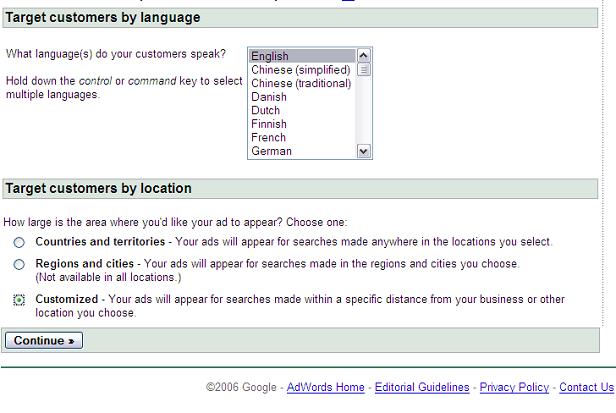

Adwords program (here some of the screen grab of the application within Adwords).


On another note, if one were to have a very high resolution camera, one could shoot a high definition picture and use the same Google Maps interface to go into the details of that picture (like in the following game using Google Maps). More information on how to introduce a custom map into Google maps can be found in GoogleMapki. This possibility offers other avenues,. For instance, if one were to have an HDTV camera, one could patch different pictures from a scene (every picture is taken at 1/30 th second) and have the Google interface allow navigation through it. One cannot but think that a similar system would work well for Nat's world (a program designed to help Autistic kids know their environment by navigating through it.)

Thursday, February 02, 2006

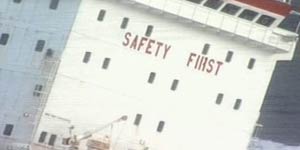
Safety is our job Number...errr... make that Number 6


Some time ago, two tankers collided off the French coast on the English Channel. Here is what happens when corporate speak does not mean what it should mean. This tanker sank with all its phosphoric acid payload. (here is another example)

Tuesday, January 31, 2006

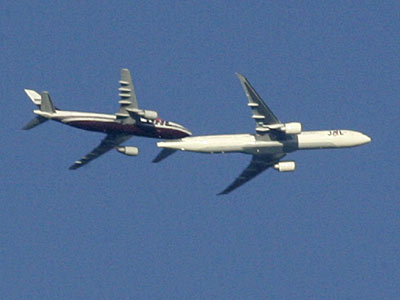
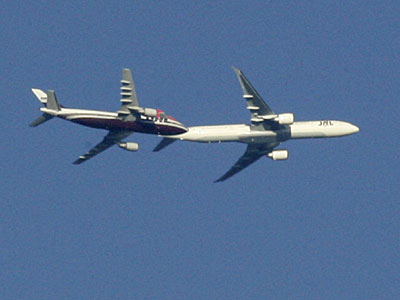
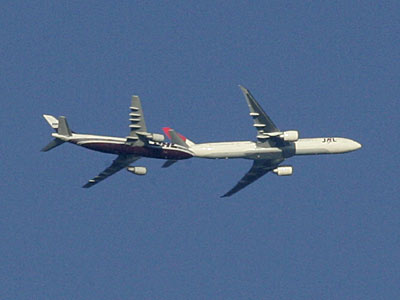
Optical Illusion

Here is a very interesting optical illusion borne out of the lack of other types of cues than the one provided by the planes themselves yielding a lack of depth perception. Depth perception is not just coming from stereo (two eyes) imaging, it is a combination of texture, colors that allows the brain to evaluate depth. In this case, all these information are lacking yielding this impression that the planes are about to collide.


Saturday, January 28, 2006

Prompt Critical Junk


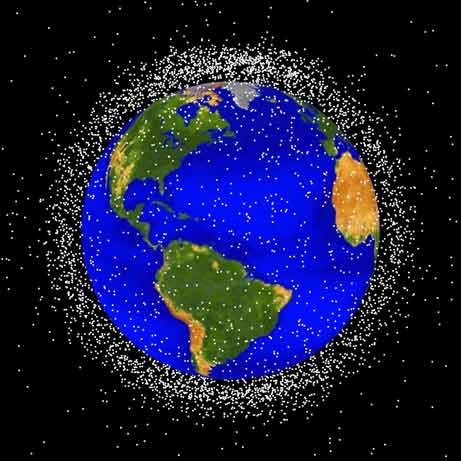
It looks like, if computations were done correctly, space junk in Low Earth Orbit will increase after 2055 even if we do not add to the stack. So far we seem to continue on adding to the stack with this spacesuit.

Friday, January 27, 2006

Imagine: Autonomous Blimps


I just saw this on Lemonodor and I thought it was cool: Autonomous blimps. They just need to put a micro-camera on these.

How long before we have a weight loss program based on this ?

Researchers at UT have found that if you stay in darkness about 48 hours, you begin to burn fat.

Thinking outside of our world


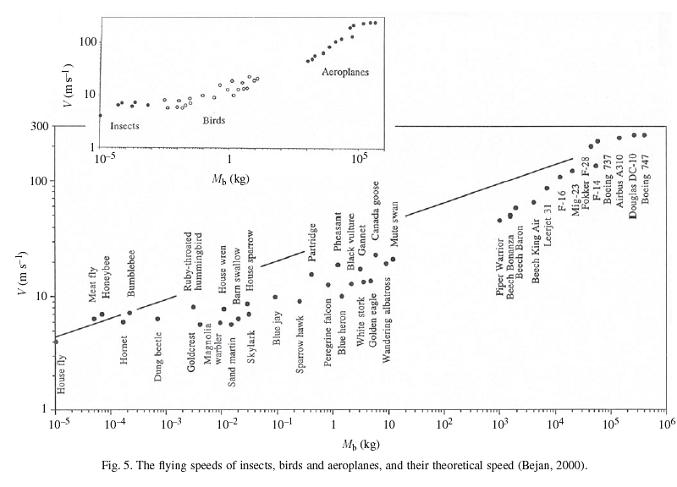
Adrian Bejan, a noted heat transfer researcher, believes that he has found laws that would explain locomotion on the ground, in the air and in water. This is pretty significant since it does not seem obvious on how to connect swimming behavior to walking on the ground. Most of his argument revolves around what he calls constructal theory which as far as I understand says that nature allows for different shapes to occur as a result of optimizing heat transfer at different scales. That results allows for a clear explanation of tree like structures for the lungs, veins, trees, roots which has mostly being looked at as being an ad-hoc assumption. This is a also a result that explains why Nature is not made of fractals. In 2000, he showed you could draw a line through meat flies on 747s on the same graph (the x-axis is the mass, the y-axis is their theoretical speed). This time he shows how, given gravity, density of the body, air and water he can fit pretty much all living things in log-log straight lines.


This is very interesting on many levels. Obviously, our brain says it OK when we see shapes that follow these principles:

  • In the MEMS world, gravity becomes less important compared to Van der Waals forces. Why should normal shapes found at the human scale world be found at these microscales ?


  • On other planets, such as Europa, where there is an expectation of prospects of life, how does different gravity levels (1/6th of a g) changes the shapes of the living bodies there ? Similarly, while most current spacecrafts look like airplanes or cylinders (rocket parts), is there an optimum shaping mechanism in zero-g, how will future spacecrafts built in space look like ?

  • Can we make out the muscle structure of dinosaurs from these types of consideration ? and what is the largest animal we could ever find when digging since every year, there is an announcement of finding larger and larger prehistoric animals ?
  • Return to the Future

    From Hackaday, Bogdan Marinescu shows off his inventive ReVaLuaTe which stands for Renesas Valuable Lua Terminal. This a LUA based microcontroller. The catch: no PC required.
    It uses the the high level LUA programming language. This looks like using BASIC on the Sinclair ZX Spectrum computer.

    Tuesday, January 24, 2006

    Tex-MEMS VIII in San Antonio


    Tex-MEMS VIII will occur in San Antonio on September 21-22, 2006. The conference will include presentations of some of the most prominent experts in the fields of Microfluidics, Microfabrication, Sensors and Nanotechnology. Check their site out.


    For information, previous meetings were held at the following locations/dates:

  • Tex-MEMS I : August 23, 1999, Texas A&M University, College station, TX

  • Tex-MEMS II : May 6, 2000, Southern Methodist University, Dallas, TX

  • Tex-MEMS III : Jun 7, 2001, UT-Dallas, Dallas, TX

  • Tex-MEMS IV : July 11, 2002, Texas Tech University, Lubbock, TX

  • Tex-MEMS V : May 6, 2003, UT-Arlington, Fort Worth, TX

  • Tex-MEMS VI : September 9, 2004, Texas A&M University, College Station, TX

  • Tex-MEMS VII : September 21-22, 2005, UT-El Paso, El Paso, TX

  • Tex-MEMS VIII : International Conference on Micro & Nano Systems, Spetember 21, 2006, UT-San Antonio, San Antonio, TX
  • Saturday, January 14, 2006

    Eye tracking and Autism: part III

    Hackaday pointed to an effort on how to build an eye tracker by Jeff Pelz at RIT (paper here.) This is problaby a good way for obtaining a larger amount of data on autism and eye tracking than currently exist. I have had entries on this before (part 1, part 2).

    Printfriendly