We describe and analyze a simple random feature scheme (RFS) from prescribed compositional kernels. The compositional kernels we use are inspired by the structure of convolutional neural networks and kernels. The resulting scheme yields sparse and efficiently computable features. Each random feature can be represented as an algebraic expression over a small number of (random) paths in a composition tree. Thus, compositional random features can be stored compactly. The discrete nature of the generation process enables de-duplication of repeated features, further compacting the representation and increasing the diversity of the embeddings. Our approach complements and can be combined with previous random feature schemes.
Page Views on Nuit Blanche since July 2010
Nuit Blanche community
@NuitBlog || Facebook || Reddit
Compressive Sensing on LinkedIn
Advanced Matrix Factorization on Linkedin ||
Wednesday, March 29, 2017
Random Features for Compositional Kernels
Random features used in a hierarchical manner, I like it !
Join the CompressiveSensing subreddit or the Google+ Community or the Facebook page and post there !
Liked this entry ? subscribe to Nuit Blanche's feed, there's more where that came from. You can also subscribe to Nuit Blanche by Email, explore the Big Picture in Compressive Sensing or the Matrix Factorization Jungle and join the conversations on compressive sensing, advanced matrix factorization and calibration issues on Linkedin.
Evolution Strategies as a Scalable Alternative to Reinforcement Learning - implementation -
We already mentioned it earlier with a different implementation. Since OpenAI is doing the work of making it available by explaining it through a blog entry and a video (see below) and a Github repository ( https://github.com/openai/evolution-strategies-starter ), I am featuring it again.
Evolution Strategies as a Scalable Alternative to Reinforcement Learning by Tim Salimans, Jonathan Ho, Xi Chen, Ilya Sutskever
We explore the use of Evolution Strategies, a class of black box optimization algorithms, as an alternative to popular RL techniques such as Q-learning and Policy Gradients. Experiments on MuJoCo and Atari show that ES is a viable solution strategy that scales extremely well with the number of CPUs available: By using hundreds to thousands of parallel workers, ES can solve 3D humanoid walking in 10 minutes and obtain competitive results on most Atari games after one hour of training time. In addition, we highlight several advantages of ES as a black box optimization technique: it is invariant to action frequency and delayed rewards, tolerant of extremely long horizons, and does not need temporal discounting or value function approximation.
An in-depth OpenAI blog entry on the subject by Andrej Karpathy is here. There is also a video of Ilya on stage at EmTech Digital.
Tuesday, March 28, 2017
Preconditioned Data Sparsification for Big Data with Applications to PCA and K-means - implementation -
Stephen just sent me the following:
Hi Igor,
Hope all is going well and that springtime is coming to Paris.
My student Farhad Pourkamali-Anaraki and I have a recent paper that may be interesting for the blog. It was just published in the IEEE Transactions Information Theory journal (https://doi.org/10.1109/TIT.2017.2672725) but we also have a free version at https://arxiv.org/abs/1511.00152, as well as open source code at https://github.com/stephenbeckr/SparsifiedKMeans. We discuss several applications in the paper, and we think that applying our method to K-means leads to one of the fastest big-data K-means algorithms.
Best,
Stephen
Preconditioned Data Sparsification for Big Data with Applications to PCA and K-means by Farhad Pourkamali-Anaraki, Stephen Becker
We analyze a compression scheme for large data sets that randomly keeps a small percentage of the components of each data sample. The benefit is that the output is a sparse matrix and therefore subsequent processing, such as PCA or K-means, is significantly faster, especially in a distributed-data setting. Furthermore, the sampling is single-pass and applicable to streaming data. The sampling mechanism is a variant of previous methods proposed in the literature combined with a randomized preconditioning to smooth the data. We provide guarantees for PCA in terms of the covariance matrix, and guarantees for K-means in terms of the error in the center estimators at a given step. We present numerical evidence to show both that our bounds are nearly tight and that our algorithms provide a real benefit when applied to standard test data sets, as well as providing certain benefits over related sampling approaches.
The implementation is here: https://github.com/stephenbeckr/SparsifiedKMeans
CSjob: Three Postdocs, SAMP-Lab, Technion
[FYI, all jobs posted here on Nuit Blanche can be found under the CSjob tag.]
Dear IgorI was wondering if you could post some post doc positions at your great blog:Postdoc in Signal Processing of Medical ImagingHost Professor: Yonina EldarPosition Description: The Signal Acquisition Measurement and Processing Lab at the Technion invites applications for a postdoctoral position with focus on Medical imaging. We are looking for thought leaders in the fields of MRI, CT Ultrasound and PET who can develop new areas and applications in Medical imaging systems. Candidate is expected to have a good background in advanced signal processing, image processing, computational mathematics and statistics. The applicant should be very comfortable with physical concepts of at least one medical imaging modality. The balance of work between theory and practice will vary on project-basis, and a successful candidate should be proficient in both aspects. Candidate should have an excellent publication record in leading medical imaging or image processing journals, ability to lead and interface with large teams comprising of theoreticians and hardware engineers is a plus. Excellent written and presentation skills in English are an advantage.About SAMPL: The Lab focuses on sampling, modeling and processing of continuous-time and discrete-time signals and on new design paradigms in which sampling and processing are designed jointly in order to exploit signal properties already in the sampling stage. This approach has the potential to drastically reduce the sampling and processing rates well below the Nyquist rate, typically considered as the ultimate limit for analog to digital conversion. The laboratory facilitates the transition from pure theoretical research to the development, design and implementation of prototype systems in areas ranging from bioimaging through communications, laser optics, cognitive radio and radar systems. Research projects are available in the areas of phase retrieval, superresolution imaging, radar systems, medical imaging, deep networks, sampling over graphs, blind deconvolution, and communication systems. The group works closely with several major hospitals in Israel.Contact Details:For more details please visit Prof. Eldar’s website.To submit your application, please send an updated CV with a list of publications, 3 letters of recommendation and a cover letter to yonina@ee.technion.ac.ilPostdoc in Radar Signal ProcessingHost Professor: Yonina EldarPosition Description: The Signal Acquisition Measurement and Processing Lab at the Technion invites applications for one postdoctoral position with focus on radar system design and radar signal processing. We are looking for thought leaders in radar who can develop new areas and applications in radar and remote sensing. Candidate is expected to have a good background in advanced signal processing, electromagnetic theory, computational mathematics and statistics. The applicant should be very comfortable with radar hardware design. The balance of work between theory and hardware will vary on project-basis, and a successful candidate should be proficient in both aspects. Candidate should have an excellent publication record in leading radar journals, ability to lead and interface with large teams comprising of theoreticians and hardware engineers is a plus. Excellent written and presentation skills in English are an advantage.About SAMPL: The Lab focuses on sampling, modeling and processing of continuous-time and discrete-time signals and on new design paradigms in which sampling and processing are designed jointly in order to exploit signal properties already in the sampling stage. This approach has the potential to drastically reduce the sampling and processing rates well below the Nyquist rate, typically considered as the ultimate limit for analog to digital conversion. The laboratory facilitates the transition from pure theoretical research to the development, design and implementation of prototype systems in areas ranging from bio imaging through communications, laser optics, cognitive radio and radar systems. Research projects are available in the areas of phase retrieval, super resolution imaging, radar systems, ultrasound and MRI imaging, sampling over graphs, blind deconvolution, and communication systems.Contact Details:For more details please visit Prof. Eldar’s website.To submit your application, please send an updated CV with a list of publications, 3 letters of recommendation and a cover letter to yonina@ee.technion.ac.ilPostdoc in Signal Processing on GraphsHost Professor: Yonina EldarPosition Description: The Signal Acquisition Measurement and Processing Lab at the Technicon welcomes applications for a postdoctoral position with focus on signal processing on graphs. The field of signal processing on graphs is a new field of study, combining traditional signal processing with signals defined over a graph. Applicants are expected to have a good background in graph theory. Excellent written and presentation skills in English are an advantage.About SAMPL: The Lab focuses on sampling, modeling and processing of continuous-time and discrete-time signals and on new design paradigms in which sampling and processing are designed jointly in order to exploit signal properties already in the sampling stage. This approach has the potential to drastically reduce the sampling and processing rates well below the Nyquist rate, typically considered as the ultimate limit for analog to digital conversion. The laboratory facilitates the transition from pure theoretical research to the development, design and implementation of prototype systems in areas ranging from bio imaging trough communications, laser optics, cognitive radio, radar systems and graph signal processing.Research projects are available in the areas of phase retrieval, super resolution imaging, radar systems, medical imaging, deep networks, sampling over graphs, blind deconvolution, and communication systems.Contact Details:For more details please visit Prof. Eldar’s website.To submit your application, please send an updated CV with a list of publications, 3 letters of recommendation and a cover letter to yonina@ee.technion.ac.ilThanks,Regards,Liat EilatProfessor assistant - Research support
Monday, March 27, 2017
CSjobs: Postdocs, Signal and Image Processing Institute, University of Southern California
Justin just sent me the following:
Sure Justin !
A press release for the project can be found at: ISI Selected to Participate in New IARPA (RAVEN) Program
The job description is given below:
Join the CompressiveSensing subreddit or the Google+ Community or the Facebook page and post there !
Liked this entry ? subscribe to Nuit Blanche's feed, there's more where that came from. You can also subscribe to Nuit Blanche by Email, explore the Big Picture in Compressive Sensing or the Matrix Factorization Jungle and join the conversations on compressive sensing, advanced matrix factorization and calibration issues on Linkedin.
Hi Igor,
We're currently looking for postdocs with a strong background in computational imaging/compressive sensing to work on a major new funded project. Would you be willing to advertise this on your blog? A description of the position can be found belowThanks, and much appreciated!--Justin HaldarAssistant ProfessorSignal and Image Processing InstituteDepartments of Electrical Engineeringand Biomedical EngineeringUniversity of Southern California
A press release for the project can be found at: ISI Selected to Participate in New IARPA (RAVEN) Program
The job description is given below:
Post-Doctoral Research Associate
Signal and Image Processing Institute
University of Southern California
Several Postdoctoral Research Associate positions are available immediately for an exciting new government funded project with the goal of 3D coherent x-ray imaging of silicon integrated circuits at less than 10nm resolution. Successful candidates will work as part of an interdisciplinary multi-institution team (including USC, Northwestern University, Argonne National Labs and the Paul Scherrer Institute), with a focus on system modeling, simulation, image analysis and computational image reconstruction from sparsely-sampled data. The position will involve algorithm development and analysis, software implementations, evaluation on experimental data, and preparation of research articles.
Required Qualifications: PhD in Electrical Engineering, Statistics, Computer Science, or Physics. Programming experience, preferably including Matlab, Python, C++. Experience and publications in at least one of the following areas: computational imaging, 3D tomographic image reconstruction, inverse problems, low-dimensional signal representations (sparsity, low-rank, etc.), numerical optimization, diffractive optics, optical simulation, coherent diffraction imaging, phaseless imaging, and ptychography,
Successful applicants will join the Signal and Image Processing Institute in the Department of Electrical Engineering and work with a team of faculty including Richard Leahy, Anthony Levi, Justin Haldar and Mahdi Soltanolkotabi.
The University of Southern California strongly values diversity and is committed to equal opportunity in employment. Women and men, and members of all racial and ethnic groups, are encouraged to apply.
Send applications to:
Richard M. Leahy, Ph.D.
Professor and Director
Signal and Image Processing Institute
3740 McClintock Ave, EEB400
University of Southern California
Los Angeles, CA 90089 2564
http://neuroimage.usc.edu
leahy@sipi.usc.edu
Data Science Summer School, Ecole Polytechnique, France, August 28th- September 1st, 2017
Julie tells me of this event;
The data science initiative of Ecole Polytechnique organizes a Data Science Summer School from the 28 of August to the 1st of September 2017. http://www.ds3-datascience-polytechnique.fr/ The primary focus of the event is to provide a series of courses and talks covering the latest advances in the field presented by leading experts of the area, with a special session on Data Science for Smart Grids, and several networking facilities. The event is targeted for MSc2 and PhD students, postdocs, academics, members of public institutions, and professionals.
Courses:Talks:
- Yoshua BENGIO deep learning
- Pradeep RAVIKUMAR graphical models
- Peter RICHTÁRIK optimization models
- Csaba SZEPESVÁRI bandits
- Cédric ARCHAMBEAU
- Olivier BOUSQUET
- Damien ERNST
- Laura GRIGORI
- Sean MEYN
- Sebastian NOWOZIN
- Stuart RUSSELL
Key Dates:
- Application deadline: Apr. 20, 2017.
- Notification of acceptance by May 7, 2017.
- Event: Monday, Aug. 28 - Friday, Sept. 1, 2017
CSjob; Internship (Spring/Summer/Fall 2017), IFP Energies nouvelles, France
Laurent just sent me the following:
Dear Igor
I have a late internship proposal at IFP Energies nouvelles. I would be delighted if you could advertise it. The update page is:
http://www.laurent-duval.eu//lcd-2017-intern-sparse-regression-dim-reduction.html
and the pdf file is here:
http://www.laurent-duval.eu//Documents/IFPEN_2017_SUBJ_Robust-sparse-regression.pdf
A text (same as the webpage if you need html code):
Sparse regression and dimension reduction for sensor measurements and data normalization
The instrumental context is that of multiple 1D data or measurements ym related to the the same phenomenon x, corrupted by random effects nm and a different scaling parameter am, due to uncontrolled sensor calibrations or measurement variability. The model is thus:
ym(k) = am x(k) + nm(k) .
The aim of the internship is to robustly estimate scaling parameters am (with confidence bounds) in the presence of missing data or outliers for potentially small, real-life signals x with large amplitude variations. The estimation should be as automatized as possible, based on data properties and priors (e.g. sparsity, positivity), so as to be used by non-expert users. Signals under study are for instance: vibration, analytical chemistry or biological data. Of particular interest for this internship is the study and performance assessment of robust loss or penalty functions (around the l2,1-norm) such as the R1-PCA or low-rank decomposition.
Best
Join the CompressiveSensing subreddit or the Google+ Community or the Facebook page and post there !
Saturday, March 25, 2017
Saturday Morning Video: #NIPS2016 Symposium, Recurrent Neural Networks and Other Machines that Learn Algorithms
Program
Full session videos are available here: Session 1, Session 2, Session 3.
We provide individual videos and slides below. You can also watch this Playlist.
2:00 - 2:20 Jürgen Schmidhuber
Introduction to Recurrent Neural Networks and Other Machines that Learn Algorithms
Slides Video2:20 - 2:40 Paul Werbos
Deep Learning in Recurrent Networks: From Basics To New Data on the Brain
Slides Video2:40 - 3:00 Li Deng
Three Cool Topics on RNN
Slides Video3:00 - 3:20 Risto Miikkulainen
Scaling Up Deep Learning through Neuroevolution
Slides Video3:20 - 3:40 Jason Weston
New Tasks and Architectures for Language Understanding and Dialogue with Memory
Slides Video3:40 - 4:00 Oriol Vinyals
Recurrent Nets Frontiers
Slides Unavailable Video4:00 - 4:30 Coffee Break 4:30 - 4:50 Mike Mozer
Neural Hawkes Process Memories
Slides Video4:50 - 5:10 Ilya Sutskever
Meta Learning in the Universe
Slides Video5:10 - 5:30 Marcus Hutter
Asymptotically fastest solver of all well-defined problems
Slides Video(unfortunately cannot come - J. Schmidhuber will stand in for him) 5:30 - 5:50 Nando de Freitas
Learning to Learn, to Program, to Explore and to Seek Knowledge
Slides Video5:50 - 6:10 Alex Graves
Differentiable Neural Computer
Slides Video6:30 - 7:30 Light dinner break/Posters 7:30 - 7:50 Nal Kalchbrenner
Generative Modeling as Sequence Learning
Slides Video7:50 - 9:00 Panel Discussion
Topic: The future of machines that learn algorithms
Panelists: Ilya Sutskever, Jürgen Schmidhuber, Li Deng, Paul Werbos, Risto Miikkulainen, Sepp Hochreiter
Moderator: Alex Graves
Video
Saturday Morning Video: The Role of Multi-Agent Learning in Artificial Intelligence Research at DeepMind
Friday, March 24, 2017
Around The Blogs In 78 Hours
Yes, this is an issue and the blogs are helping seeing through some of it:
Major recurring theme of deep learning twitter is how even those 100% dedicated to the field can't keep up with progress. https://t.co/9MzFQFuHyT— tarantula web (@beaucronin) 22 mars 2017
Jort and his team have released Audioset
Bob
Muthu
Laurent
- Co-simulation, state-of-the-art by Claudio Gomes
- BARCHAN: Blob Alignment for Robust CHromatographic ANalysis (GCxGC)
- Signal and image classification with invariant descriptors (scattering transforms): Internship
Mitya
Felix
- Notes on “Deformable Convolutional Networks”
- Speed/accuracy trade-offs for modern convolutional object detectors
- Deep Nets Don’t Learn via Memorization
Adrian
- Convolution neural networks, Part 3
- Convolution neural nets, Part 2
- Convolutional neural networks, Part 1
- Recurrent Neural Network models
Ferenc
Francois
- Running Jupyter notebooks on GPU on AWS: a starter guide Francois
- Introducing Keras 2
- Building powerful image classification models using very little data
- Building Autoencoders in Keras
- Keras as a simplified interface to TensorFlow: tutorial
Terry
Here is an 'old' blog entry from Dustin on some of Yves' work in compressed sensing
Dustin
Vladimir
Sebastien
Andrew
Sebastien
- New journal: Mathematical Statistics and Learning
- STOC 2017 accepted papers
- Geometry of linearized neural networks
Andrew
- Deep Learning without Backpropagation Tutorial: DeepMind's Synthetic Gradients
- Building Safe A.I., A Tutorial for Encrypted Deep Learning
- Tutorial: Deep Learning in PyTorch, An Unofficial Startup Guide.
- Grokking Deep Learning: Anyone Can Learn to Code and Understand Deep Learning
- How to Code and Understand DeepMind's Neural Stack Machine:Learning to Transduce with Unbounded Memory
Zac
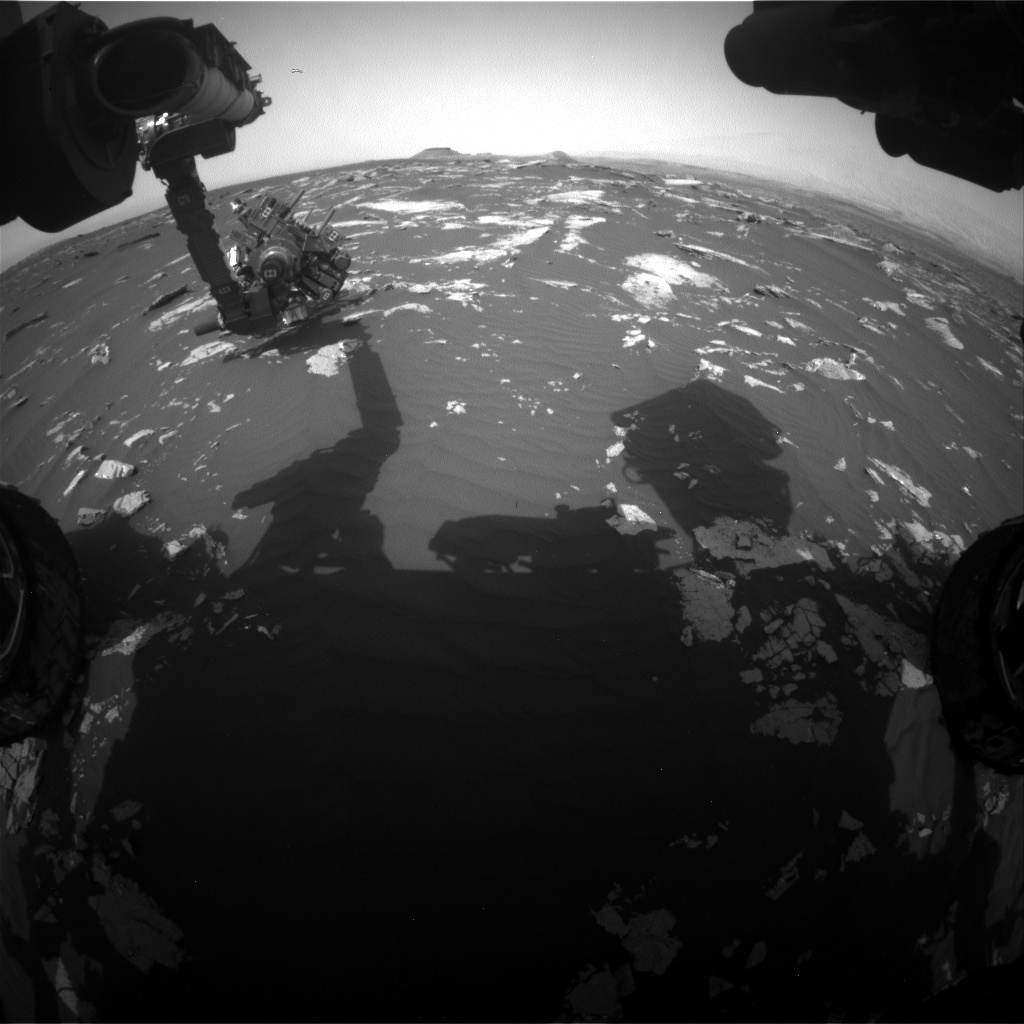
| This image was taken by Front Hazcam: Right B (FHAZ_RIGHT_B) onboard NASA's Mars rover Curiosity on Sol 1644 (2017-03-22 09:54:03 UTC). Image Credit: NASA/JPL-Caltech Full Resolution |
Subscribe to:
Posts (Atom)