Tuesday, January 10, 2017

CSjobs: two postdoctoral researchers, "C-SENSE: Exploiting low dimensional signal models for sensing, computation and processing" and "CS for Radar and Electronic Surveillance", Edinburgh, Scotland

Mike just sent me the following:

Hi Igor 
I am currently trying to recruit two postdoctoral researchers, one on the theory side (compressed sensing theory, sketching, concentration of measure) to work on my ERC grant "C-SENSE: Exploiting low dimensional signal models for sensing, computation and processing", and one on the applications side (CS for Radar and Electronic Surveillance) to work on our Defence signal processing project. Details of the vacancies can be found at:
https://www.vacancies.ed.ac.uk/pls/corehrrecruit/erq_jobspec_version_4.jobspec?p_id=038321
and
https://www.vacancies.ed.ac.uk/pls/corehrrecruit/erq_jobspec_version_4.jobspec?p_id=038322
I would be very grateful if you could advertise these on your blog and encourage people to apply.
Many thanks
Mike

--
Mike Davies
Professor of Signal and Image Processing
Institute for Digital Communications (IDCOM),
School of Engineering,
University of Edinburgh,
The King's buildings, Edinburgh, EH9 3JL
Director of the University Defence Research Collaboration (UDRC)
http://mod-udrc.org/ in Sensor Signal Processing
email: mike.davies@ed.ac.ukweb: http://www.research.ed.ac.uk/portal/mdavies4http://www.research.ed.ac.uk/portal/mdavies4

The University of Edinburgh is a charitable body, registered in
Scotland, with registration number SC005336.


Join the CompressiveSensing subreddit or the Google+ Community or the Facebook page and post there !

FINN: A Framework for Fast, Scalable Binarized Neural Network Inference / Scaling Binarized Neural Networks on Reconfigurable Logic

Michaela just provided me with some of the latest results on optimizing Binarized Neural networks on FPGAs. This is quite interesting and impressive.


Research has shown that convolutional neural networks contain significant redundancy, and high classification accuracy can be obtained even when weights and activations are reduced from floating point to binary values. In this paper, we present FINN, a framework for building fast and flexible FPGA accelerators using a flexible heterogeneous streaming architecture. By utilizing a novel set of optimizations that enable efficient mapping of binarized neural networks to hardware, we implement fully connected, convolutional and pooling layers, with per-layer compute resources being tailored to user-provided throughput requirements. On a ZC706 embedded FPGA platform drawing less than 25 W total system power, we demonstrate up to 12.3 million image classifications per second with 0.31 {\mu}s latency on the MNIST dataset with 95.8% accuracy, and 21906 image classifications per second with 283 {\mu}s latency on the CIFAR-10 and SVHN datasets with respectively 80.1% and 94.9% accuracy. To the best of our knowledge, ours are the fastest classification rates reported to date on these benchmarks.


Scaling Binarized Neural Networks on Reconfigurable Logic by Nicholas J. Fraser, Yaman Umuroglu, Giulio Gambardella, Michaela Blott, Philip Leong, Magnus Jahre and Kees Vissers

Binarized neural networks (BNNs) are gaining interest in the deep learning community due to their significantly lower computational and memory cost. They are particularly well suited to recon gurable logic devices, which contain an abundance of ne-grained compute resources and can result in smaller, lower power implementations, or conversely in higher classification rates. Towards this end, the Finn framework was recently proposed for building fast and exible eld programmable gate array (FPGA) accelerators for BNNs. Finn utilized a novel set of optimizations that enable e fficient mapping of BNNs to hardware and implemented fully connected, non-padded convolutional and pooling layers, with per-layer compute resources being tailored to user-provided throughput requirements. However, FINN was not evaluated on larger topologies due to the size of the chosen FPGA, and exhibited decreased accuracy due to lack of padding. In this paper, we improve upon Finn to show how padding can be employed on BNNs while still maintaining a 1-bit datapath and high accuracy. Based on this technique, we demonstrate numerous experiments to illustrate exibility and scalability of the approach. In particular, we show that a large BNN requiring 1.2 billion operations per frame running on an ADM-PCIE-8K5 platform can classify images at 12 kFPS with 671 mus latency while drawing less than 41W board power and classifying CIFAR-10 images at 88.7% accuracy. Our implementation of this network achieves 14.8 trillion operations per second. We believe this is the fastest classification rate reported to date on this benchmark at this level of accuracy. 


Join the CompressiveSensing subreddit or the Google+ Community or the Facebook page and post there !
Liked this entry ? subscribe to Nuit Blanche's feed, there's more where that came from. You can also subscribe to Nuit Blanche by Email, explore the Big Picture in Compressive Sensing or the Matrix Factorization Jungle and join the conversations on compressive sensing, advanced matrix factorization and calibration issues on Linkedin.

Monday, January 09, 2017

A Matrix Factorization Approach for Learning Semidefinite-Representable Regularizers

Thanks to N Krishnaswami for the heads-up !


A Matrix Factorization Approach for Learning Semidefinite-Representable Regularizers by Yong Sheng Soh, Venkat Chandrasekaran

Regularization techniques are widely employed in optimization-based approaches for solving ill-posed inverse problems in data analysis and scientific computing. These methods are based on augmenting the objective with a penalty function, which is specified based on prior domain-specific expertise to induce a desired structure in the solution. We consider the problem of learning suitable regularization functions from data in settings in which precise domain knowledge is not directly available. Previous work under the title of `dictionary learning' or `sparse coding' may be viewed as learning a regularization function that can be computed via linear programming. We describe generalizations of these methods to learn regularizers that can be computed and optimized via semidefinite programming. Our framework for learning such semidefinite regularizers is based on obtaining structured factorizations of data matrices, and our algorithmic approach for computing these factorizations combines recent techniques for rank minimization problems along with an operator analog of Sinkhorn scaling. Under suitable conditions on the input data, our algorithm provides a locally linearly convergent method for identifying the correct regularizer that promotes the type of structure contained in the data. Our analysis is based on the stability properties of Operator Sinkhorn scaling and their relation to geometric aspects of determinantal varieties (in particular tangent spaces with respect to these varieties). The regularizers obtained using our framework can be employed effectively in semidefinite programming relaxations for solving inverse problems.


Join the CompressiveSensing subreddit or the Google+ Community or the Facebook page and post there !
Liked this entry ? subscribe to Nuit Blanche's feed, there's more where that came from. You can also subscribe to Nuit Blanche by Email, explore the Big Picture in Compressive Sensing or the Matrix Factorization Jungle and join the conversations on compressive sensing, advanced matrix factorization and calibration issues on Linkedin.

Saturday, January 07, 2017

Thursday, January 05, 2017

CSJob: Postdoctoral Position Computational Optics and Optical Computing, LKB, ENS, Paris, France

Sylvain, who recently got an ERC consolidator grant (congrats), is now looking for a Postdoc


Postdoctoral PositionComputational Optics and Optical Computing 

The « optical imaging in biological and complex media » group at LKB (ENS Paris) is looking for a motivated and experienced candidate, to work in a challenging project, combining Signal Processing, and Computer Science with Optics for new and exciting applications. 

Context and project: 

The context : Scattering of light in complex environments has long been considered a nuisance and an inescapable limitation to imaging and sensing alike, ranging from astronomical observation, biomedical imaging, spectroscopy, etc. In the last decade, wavefront shaping techniques have revolutionized this view, by allowing light focusing and imaging even deep in the multiple scattering regime. This principle is embodied in the possibility –pioneered in the group- to access the transmission matrix of a complex medium1 . Generalized imaging and sensing: Rather than tediously focusing and imaging through a scattering material, we have recently shown that computational approaches can significantly improve and simplify the imaging process 2 or even bypass it for direct information extraction. Optical computing: Thanks to the highly multimode nature and the strong mixing properties of complex material, we have also investigated complex media as a platform for (analog) high performance optical computing 3 . 
The project: The project will aim at pushing these concepts further, and develop novel computational methods for microscopy deep in scattering media, with application in biomedical imaging, exploiting concepts such a (but not restricted to) phase-retrieval, compressive sensing, machine learning, etc. Correspondingly, the candidate will be involved in developing new optical computing applications exploiting randomized algorithms.

 The candidate: We are looking for a skilled researcher, with prior experience in signal processing, machine learning, computer Science, and/or computational optic. Prior training or experience in physics is not required, but the candidate will be embedded in an interdisciplinary physicist environment, and the ability to interact with scientist from different background is definitely a must. The candidate will have the opportunity to develop new algorithms and methods for optical imaging and/or computing in complex media. He/she will work in close collaboration with experimentalists of the team to implement his ideas on real-life systems. He/she will also have the opportunity to interact with our signal processing/ML collaborators, most notably the nearby team of Prof. F. Krzakala and startup company LightOn (www.lighton.io). 

conditions : The Project is supported by a ERC Consolidator Grant. The expected duration is for 2 years (+1 year possible extension). Start date from Apr.1st 2017. Contact (PI): Prof. Sylvain Gigan - sylvain.gigan@lkb.ens.fr Group website : http://www.lkb.upmc.fr/opticalimaging/ 

1 S. Popoff, et al. Measuring the Transmission Matrix in Optics: An Approach to the Study and Control of Light Propagation in Disordered Media Phys. Rev. Lett. 104, 100601 (2010) link 
2 A. Liutkus, et al., Imaging With Nature: Compressive Imaging Using a Multiply Scattering Medium, Scientific Reports 4, 5552 (2014) link 
3 A.Saade, F. Caltagirone, I. Carron, L. Daudet, A. Drémeau, S. Gigan, F. Krzakala, Random projections through multiple optical scattering:approximating kernels at the speed of light, IEEE ICASSP (2016) link


Join the CompressiveSensing subreddit or the Google+ Community or the Facebook page and post there !
Liked this entry ? subscribe to Nuit Blanche's feed, there's more where that came from. You can also subscribe to Nuit Blanche by Email, explore the Big Picture in Compressive Sensing or the Matrix Factorization Jungle and join the conversations on compressive sensing, advanced matrix factorization and calibration issues on Linkedin.
Wednesday, January 04, 2017

PhaseMax: Convex Phase Retrieval via Basis Pursuit - implementation -


Christoph just sent me the following:

 Hey Igor,

Happy New Year!

Tom Goldstein and I created a website for our recent convex phase retrieval method called PhaseMax that avoids lifting (unlike PhaseLift or PhaseCut): 

The website contains links to our arXiv paper and to four other papers that are related to PhaseMax. There is also example code that implements PhaseMax using our solver FASTA.

It would be great if you could feature this on your blog.

Thanks a lot!
Christoph
Christoph Studer
Assistant Professor
School of ECE, Rhodes Hall 331
Cornell University
Ithaca, NY 14853, USA
Thanks Christoph ! Here is the paper: PhaseMax: Convex Phase Retrieval via Basis Pursuit by Tom Goldstein, Christoph Studer

We consider the recovery of a (real- or complex-valued) signal from magnitude-only measurements, known as phase retrieval. We formulate phase retrieval as a convex optimization problem, which we call PhaseMax. Unlike other convex methods that use semidefinite relaxation and lift the phase retrieval problem to a higher dimension, PhaseMax operates in the original signal dimension. We show that the dual problem to PhaseMax is Basis Pursuit, which implies that phase retrieval can be performed using algorithms initially designed for sparse signal recovery. We develop sharp lower bounds on the success probability of PhaseMax for a broad range of random measurement ensembles, and we analyze the impact of measurement noise on the solution accuracy. We use numerical results to demonstrate the accuracy of our recovery guarantees, and we showcase the efficacy and limits of PhaseMax in practice.


Join the CompressiveSensing subreddit or the Google+ Community or the Facebook page and post there !
Liked this entry ? subscribe to Nuit Blanche's feed, there's more where that came from. You can also subscribe to Nuit Blanche by Email, explore the Big Picture in Compressive Sensing or the Matrix Factorization Jungle and join the conversations on compressive sensing, advanced matrix factorization and calibration issues on Linkedin.

Tuesday, January 03, 2017

Videos and Slides: 6th MMDS Workshop on Algorithms for Modern Massive Data Sets


 The 6th MMDS Workshop on Algorithms for Modern Massive Data Sets was held June 21–24, 2016, in Berkeley, CA. It is an event that occurs every two years. Unlike the ML conferences,the KDD conferences or the Simons workshop, this meeting finds its voice in gathering folks around the issue of dealing with very large data. Video recordings of all the talks may be found on their YouTube channel. Download the full MMDS 2016 program here. The links to the videos and slides of most talks are listed below, Previous MMDS meetings with slides and videos can be found with the MMDS tag. enjoy !


 Tue, June 21

Data Analysis and Statistical Data Analysis *
08:00 09:45 Breakfast and registration *
09:45 10:00 Welcome and opening remarks Organizers
10:00 11:00 Meaningful Visual Exploration of Massive Data Peter Wang
11:00 11:30 Scalable Collective Inference from Richly Structured Data
show video
Lise Getoor
11:30 12:00 A Framework for Processing Large Graphs in Shared Memory
show video
Julian Shun
12:00 02:00 Lunch *
02:00 02:30 Minimax optimal subsampling for large sample linear regression
show video
Aarti Singh
02:30 03:00 Randomized Low-Rank Approximation and PCA: Beyond Sketching
show video
Cameron Musco
03:00 03:30 Restricted Strong Convexity Implies Weak Submodularity
show video
Alex Dimakis
03:30 04:00 Coffee break *
04:00 04:30 The Stability Principle for Information Extraction from Data
show video
Bin Yu
04:30 05:00 New Results in Non-Convex Optimization for Large Scale Machine Learning
show video
Constantine Caramanis
05:00 05:30 The Union of Intersections Method
show video
Kristofer Bouchard
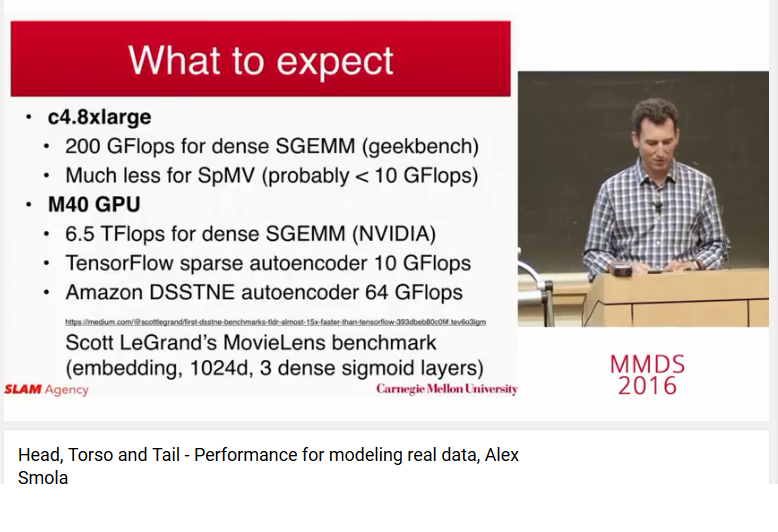
05:30 06:00 Head, Torso and Tail - Performance for modeling real data
show video
Alex Smola
06:00 08:00 Dinner Reception
Wed, June 22 Industrial and Scientific Applications *
09:00 10:00 New Methods for Designing and Analyzing Large Scale Randomized Experiment
show video
Jasjeet Sekhon
10:00 10:30 Cooperative Computing for Autonomous Data Centers Storing Social Network Data
show video
Jonathan Berry
10:30 11:00 Coffee break
11:00 11:30 Is manifold learning for toy data only?
show video
Marina Meila
11:30 12:00 Exploring Galaxy Evolution through Manifold Learning Jake VanderPlas
12:00 02:00 Lunch
02:00 02:30 Fast, flexible, and interpretable regression modeling
show video
Daniela Witten
02:30 03:00 Randomized Composable Core-sets for Distributed Computation Vahab Mirrokni
03:00 03:30 Local graph clustering algorithms: an optimization perspective
show video
Kimon Fountoulakis
03:30 04:00 Coffee break
04:00 04:30 Using Principal Component Analysis to Estimate a High Dimensional Factor Model with High-Frequency Data
show video
Dacheng Xiu
04:30 05:00 Identifying Broad and Narrow Financial Risk Factors with Convex Optimization: Part 1
show video
Lisa Goldberg
05:00 05:30 Identifying Broad and Narrow Financial Risk Factors with Convex Optimization: Part 2 Alex Shkolnik
05:30 06:00 Learning about business cycle conditions from four terabytes of data
show video
Serena Ng
Thu, June 23 Novel Algorithmic Methods *
09:00 10:00 Top 10 Data Analytics Problems in Science
show video
Prabhat
10:00 10:30 Low-rank matrix factorizations at scale: Spark for scientific data analytics Alex Gittens
10:30 11:00 Coffee break
11:00 11:30 Structure & Dynamics from Random Observations
show video
Abbas Ourmazd
11:30 12:00 Stochastic Integration via Error-Correcting Codes Dimitris Achlioptas
12:30 02:00 Lunch *
02:00 02:30 Why Deep Learning Works: Perspectives from Theoretical Chemistry Charles Martin
02:30 03:00 A theory of multineuronal dimensionality, dynamics and measurement
show video
Surya Ganguli
03:00 03:30 Sub-sampled Newton Methods: Uniform and Non-Uniform Sampling
show video
Fred Roosta
03:30 04:00 Coffee break *
04:00 04:30 In-core computation of geometric centralities with HyperBall: A hundred billion nodes and beyond
show video
Sebastiano Vigna
04:30 05:00 Higher-order clustering of networks David Gleich
05:00 05:30 Mining Tools for Large-Scale Networks
show video
Charalampos Tsourakakis
05:30 06:00 Building Scalable Predictive Modeling Platform for Healthcare Applications
show video
Jimeng Sun
06:00 08:00 Dinner reception and poster session
Fri, June 24 Novel Matrix and Graph Methods *
09:00 10:00 Scalable interaction with data: where artificial intelligence meets visualization Christopher White
10:00 10:30 Ameliorating the Annotation Bottleneck Christopher Re
10:30 11:00 Coffee break
11:00 11:30 Homophily and transitivity in dynamic network formation Bryan Graham
11:30 12:00 Systemwide Commonalities in Market Liquidity Mark Flood
12:30 02:00 Lunch *
02:00 02:30 Train faster, generalize better: Stability of stochastic gradient descent Moritz Hardt
02:30 03:00 Extracting governing equations from highly corrupted data Rachel Ward
03:00 03:30 Nonparametric Network Smoothing Cosma Shalizi
03:30 04:00 Coffee break *
04:00 04:30 PCA from noisy linearly reduced measurements
show video
Amit Singer and Joakim Anden
04:30 05:00 PCA with Model Misspecification
show video
Robert Anderson
05:00 05:30 Fast Graphlet Decomposition
show video
Ted Willke and Nesreen Ahmed


Join the CompressiveSensing subreddit or the Google+ Community or the Facebook page and post there !
Liked this entry ? subscribe to Nuit Blanche's feed, there's more where that came from. You can also subscribe to Nuit Blanche by Email, explore the Big Picture in Compressive Sensing or the Matrix Factorization Jungle and join the conversations on compressive sensing, advanced matrix factorization and calibration issues on Linkedin.

Monday, January 02, 2017

In Texas, we just call them Neural Networks.

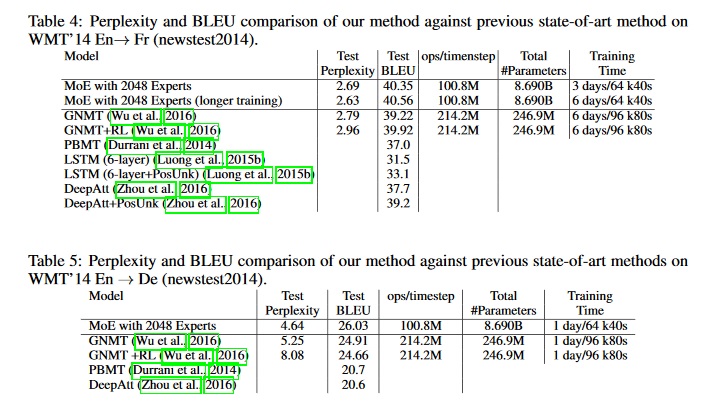
What happens when you have to learn a lot of things ? Two ICLR papers seem to point to the need for equally big models with an implication on regularization or in sparsely using them.


Outrageously Lare Neural Networks: The Sparsely-Gated Mixture-of-Experts Layer by Noam Shazeer, Azalia Mirhoseini, Krzysztof Maziarz, Andy Davis, Quoc Le, Geoffrey Hinton and Jeff Dean

The capacity of a neural network to absorb information is limited by its number of parameters.  In this work, we present a new kind of layer, the Sparsely-Gated Mixture-of-Experts (MoE), which can be used to effectively increase model capacity with only a modest increase in computation.  This layer consists of up to thousands of feed-forward sub-networks (experts) containing a total of up to billions of parameters.  A trainable gating network determines a sparse combination of these experts to use for each example.  We apply the MoE to the task of language modeling, where model capacity is critical for absorbing the vast quantities of world knowledge available in the training corpora.  We present new language model architectures where an MoE layer is inserted between stacked LSTMs, resulting in models with orders of magnitude more parameters than would otherwise be feasible. On language modeling and machine translation benchmarks, we achieve comparable or better results than state-of-the-art at lower computational cost, including test perplexity of 28.0 on the 1 Billion Word Language Modeling Benchmark and BLEU scores of 40.56 and 26.03 on the WMT’14 En to Fr and En to De datasets respectively.
 
 In the second paper, we can note the following:
 
"Deep neural networks easily fit random labels...The effective capacity of neural networks is large enough for a brute-force memorization of the entire data set...."
 
 
Understanding Deep Learning Requires Re-Thinking Generalization by Chiyuan Zhang, Samy Bengio, Moritz Hardt, Benjamin Recht, Oriol Vinyals

Despite their massive size, successful deep artificial neural networks can exhibit a remarkably small difference between training and test performance. Conventional wisdom attributes small generalization error either to properties of the model family, or to the regularization techniques used during training. Through extensive systematic experiments, we show how these traditional approaches fail to explain why large neural networks generalize well in practice. Specifically, our experiments establish that state-of-the-art convolutional networks for image classification trained with stochastic gradient methods easily fit a random labeling of the training data. This phenomenon is qualitatively unaffected by explicit regularization, and occurs even if we replace the true images by completely unstructured random noise. We corroborate these experimental findings with a theoretical construction showing that simple depth two neural networks already have perfect finite sample expressivity as soon as the number of parameters exceeds the number of data points as it usually does in practice. We interpret our experimental findings by comparison with traditional models.


Join the CompressiveSensing subreddit or the Google+ Community or the Facebook page and post there !
Liked this entry ? subscribe to Nuit Blanche's feed, there's more where that came from. You can also subscribe to Nuit Blanche by Email, explore the Big Picture in Compressive Sensing or the Matrix Factorization Jungle and join the conversations on compressive sensing, advanced matrix factorization and calibration issues on Linkedin.
Randomized Clustered Nystrom for Large-Scale Kernel Machines

I note the following from the conclusions:
 
Based on our experiments, random projection of the input data points onto a low-dimensional space withp0= 10 or smaller dimensions yields very accurate low-rank approximations. In fact, the accuracy of our proposed method is very close to the best rank-r approximation obtained by the exact eigenvalue decomposition or SVD of kernel matrices

Randomized Clustered Nystrom for Large-Scale Kernel Machines by Farhad Pourkamali-Anaraki, Stephen Becker

The Nystrom method has been popular for generating the low-rank approximation of kernel matrices that arise in many machine learning problems. The approximation quality of the Nystrom method depends crucially on the number of selected landmark points and the selection procedure. In this paper, we present a novel algorithm to compute the optimal Nystrom low-approximation when the number of landmark points exceed the target rank. Moreover, we introduce a randomized algorithm for generating landmark points that is scalable to large-scale data sets. The proposed method performs K-means clustering on low-dimensional random projections of a data set and, thus, leads to significant savings for high-dimensional data sets. Our theoretical results characterize the tradeoffs between the accuracy and efficiency of our proposed method. Extensive experiments demonstrate the competitive performance as well as the efficiency of our proposed method.


Join the CompressiveSensing subreddit or the Google+ Community or the Facebook page and post there !
Liked this entry ? subscribe to Nuit Blanche's feed, there's more where that came from. You can also subscribe to Nuit Blanche by Email, explore the Big Picture in Compressive Sensing or the Matrix Factorization Jungle and join the conversations on compressive sensing, advanced matrix factorization and calibration issues on Linkedin.

Sunday, January 01, 2017

Nuit Blanche in Review (December 2016).

Happy New Year 2017 ! Since the Nuit Blanche in Review (November 2016), NIPS2016 happened and a few other important things ! As a reminder, we are still in this period of intense intellectual wandering, What Are You Waiting For ?

This past month, we also had a few implementations:


Some in-depth blog entries:


Two theses


A few entries covering NIPS2016


Paris Machine Learning meetup


Slides:


Jobs:


Saturday Morning Videos:


Conferences:


Join the CompressiveSensing subreddit or the Google+ Community or the Facebook page and post there !
Liked this entry ? subscribe to Nuit Blanche's feed, there's more where that came from. You can also subscribe to Nuit Blanche by Email, explore the Big Picture in Compressive Sensing or the Matrix Factorization Jungle and join the conversations on compressive sensing, advanced matrix factorization and calibration issues on Linkedin.

Printfriendly