Friday, July 29, 2005

Meet Planets Lila and 2003 EL61


Planet Lila was found today and it is bigger than Pluto. But what is more amazing is that there was second announcement yesterday about another planet called 2003 EL61 and they are not the same. What are the odds of finding two planets in the solar system in less than a day ?

Thursday, July 28, 2005

A very expensive paint job

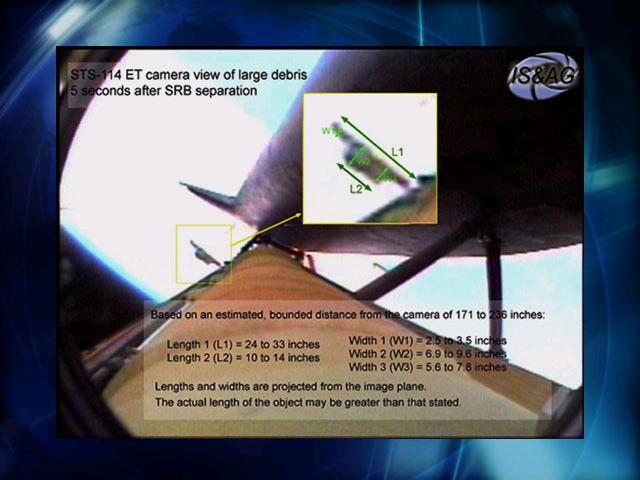
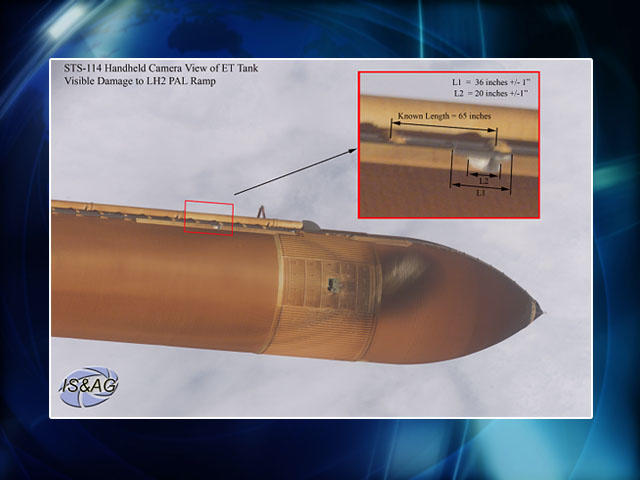
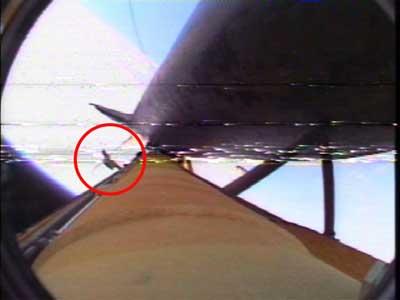
It looks like the paint fragment that


fell off the main booster tank


has not affected the belly of Discovery

Monday, July 25, 2005

Using a larger pool of talent to refine your models


When debris flew off Discovery, NASA was surprised about the type of debris that fell off during launch even through they had spent some time to reduce this type of occurence. This is a true statement about how many uncertainties they have to deal with. Another poorly understood process is that of debris falling when they reenter the atmosphere. What is pretty astounding is that the data generally used to detect tornadoes could be used on February 2, 2003 to see real-time the plume made the disintegration of the orbiter.


While I am pretty sure that these data are being used to refine debris reentry modeling, it is quite exceptional that one can have access to this type of data. With the Python module pyRadar, I am pretty sure an active tornado warning system could be designed somewhat easily using a larger pool of talent.

Friday, July 15, 2005

GIS on steroids


In my first entry in this blog, I made the plea for better and cheaper maps. That was a year and a half ago. Now Google, has come up with two different services that enable pretty much everybody to superimpose additional layer of data on maps and satellite imagery.
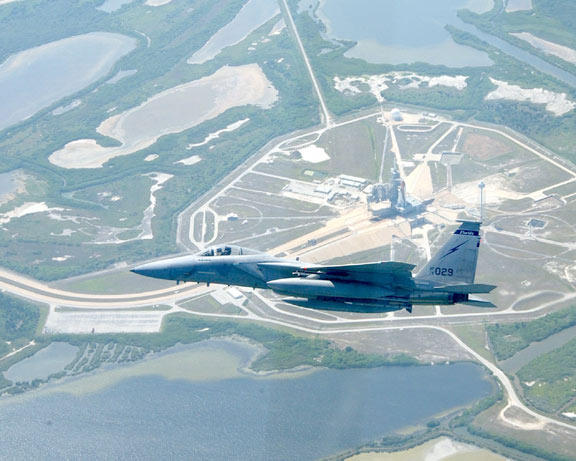
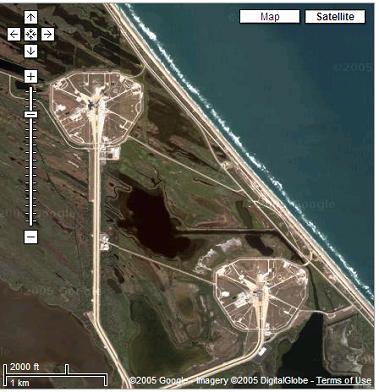
The services are Google Maps and Google Earth. The first service has an API that allows people to use it and add features to the initial service provided by Google. Google Maps Mania lists all these new ideas and the amount of them keep on growing everyday. The space shuttle Discovery lifted off yesterday and one can already see bow different aspect of these services can be used, first one can see where the launchpad was. The same capability can be used to figure out the location of the International Space Station and the Shuttle. Other examples putting meaning and geography together can be found here and there. Fascinating. One can always think of other type of data to be added or how it can be used to tell a story such as that of the Grand Challenge 2004 as John Wiseman did.

And you thought your day was bad


In September of last year, I was mentionning the issue of a perfect storm compounding high interest rates, oil platforms, hurricanes and high oil prices. Well, it is not getting any better:

- First, the Saudis warn of shortfalls as oil hits $61

- The, we learn that Dennis just tilted a one billion dollar oil platform

Python is your friend


Looks like some of the reasons we chose Python for the Grand Challenge race are very similar to the ones Google is using to build its own business.

WITS, a collection of links to choose wavelets and other related functions.

Ths WITS lists a pretty complete collection of links to functions such as wavelets, ridgelets, curvelets, contourlets, bandelets and other beamlets. With the increase in the number of families of functions needed to study higher dimensional spaces (above 1), it is a very good idea. Some of these codes are available in matlab.

Tuesday, June 28, 2005

Saving Private Rudi

Captain Miller: He better be worth it. He better go home and cure a disease, or invent a longer-lasting light bulb.


Rudi Cilibrasi works on the Normalized Compression Distance concept through the use of Google and other tools like Winzip. This is very clever because it uses tools that are already available to everybody while at the same time he uses them to do something that was thought to be impossible. In effect, the data mining and clustering of data in multidimensional space is an issue at the crossroads of many problems of importance nowadays from bioinformatics to robotics, including drug discovery.

The nice thing about Rudi is that he is making available some of his tools and findings free to whoever wants to use them: his code is on sourceforge (GPL). This is a little bit like what Dave Donoho does at Stanford with his Wavelab software thereby providing proof of scholarship as opposed to the usual article publication which is just a means of advertizing that scholarship.

Why am I saying these things ? because there is a twist: Rudi is dying. He has Hepitatis C. His parents have already passed away from the disease.

This is ironic since there is a non trivial chance that one day, a researcher at one of the big pharmaceutical company will use his software, or a derivative of it, in order to discover a drug capable of taking down Hepitatis C. It is also very likely that the product of this discovery will belong to the drug company's Intellectual Property (IP) and that Rudi may be restricted to have access to this drug because he is on the wrong continent or country as has been the case in his story.

In our war on diseases, it would be a damm shame to lose Rudi since he may even be part of the solution directly or indirectly.

Please, sign the petition, let's Save Private Rudi.

Friday, June 17, 2005

Bob, I would not call it "co-existing"

Via BoingBoing, I found this tidbit about how Australia's megafauna coexisted with humans:

New research conducted by Australian and British scientists reveals that in fact humans and megafauna, such as gigantic three tonne wombat-like creatures, a ferocious marsupial "lion" and the world's all-time biggest lizard, may have co-existed for around 15 000 years.


Don't get me wrong, I am not objecting to the fact that they were not living at the same time, rather the word "co" in latin translates into "with". I'd rather qualify the situation as humans surviving against some pretty tough odds.

Wednesday, June 08, 2005

Catch my gamma rays if you can.

NIAC just released their new grants. One of them is focused on how to harvest antimatter. Why antimatter ? well because everybody knows that if you use some antimatter with its matter equivalent, they annihilate with each other releasing a large amount of energy. Why do we care ? well, the story goes that with a lot of energy, you can go anywhere in space. In essence, once you get antimatter, you're ready for some Star Treck action.

The main problem is that the last statement is just plain wrong. In order to go anywhere in space, you need to eject mass from your spaceship. You know, inertia, if something goes one way, the rest goes the other way. Hence, in order to have a rapid spaceship, you have to efficiently eject mass as rapidily as possible in the opposite direction. The only way we know how to rapidily eject matter is to heat it up. The warmer the heat, the higher the ejection speed of the fuel and therefore, the higher the speed of your rocket. This is why chemical rockets are less efficient than nuclear rockets.

In the case of the "antimatter" devices proposed, the large amount of energy released is just massless photons, high energy photons, but massless photons nonetheless. How do you suppose large masses of matter can be heated up and ejected when the fuel is made up of massless photons ? Well if they remain photons, it won't help therefore you need a conversion process enabling matter to pick up the energy of the massless photons instead. And here lies the problem, the cross section of gases to high energy photons is very very small. In effect, physically, it is so poor that it does not compete seriously with any existing and tested nuclear rocket concepts.

Printfriendly