Wednesday, July 26, 2006

GeoCam: An Off-The-Shelf Imager for High Altitude Balloons

The blog for the GeoCam Imager is up and can be found here. Here is the most recent photo of it in its casing.


The whole reason as to why we think this off-the-shelf camera is a good idea is explained here.

Fabricating elements around current high end consumer digital cameras (like the clicker) is the most effective way of utilizing advances in digital camera development. We intend on showing how we did all this on sites like Hackaday. Thank you to the HASP program at LSU for giving us a seat in the High Altitude Student Platform (HASP).

Tuesday, July 04, 2006

Designing a Collaborative Task Manager


I mentionned before the fact that multitaskers could not be more efficient than single minded people because there was a cognitive cost associated with having to upload their memory of the previous tasks. In a remarkable study, Gloria Mark goes farther and notes:

What we found is that the average amount of time that people spent on any single event before being interrupted or before switching was about three minutes. Actually, three minutes and five seconds, on average. That does not include formal meetings, because we figured if they were in a formal meeting, they were prisoners at the meeting, right? They couldn't leave or switch activities. So we didn't count that. Then we looked at [use of] devices, working on a PC, the desk phone, using any kind of paper document, using a cell phone. We found the average amount of time that people spent working on a device before switching was 2 minutes and 11 seconds.


But we called it a "working sphere" because "project" has a limited connotation, and a working sphere is a broader idea. Anything where there's a common goal, there's a certain group of people involved with it, there are certain resources attached to it, it has its own time framework and its own deadline, is a working sphere


So even when we took out what we call "non-significant" interruptions, we find that people still worked 12 minutes and 18 seconds in a working sphere before switching.


But there are also internal interruptions; for whatever reason, people interrupt themselves of their own volition and switch to something else. And what fascinates me is that people interrupted themselves almost as much as they were interrupted by external sources. They interrupted themselves about 44% of the time. The rest of the interruptions were from external sources.


GMJ: How long does it take to get back to work after an interruption?

Mark: There's good news and bad news. To have a uniform comparison, we looked at all work that was interrupted and resumed on the same day. The good news is that most interrupted work was resumed on the same day -- 81.9 percent -- and it was resumed, on average, in 23 minutes and 15 seconds, which I guess is not so long.

But the bad news is, when you're interrupted, you don't immediately go back to the task you were doing before you were interrupted. There are about two intervening tasks before you go back to your original task, so it takes more effort to reorient back to the original task. Also, interruptions change the physical environment. For example, someone has asked you for information and you have opened new windows on your desktop, or people have given you papers that are now arranged on your desk. So often the physical layout of your environment has changed, and it's harder to reconstruct where you were. So there's a cognitive cost to an interruption.


The designers of a task manager for a small business could learn a lot from these results. For instance, in my case, the application we developed at my workplace was aimed at handling the communication load of about 60 people with many different schedules, projects and from different functional groups. After some time, we noticed certain behaviors. First, we found out that if the application was not used by everybody uniformly, sooner rather than later, an assymetry of the information stream helped people who were least likely to contribute/use the system. In effect, cooperation between users was less effective over time. The second finding was a little more subtle. The application was written in PHP but did not use AJAX. Every time the page would load with new information, it took the new page about 10 seconds to refresh. In light of the study by Mark, it seems that this is enough of a burden that this cost of "waiting" for the refresh would have people drift into other applications and other "working spheres". For participants, the time spent in updating knowledge in the application felt like "feeding the beast" as opposed to being part of a normal cognitive process.

Wednesday, June 21, 2006

Tex-MEMS VIII (or Tex-MEMS 2006) will take place in Dallas

It looks like a fire that occured in San Antonio is precluding the organizers to have tex-mems VIII in San Antonio this year. The folks at UT Dallas have decided to organize it instead. The web site will be up shortly.

Wednesday, March 29, 2006

Going high


Our proposal for the Geocam has been selected to fly on-board a high altitude balloon campaign organized by the Louisiana Space Consortium. It will be launched from Fort Sumner, NM. Movies taken from high altitude balloons can be found at the University of Montana within the BOREALIS High Altitude Balloon program.

We expect to use an JVC Everio Hard Disk Camcorder in order to fit our tiny requirements.

Friday, March 17, 2006

Seeing through takes time


When Mikhail Vorontsov talks (Anisoplanatic imaging through turbulent media: image recovery by local information fusion from a set of short-exposure images, [J. Opt. Soc. Am. A/ Vol. 18, No. 6/June 2001]) about superresolution, he is basically saying that the turbulence located between the camera and the object of interest will help in focusing. The idea is that turbulence will bend rays of lights and allow for micro-lensing to occur. It is interesting that in effect, this idea cannot be applied to Space for short distances. In Space however, while there is no turbulence, one can rely on gravity to bend light and allow for this micro-lensing to occur. This is how the latest Earth like object was found. The technique itself has to figure out which frames and what part of the frame is the one of highest quality. This is no small feat. In effect, one has to determine a criterion that evaluates the quality of focus for every part of the frame and has to perform the fusion of these "lucky" parts of the frame.

Saturday, February 18, 2006

Multi-use of Google Maps


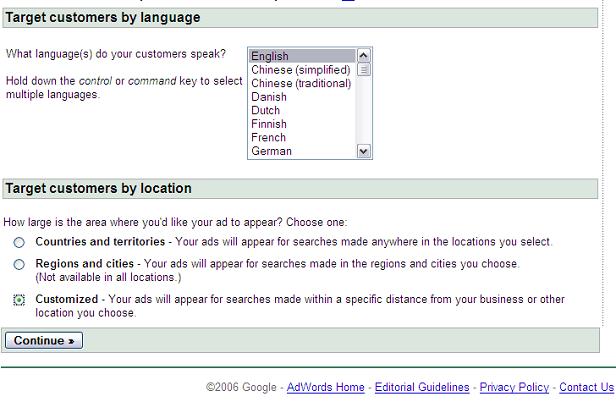
Google Maps Mania just featured Peter Pesti at Georgia Tech with his Google Maps Nighttime!. At the same time, Google also uses Google Maps to geographically target customers through their


Adwords program (here some of the screen grab of the application within Adwords).


On another note, if one were to have a very high resolution camera, one could shoot a high definition picture and use the same Google Maps interface to go into the details of that picture (like in the following game using Google Maps). More information on how to introduce a custom map into Google maps can be found in GoogleMapki. This possibility offers other avenues,. For instance, if one were to have an HDTV camera, one could patch different pictures from a scene (every picture is taken at 1/30 th second) and have the Google interface allow navigation through it. One cannot but think that a similar system would work well for Nat's world (a program designed to help Autistic kids know their environment by navigating through it.)

Thursday, February 02, 2006

Safety is our job Number...errr... make that Number 6


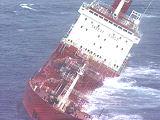
Some time ago, two tankers collided off the French coast on the English Channel. Here is what happens when corporate speak does not mean what it should mean. This tanker sank with all its phosphoric acid payload. (here is another example)

Tuesday, January 31, 2006

Optical Illusion

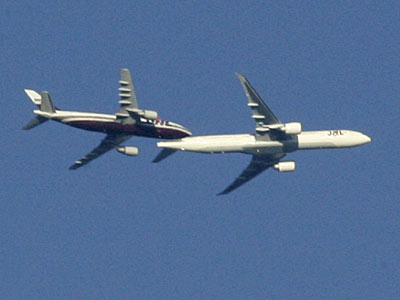
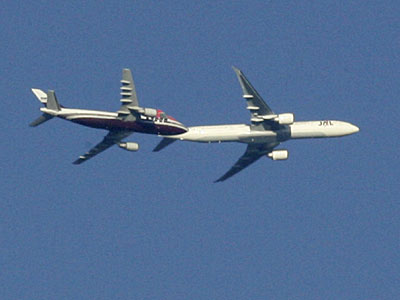
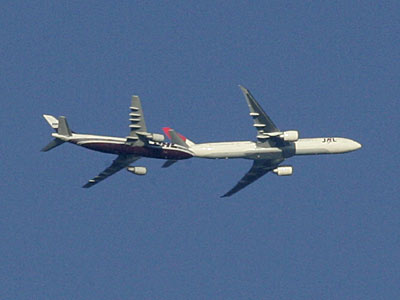
Here is a very interesting optical illusion borne out of the lack of other types of cues than the one provided by the planes themselves yielding a lack of depth perception. Depth perception is not just coming from stereo (two eyes) imaging, it is a combination of texture, colors that allows the brain to evaluate depth. In this case, all these information are lacking yielding this impression that the planes are about to collide.


Saturday, January 28, 2006

Prompt Critical Junk


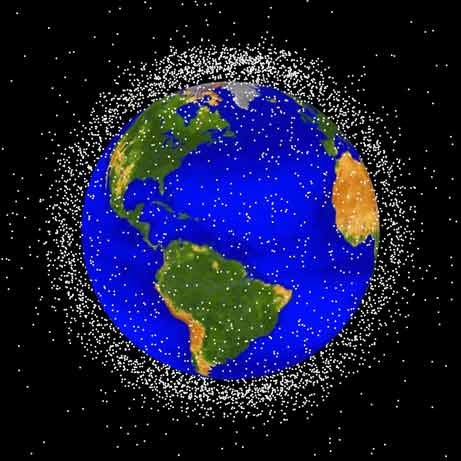
It looks like, if computations were done correctly, space junk in Low Earth Orbit will increase after 2055 even if we do not add to the stack. So far we seem to continue on adding to the stack with this spacesuit.

Printfriendly